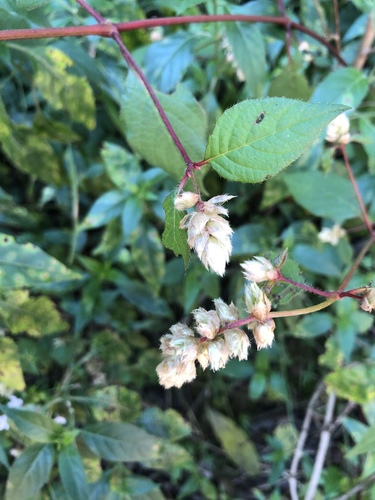
Salsola komarovii
Iljin.
Komarov Russian thistle
iNaturalist· cc-by-nc
(c) Svetlana Nesterova, some rights reserved (CC BY-NC), uploaded by Svetlana Nesterova
iNaturalist· cc-by-nc
(c) Chuangzao, some rights reserved (CC BY-NC)
Summary
Source: WikipediaSalsola komarovii is an annual plant native to China, Korea, Japan and eastern Russia. It grows to a height of 20 to 50 centimeters (8 to 20 in). It is cultivated as a vegetable; the leaves and young shoots are eaten. In Japanese it is known as okahijiki which translates as "land seaweed".
Description
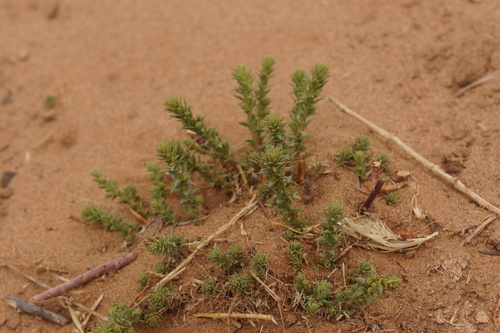
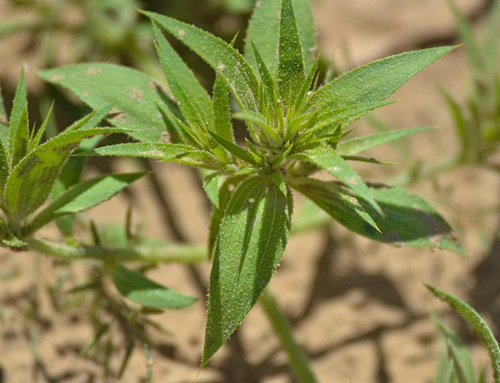
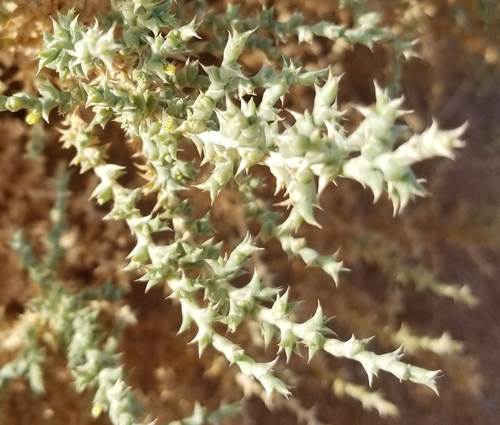
An annual herb. It grows 20-50 cm tall. The stems are erect and branched from the base. The branches are spreading and yellow-green. The leaves are alternate and spreading. They are 2-5 cm long by 2-3 mm wide.
Edible Uses
Young leaves and stems can be cooked and eaten. They have a crunchy, tender texture.
Traditional Uses
The young leaves are used as a potherb. They are put in soups. They are used as a seasoned dressing.
This uses section is brief — help expand it
Medicinal Uses
None known
Distribution
It is a temperate plant. It grows on beaches and sandy soils along rivers. It grows in salt marshes.
Where It Grows
Asia, China, Japan, Korea, Russia, Siberia,
Cultivation
We have very little information on this species and do not know if it will be hardy in Britain, though judging by its native range it should succeed outdoors in many parts of this country. The following notes are based on the general needs of the genus. Requires a very sunny position in a light or medium well-drained soil, it tolerates salty soils, occasional inundation by salt water and maritime exposure. Succeeds in poor soils and grows more vigorously on alkaline soils.
Propagation
Sow seed in spring directly in situ. Seed has short viability and should be stored in cool conditions over winter.
Other Uses
None known Special Uses
Other Information
It is a commercially cultivated vegetable.
Notes
Also put in the family Chenopodiaceae.
Nutrition
| Part | Moisture | kJ | kcal | Protein | Vit A | Vit C | Iron | Zinc |
|---|---|---|---|---|---|---|---|---|
| Stems, Leaves | 92.9 | 71 | 17 | 1.2 | — | 15 | 0.9 | 0.6 |
Synonyms
Also Known As
Oka-hijiki
References (8)
- Chen, B. & Qiu, Z., Consumer's Attitudes towards Edible Wild Plants, Ishikawa Prefecture, Japan. p 24 www.hindawi.com/journals/ijfr/aip/872413.pdf
- Facciola, S., 1998, Cornucopia 2: a Source Book of Edible Plants. Kampong Publications, p 222
- Hwang, H., et al, 2013, A Study on the Flora of 15 Islands in the Western Sea of Jeollanamdo Province, Korea. Journal of Asia-Pacific Biodiversity Vol. 6, No. 2 281-310
- Kays, S. J., and Dias, J. C. S., 1995, Common Names of Commercially Cultivated Vegetables of the World in 15 languages. Economic Botany, Vol. 49, No. 2, pp. 115-152
- Plants for a Future database, The Field, Penpol, Lostwithiel, Cornwall, PL22 0NG, UK. http://www.scs.leeds.ac.uk/pfaf/
Show all 8 references Hide references
- Tanaka,
- www.eFloras.org Flora of China
- Zeven, A. C. & de West, J. M. J., 1982, Dictionary of cultivated plants and their regions of diversity. Wageningen. p 34