Salix wallichiana
Andersson
wikimedia· cc0
Wikimedia Commons
wikimedia· cc-by-sa
Wikimedia Commons - Dinesh Valke from Thane, India
Summary
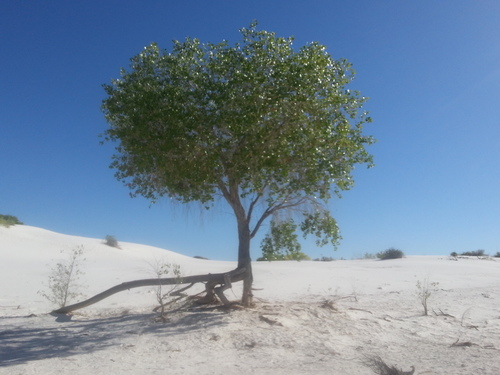
Source: WikipediaA deciduous tree reaching 5 m tall, growing at a fast rate. Produces flowers April to May with seeds ripening in June. Dioecious, requiring both male and female plants for seed production and pollinated by bees. Not self-fertile. Tolerates light sandy, medium loamy, and heavy clay soils, including poor drainage. Prefers mildly acid to neutral pH. Requires full sun and moist or wet soil conditions. Not frost tender.
Description
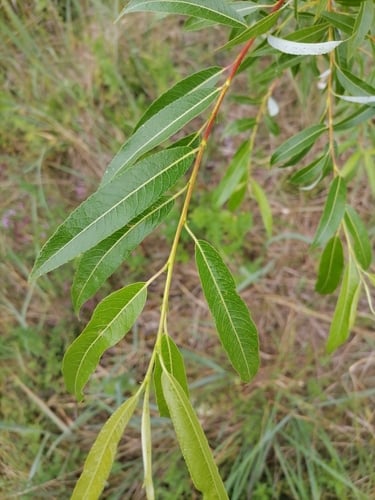
A shrub or small tree. The branches have a silky coating. The leaves are 5-11 cm long by 2-3 cm wide. They are broadly sword shaped.
This description is brief — help expand it
Edible Uses
The inner bark can be eaten raw or cooked, or dried, ground into a powder, and blended with cereal flour for bread-making. It has a very bitter flavour and is a famine food used only as a last resort. Young shoots can be cooked but are not very palatable.
Traditional Uses
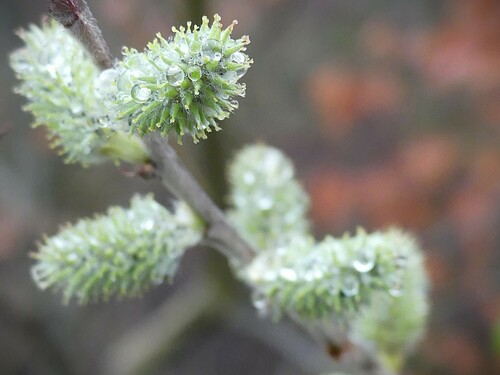
The catkins are chewed for their sweet taste.
This uses section is brief — help expand it
Medicinal Uses
The fresh bark of all willows contains salicin, which likely breaks down into salicylic acid (closely related to aspirin) in the body. This gives it properties as an anodyne and febrifuge.
Distribution
It is a subtropical plant. In Northeastern India it grows at 2,400 m above sea level.
Where It Grows
Afghanistan, Asia, Bhutan, China, Himalayas, India, Myanmar, Nepal, Pakistan, SE Asia, Tibet,
Cultivation
We have very little information on this species and do not know how hardy it will be in Britain, though judging by its native range it should succeed outdoors in most parts of the country. It is a fast-growing plant. This species hybridizes easily with Salix sinica. Together, they produce many hybrids, with intermediate states, overlapping in their distributions. The following notes are based on the general needs of the genus. Succeeds in most soils, including wet, ill-drained or intermittently flooded soils, but prefers a damp, heavy soil in a sunny position. Rarely thrives on chalk. Hybridizes freely with other members of this genus. Although the flowers are produced in catkins early in the year, they are pollinated by bees and other insects rather than by the wind. Plants in this genus are notably susceptible to honey fungus. Dioecious. Male and female plants must be grown if seed is required.
Propagation
Seed must be surface sown as soon as it ripens in late spring, as viability is very short — perhaps only a few days. Cuttings of mature wood from the current year's growth can be taken November to February and rooted in a sheltered outdoor bed or planted directly into their permanent position with a good weed-suppressing mulch; this is very easy. Plant out in autumn. Half-ripe cuttings taken June to August and rooted in a frame are also very easy.
Other Uses
The flexible stems are used in basket making, with plants typically coppiced annually or every two years when thicker upright poles are required. The twigs are used as toothbrushes.
Notes
There are about 300 Salix species.
Synonyms
Also Known As
Bhaishara, Bivir, Jangli-bains, Shibdu
References (5)
- Ambasta, S.P. (Ed.), 2000, The Useful Plants of India. CSIR India. p 542
- Flora of Pakistan. www.eFloras.org
- Kongl. Vetensk. Acad. Handl. 1850:477. 1851
- Plants for a Future database, The Field, Penpol, Lostwithiel, Cornwall, PL22 0NG, UK. http://www.scs.leeds.ac.uk/pfaf/
- Tsering, J., et al, 2017, Ethnobotanical appraisal on wild edible plants used by the Monpa community of Arunchal Pradesh. Indian Journal of Traditional Knowledge. Vol 16(4), October 2017, pp 626-637