Aralia spinosa
L.
Hercule's club, Devil's walking stick, American angelica tree
iNaturalist· cc-by
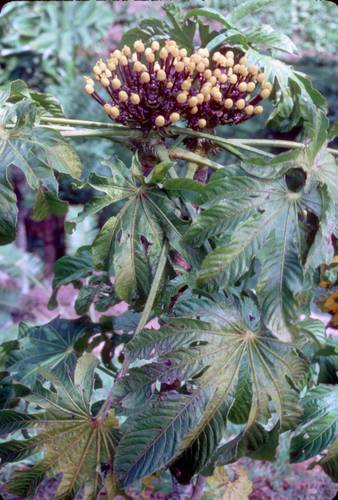
(c) Melissa McMasters, some rights reserved (CC BY)
iNaturalist· cc-by-nc
(c) Janet Wright, some rights reserved (CC BY-NC), uploaded by Janet Wright
iNaturalist· cc-by-sa
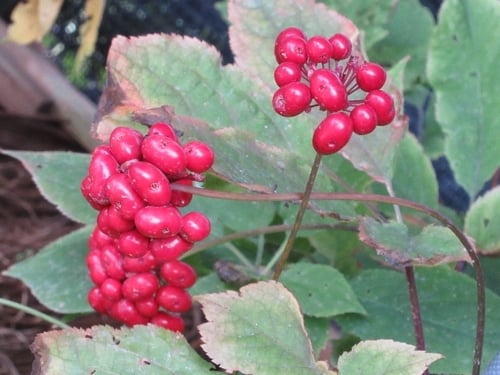
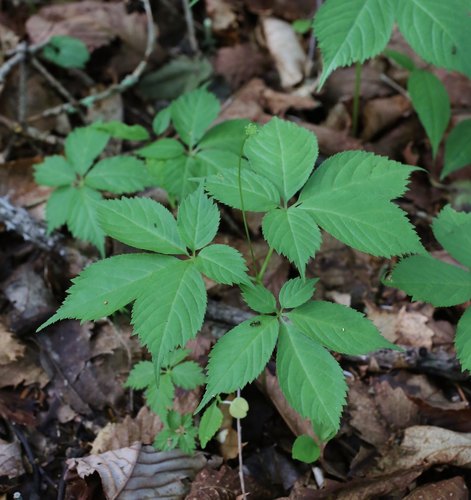
(c) Chris Hoess, some rights reserved (CC BY-SA)
Summary
Source: WikipediaAralia spinosa, commonly known as devil's walking stick, is a woody species of plant in the genus Aralia of the family Araliaceae. It is native to eastern North America. The various names refer to the viciously sharp, spiny stems, petioles and even leaf midribs. It has also been known as Angelica-tree. This species is sometimes called Hercules' club, prickly ash or prickly elder. These are common names it shares with the unrelated Zanthoxylum clava-herculis. For this reason, Aralia spinosa is sometimes confused with that species and mistakenly called the toothache tree. It does not have the medicinal properties of Zanthoxylum clava-herculis. Aralia spinosa is occasionally cultivated for its exotic or tropical appearance because of its large lacy compound leaves. It is closely related to the Asian species Aralia elata, a more commonly cultivated species with which it is easily confused.
Description
A deciduous tree. It grows 10 m tall. It spreads by root suckers. The bark is grey and has stout prickles. The leaves are twice divided and very large. They are 1 m long. There are many oval leaflets which taper to the tip. These are 7.5 cm long by 4 cm wide. They are bronze when young and become dull green above and paler underneath. They are hairy on both sides. They turn yellow to purple before they fall. The stalk is prickly and the shoot is stout and prickly. The flowers are small and white. They occur in clusters in large heads. They are on a single main axis. They fruit are rounded and purple-black. They are 6 mm long.
Edible Uses
Edible Parts: Leaves Edible Uses: Young leaves - cooked. The leaves usually have a number of slender prickles, they must be gathered before the prickles harden and are then chopped finely and used as a potherb.
Traditional Uses
The young unfolding leaves are used as a potherb. They are finely chopped, flavoured with vinegar and eaten with rice.
This uses section is brief — help expand it
Medicinal Uses
Alterative Analgesic Diaphoretic Ophthalmic Sialagogue Stimulant Analgesic. The bark, especially of the roots is the part most commonly used medicinally, though other parts of the plant, including the fruit, also possess medicinal properties. The fresh bark is strongly emetic, ophthalmic, purgative and sialagogue, when dried it is a stimulating alterative and is diaphoretic. A tincture of the berries is used in the treatment of toothache and rheumatism. A poultice of the roots is applied to boils, skin eruptions, varicose veins, old sores and swellings. A cold infusion of the roots is used as drops for sore eyes.
Known Hazards
Handling the roots can cause dermatitis in some people. Large amounts of the berries are poisonous.
Distribution
It is a temperate plant. It grows naturally in the eastern United States. It grows along riverbanks and in moist woods. It suits hardiness zones 5-9.
Where It Grows
Australia, Britain, Europe, Georgia, North America, USA,
Cultivation
Prefers a good deep loam and a semi-shady position. Requires a sheltered position. A fast-growing but short-lived tree in its native zone, this species is of little value in Britain. It is generally a single-stemmed plant, often spreading freely by means of suckers. Plants make finer foliage when growing in rich soils but are generally healthier and longer-lived in a comparatively poor soil. The young growth in spring, even on mature plants, is frost-tender and so it is best to grow the plants in a position sheltered from the early morning sun.
Propagation
Seed - best sown as soon as ripe in a cold frame. Stored seed requires 3 - 5 months of cold stratification. Germination usually takes place within 1 - 4 months at 20°c. When large enough to handle, prick the seedlings out into individual pots and grow them on in light shade in a greenhouse for at least their first winter. Once the plants are 25cm or more tall, they can be planted out into their permanent positions, late spring or early summer being the best time to do this. Root cuttings 8cm long, December in a cold frame. Store the roots upside down in sand and pot up in March/April. High percentage. Division of suckers in late winter. Very easy, the suckers can be planted out direct into their permanent positions if required.
Other Uses
Wood Wood - close-grained, weak, light, soft, brittle. Of little economic value. Special Uses
Notes
There are about 40-55 Aralia species.
References (12)
- Bircher, A. G. & Bircher, W. H., 2000, Encyclopedia of Fruit Trees and Edible Flowering Plants in Egypt and the Subtropics. AUC Press. p 37
- Coombes, A.J., 2000, Trees. Dorling Kindersley Handbooks. p 114
- Cundall, P., (ed.), 2004, Gardening Australia: flora: the gardener's bible. ABC Books. p 171
- Etherington, K., & Imwold, D., (Eds), 2001, Botanica's Trees & Shrubs. The illustrated A-Z of over 8500 trees and shrubs. Random House, Australia. p 97
- Facciola, S., 1998, Cornucopia 2: a Source Book of Edible Plants. Kampong Publications, p 25
Show all 12 references Hide references
- Hibbert, M., 2002, The Aussie Plant Finder 2002, Florilegium. p 31
- Kermath, B. M., et al, 2014, Food Plants in the Americas: A survey of the domesticated, cultivated and wild plants used for Human food in North, Central and South America and the Caribbean. On line draft. p 80
- Little, E.L., 1980, National Audubon Society Field Guide to North American Trees. Alfred A. Knopf. p 600
- Plants for a Future database, The Field, Penpol, Lostwithiel, Cornwall, PL22 0NG, UK. http://www.scs.leeds.ac.uk/pfaf/
- Recher, P, 2001, Fruit Spirit Botanical Gardens Plant Index. www.nrg.com.au/~recher/ seedlist.html p 4
- Sp. pl. 1:273. 1753
- Tozer, F., 2007, The Uses of Wild Plants. Green Man Publishing. p 31