Eleutherococcus trifoliatus
(L.) S. Y. Hu
Pak-pam
iNaturalist· cc0
no rights reserved, uploaded by Agnes Trekker
iNaturalist· cc-by-nc
(c) Hua Wan, some rights reserved (CC BY-NC), uploaded by Hua Wan
iNaturalist· cc-by-nc
(c) pollinator03, some rights reserved (CC BY-NC)
Summary
A deciduous shrub reaching 6 m tall, hardy to UK zone 7. Hermaphrodite with aromatic properties. Tolerates sandy, loamy, and clay soils including poor soil. Adapts to mildly acidic through basic pH, semi-shade to full sun, and moist conditions. Pollution-resistant.
Description
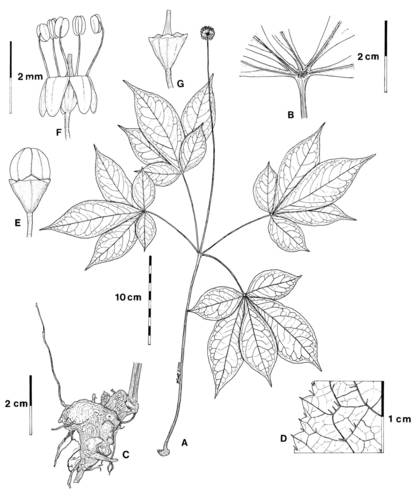
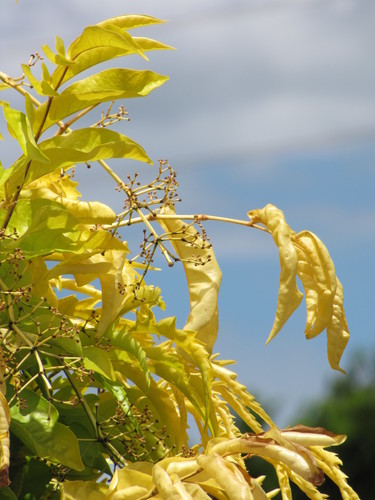
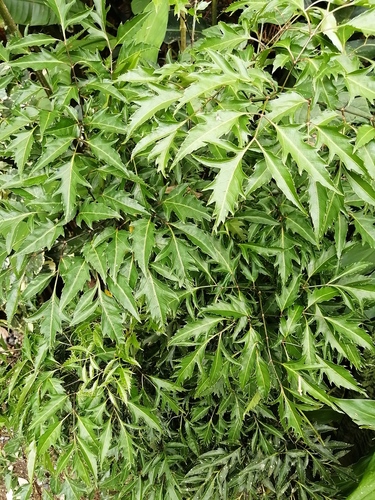
A shrub that lies over. It can be 2-4 m tall. There are a few prickles on the branches. The leaves are compound. The leaflets spread out like fingers on a hand. There are 3 leaflets that are broadly oval and 4-10 cm long by 3-6 cm wide. There are fine teeth along the edge. The fruit are flattened and round and 5 mm across. They are black when ripe.
Edible Uses
Young leaves are edible when cooked.
Traditional Uses
The young shoots are eaten as a side dish or cooked in curry. They are also used in stir fried dishes. The roots are cooked and eaten. The leaves are used as a vegetable.
Medicinal Uses
The root bark and stem bark contain triterpenoid saponins and oleanolic acid, and are used to treat rheumatism, lumbago, ostealgia, and impotence. The bark is also considered a stimulant and tonic for the central nervous system and is said to improve memory. For preparation, the bark is collected in summer and autumn, wrapped to bring out the aroma, and then thoroughly dried. The plant is also used in treating colds, coughs, neuralgia, rheumatism, and water on the knee.
Distribution
It is a tropical plant. In Thailand it grows between 1,100-1,400 m above sea level. In Sichuan and Yunnan.
Where It Grows
Asia, China, Himalayas, India, Indochina, Japan, Myanmar, Philippines, SE Asia, Taiwan, Thailand, Vietnam,
Cultivation
Eleutherococcus trifoliatus has a wide climatic range, being found at elevations up to 3,100 metres in the Himalayas where it can tolerate temperatures falling to around -10 to -15°c, through to the tropics of the Philippines. Prefers a light warm open loamy humus-rich soil and a position sheltered from north and east winds. Prefers a well-drained soil and full sun. Tolerates urban pollution and poor soils. All parts of the plant are particularly fragrant.
Propagation
Seed is best sown as soon as it is ripe in autumn in a cold frame, though germination can be slow. Stored seed requires 6 months of warm stratification followed by 3 months of cold stratification, and may also be very slow to germinate. Prick seedlings out into individual pots when large enough to handle, then grow on in light shade in a cold frame or greenhouse for at least the first winter before planting out in late spring or early summer. Other options include half-ripe wood cuttings in July/August in a frame, ripe wood cuttings of the current season's growth at 15–30cm long in a cold frame, root cuttings in late winter, or division of suckers during the dormant season.
Other Uses
None known
Other Information
It is sold in local markets in China.
Synonyms
Also Known As
Chobolaksinruibe, Cikuoluo, Ci wu jia, Habian, Ha bing, Jie dou, Kenkut, Ku ci, Shiah-ryngkhwari, Shi-soh-sat-khlaw, Wu jiao fu
References (15)
- Ambasta S.P. (Ed.), 2000, The Useful Plants of India. CSIR India. p 8 (As Acanthopanax)
- Cao, Y., et al, 2020, Ethnobotanical study on wild edible plants used by three trans-boundary ethnic groups in Jiangcheng County, Pu’er, Southwest China. Journal of Ethnobiology and Ethnomedicine (2020) 16:66
- Fu, Yongneng, et al, 2003, Relocating Plants from Swidden Fallows to Gardens in Southwestern China. Economic Botany, 57(3): 389-402 (As Merr.) (As Acanthopanax)
- Ghorbani, A., et al, 2012, A comparison of the wild food plant use knowledge of ethnic minorities in Naban River Watershed Nature Reserve, Yunnan, SW China. Journal of Ethnobiology and Ethnomedicine; 8:17
- Hu, Shiu-ying, 2005, Food Plants of China. The Chinese University Press. p 586
Show all 15 references Hide references
- J. Arnold Arbor. 61:110. 1980
- Japanese International Research Centre for Agricultural Science www.jircas.affrc.go.jp/project/value_addition/Vegetables
- Li, D. et al, 2017, Ethnobotanical survey of herbal tea plants from the traditional markets in Chaoshan, China. Journal of Ethnopharmacology. 205 (2017) 195-206
- Luo, B., et al, 2019, Wild edible plants collected by Hani from terraced rice paddy agroecosystem in Honghe Prefecture, Yunnan, China. Journal of Ethnobiology and Ethnomedicine 15:56 (As Acanthopanax trifoliatum)
- Maisuthisakul, P., 2012, Phenolic Constituents and Antioxidant Properties of some Thai Plants. www.intechopen.com (As Acanthopanax trifoliatum)
- Nakahara, K. et al, 2002, Antimutagenicity of Some Edible Thai Plants, and a Biocative Carbazole Alkaloid, Mahanine, Isolated from Micromelum minutum. Journal of Agricultural and Food Chemistry. 50: 4796-4892
- Plants for a Future database, The Field, Penpol, Lostwithiel, Cornwall, PL22 0NG, UK. http://www.scs.leeds.ac.uk/pfaf/
- Seidemann J., 2005, World Spice Plants. Economic Usage, Botany, Taxonomy. Springer. p 2 (As Acanthopanax trifoliatus)
- Vilm. Blumeng rtn. ed. 3, 1:406. 1894 "trifoliatum" (As Acanthopanax)
- Xu, You-Kai, et al, 2004, Wild Vegetable Resources and Market Survey in Xishuangbanna, Southwest China. Economic Botany. 58(4): 647-667. (As Acanthopanax trifoliatus)