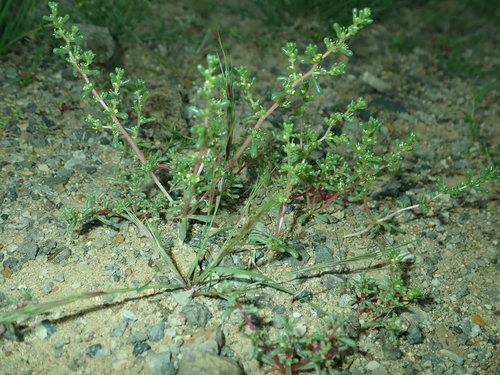
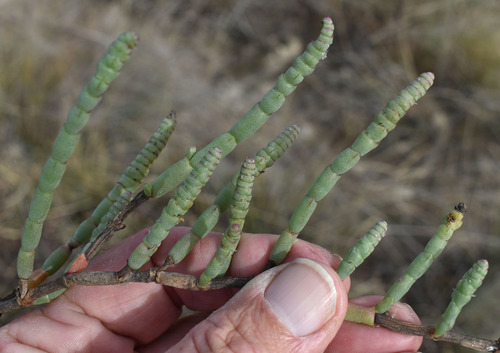
Salicornia virginica
L.
Virginia glasswort, Beach asparagus
Wikipedia· cc-by-sa
Wikimedia Commons - Glasswort_Salicornia_virginica.jpg
iNaturalist· cc-by-nc
(c) Kenny Cao, some rights reserved (CC BY-NC)
iNaturalist· cc-by-nc
(c) kellybower, some rights reserved (CC BY-NC)
Summary
Source: WikipediaSalicornia virginica (American glasswort, pickleweed) is a halophytic perennial dicot which grows in various zones of intertidal salt marshes and can be found in alkaline flats. It is native to various regions of the Northern Hemisphere including both coasts of North America from Canada to Mexico. The plant is one of the Salicornia species being tested as biofuel crop as its seeds are composed of 32% oil, and being a halophyte, it can be irrigated with salt water. Salicornia virginica is classified as a obligate wetland (OBL) species which means it "occurs almost always (estimated probability 99%) under natural conditions in wetlands".
Description
A fleshy herb. It is succulent and keeps growing from year to year. It can be 30 cm tall. The flowers are small and greenish and in clusters at the top of the plant. These turn red as they ripen.
Edible Uses
Leaves are eaten raw or cooked and have a salty flavour. Young stems and seeds are also edible — stems are crisp and salty, suitable for eating raw, cooked, or pickled, though excessive salt intake is a concern. Seeds are small and enclosed in tough utricles but, once processed, can be made into flour or porridge. Native Americans used the seeds as a grain in coastal areas.
Traditional Uses
The fleshy stems are used for food. They are cooked or pickled.
This uses section is brief — help expand it
Medicinal Uses
The plant has been used externally to treat arthritic pain, rheumatism, aches, pains, and swellings.
Distribution
It is a tropical plant. It grows in marshes and along beaches. It can tolerate salt water.
Where It Grows
Atlantic, Bahamas, Canada, Caribbean, Dominican Republic, Haiti*, Hawaii, Jamaica*, North America, Pacific, Puerto Rico, USA, West Indies*,
Cultivation
Perennial halophyte forming dense mats. Helps bind soils in estuaries and contributes to wetland biodiversity. Common in coastal salt marshes, tidal flats, and brackish estuaries along both Atlantic and Pacific coasts of North America. We have very little information on this species and do not know if it will be hardy in Britain, though judging by its native range it should succeed outdoors in most parts of the country. There is some doubt over the correct application of this name, it probably refers to S. depressa. The plants native habitat will give some idea of its cultivation needs. 20–70 cm tall, bushy with jointed succulent stems. Best grown in saline wet soils with periodic tidal flooding. Prefers full sun.
Propagation
No specific information is available for this species. It is suggested to sow seed as soon as it is ripe where possible, otherwise in spring, in a greenhouse using a light sandy compost. Prick seedlings out into individual pots when large enough to handle, and plant out during summer. Division may also be possible in spring.
Other Uses
Ashes from burnt plants are used in making glass and soap. The plant is also useful for shoreline stabilisation in estuarine restoration and provides food for waterfowl as well as habitat for invertebrates.
Notes
Also put in the family Chenopodiaceae.
Synonyms
Also Known As
Pickleweed, Salmuera, Saltwort
References (6)
- Kermath, B. M., et al, 2014, Food Plants in the Americas: A survey of the domesticated, cultivated and wild plants used for Human food in North, Central and South America and the Caribbean. On line draft. p 776
- MacKinnon, A., et al, 2009, Edible & Medicinal Plants of Canada. Lone Pine. p 310
- Moerman, D. F., 2010, Native American Ethnobotany. Timber Press. p 500
- Plants for a Future database, The Field, Penpol, Lostwithiel, Cornwall, PL22 0NG, UK. http://www.scs.leeds.ac.uk/pfaf/
- Plants of Haiti Smithsonian Institute http://botany.si.edu
Show all 6 references Hide references
- Sp. pl. 1:4. 1753 "virginia" - non S. virginica auct. (= Sarcocornia perennis (Mill.) A. J. Scott)