Sagittaria sagittifolia
L.
Arrowhead, Japanese Arrowhead, Chinese Arrowhead
iNaturalist· cc-by-nc
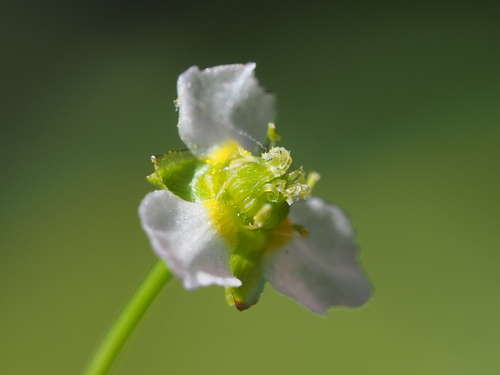
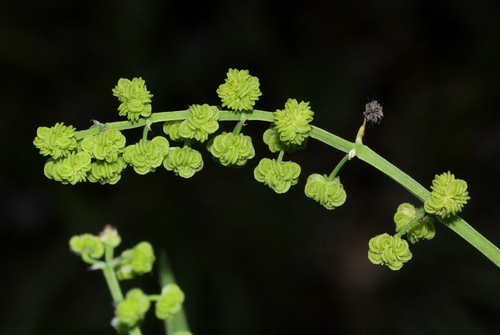
(c) Paweł Fortuna, some rights reserved (CC BY-NC), uploaded by Paweł Fortuna
iNaturalist· cc-by
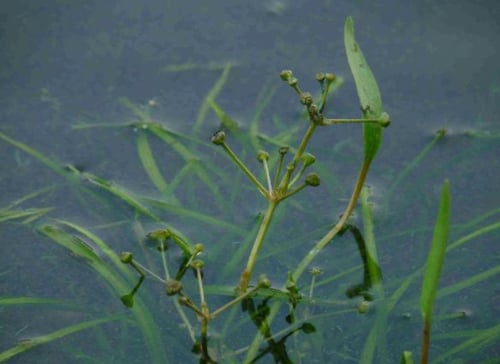
(c) Gabriel Campbell-Martinez, some rights reserved (CC BY)
iNaturalist· cc-by-nc
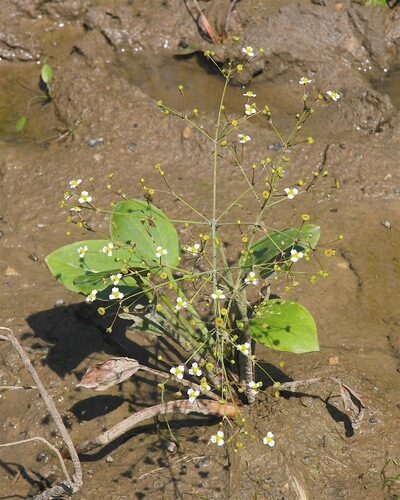
(c) Susan Elliott, some rights reserved (CC BY-NC), uploaded by Susan Elliott
Summary
Source: WikipediaSagittaria sagittifolia (also called arrowhead because of the shape of its leaves) is an Old World flowering plant in the family Alismataceae.
Description
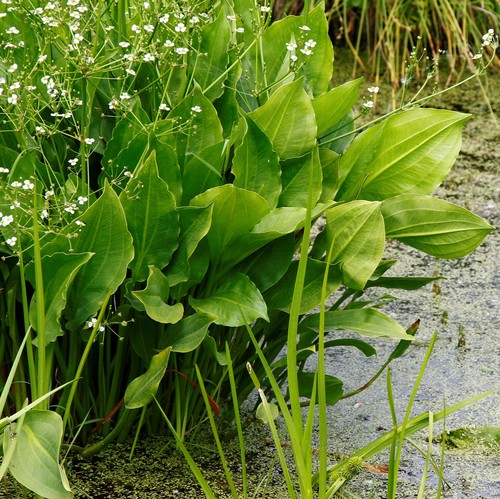
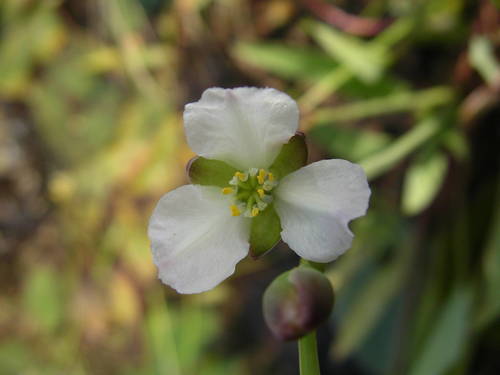
This perennial herb has arrow shaped leaves. It grows 50-80 cm high. Leaves are arrowhead-shaped and 5-20 cm wide. They are raised above the water level. The flowers are in rings around the stem and are white with a yellow centre. The flower stalk is long. The plant produces edible tubers. These underground corms are spherical, yellowish or brownish, with membranous scales on two or three rings. There are usually 4-6 tubers on each plant. They are 5 cm across.
Edible Uses
The tubers are starchy with a distinct flavour and should not be eaten raw. Roasted, they are excellent — tasting somewhat like potatoes. The bitter skin is best removed after cooking. Tubers can also be dried and ground into a powder for use as a gruel or added to cereal flours for breadmaking. They grow at the ends of slender roots, often 30cm deep and some distance from the parent plant; wild tubers reach about 15cm in diameter and are best harvested in late summer as the leaves die back. Per 100g dried root: 364 calories, 17g protein, 1g fat, 76.2g carbohydrate, 3.1g fibre, 5.8g ash, 44mg calcium, 561mg phosphorus, 8.8mg iron, 2,480mg potassium, 0.54mg thiamine, 0.14mg riboflavin, 4.76mg niacin, 17mg ascorbic acid; no carotene. Young leaves and stems can also be cooked, though they are somewhat acrid.
Traditional Uses
The tubers or corms are cooked and eaten. The starch is used in dishes and for bread. The tender shoots near the root and stem is boiled well then eaten with oil and salt.
Medicinal Uses
The plant is antiscorbutic and diuretic. The leaf is used to treat a variety of skin problems. The tuber is discutient and galactofuge, and may induce premature birth.
Known Hazards
Tubers should not be eaten raw. Tubers may induce premature birth.
Distribution
It grows in tropical and subtropical places. It occurs in swamps and muddy places, growing in ponds and rice-fields. It grows in wetlands. It suits hardiness zones 7-12. In Yunnan.
Where It Grows
Asia, Australia, Balkans, Bosnia, Britain, China, Cuba, Czech Republic, Europe*, French Polynesia, Himalayas, Hungary, India, Indochina, Indonesia, Ireland, Japan, Laos, Luxembourg, Malaysia, Marquesas, Myanmar, Nepal, North America, Northeastern India, Pacific, Philippines, Russia, SE Asia, Tahiti, USA, Vietnam, West Indies,
Cultivation
A pond or bog garden plant, it requires a moist or wet loamy soil in a sunny position. Prefers shallow, still or slowly flowing water up to 30 - 60cm deep. Plants are fairly cold tolerant, surviving temperatures down to at least -10°c, though the top growth is damaged once temperatures fall below zero. They grow best in warm weather and require at least a six month growing season in order to produce a crop. A polymorphic species, the sub-species S. sagittifolia leucopetala is extensively cultivated for its edible bulb in China where there are many named varieties.
Propagation
Sow seed as soon as it is ripe in a pot standing in about 5cm of water. Prick seedlings into individual pots when large enough to handle, gradually increasing the water depth as plants grow until it reaches about 5cm above the top of the pot. Plant out in late spring or early summer of the following year. Tubers can be divided in spring or autumn — a straightforward process. Runners can be potted up at any point during the growing season.
Other Uses
None known Special Uses
Production
Corms mature in 6-7 months. Each corm weighs about 14-28 g. The starchy corms are peeled, sliced and cooked in stews or fried.
Other Information
It is a commercially cultivated vegetable. It is cultivated for its tuberous roots eaten as a vegetable. It is sold in local markets.
Nutrition
| Part | Moisture | kJ | kcal | Protein | Vit A | Vit C | Iron | Zinc |
|---|---|---|---|---|---|---|---|---|
| Corms | 70.6 | 447 | 107 | 5 | — | 1.1 | 2.6 | 0.3 |
| Leaves | 91.6 | 67 | 16 | 2.4 | — | 13 | — | — |
Synonyms
Also Known As
Alacs, Bab henru, Beea beea, Chhoto-kut, Chotokut, Chi Gu, Cigu, Elecs, Etjeng, Huring dumdum, Kere gende, King aunt, Koukha, Kuwai, Lili air, Lochkor, Muya, Muya muya, Ok-kha, Pijlkruid, Sigan godai, Sipatka strelolista, Swamp potato, Swan potato, Thaso laojeng, Tsee goo, Vodena strijela
References (65)
- Ambasta, S.P. (Ed.), 2000, The Useful Plants of India. CSIR India. p 539
- Arora, R. K., 2014, Diversity in Underutilized Plant Species - An Asia-Pacific Perspective. Bioversity International. p 108
- Baro, D., Baruah, S. and Borthukar, S. K. 2015, Documentation on wild vegetables of Baksa district, BTAD (Assam). Scholars Research Library. Archives of Applied Science Research, 2015, 7 (9):19-27
- Barrau, J., 1976, Subsistence Agriculture in Polynesia and Micronesia. Bernice P. Bishop Museu, Bulletin 223 Honolulu Hawaii. Kraus reprint. p 59
- Bodkin, F., 1991, Encyclopedia Botanica. Cornstalk publishing, p 900
Show all 65 references Hide references
- Brickell, C. (Ed.), 1999, The Royal Horticultural Society A-Z Encyclopedia of Garden Plants. Convent Garden Books. p 921
- Burkill, I.H., 1966, A Dictionary of the Economic Products of the Malay Peninsula. Ministry of Agriculture and Cooperatives, Kuala Lumpur, Malaysia. Vol 2 (I-Z) p 1976
- Brown, W.H., 1920, Wild Food Plants of the Philippines. Bureau of Forestry Bulletin No. 21 Manila. p 24
- Crawford, M., 2012, How to grow Perennial Vegetables. Green Books. p 68
- Cundall, P., (ed.), 2004, Gardening Australia: flora: the gardener's bible. ABC Books. p 1293
- Dangol, D. R. et al, 2017, Wild Edible Plants in Nepal. Proceedings of 2nd National Workshop on CUAOGR, 2017.
- Denes, A., et al, 2012, Wild plants used for food by Hungarian ethnic groups living in the Carpathian Basin. Acta Societatis Botanicorum Poloniae 81 (4): 381-396
- Den Hartog, C., 1957 Alismataceae in Flora malesiana 5(3) p 332
- Devi, O.S., P. Komor & D. Das, 2010, A checklist of traditional edible bio-resources from Ima markets of Imphal Valley, Manipur, India. Journal of Threatened Taxa 2(11): 1291-1296
- Devi, O. S., et al, 2021, Wild edible plants associated with the people of Thoubal Khunou village and its migrated villagers. Int. J. Adv. Res. Biol. Sci. 8(9): 72-90
- Dey, A. & Mukhererjee, A., 2015, Living and Survival Amidst Hunger: Wild Edible Botanicals as a Prime Forest Productivity in the Rural Purulia District, West Bengal, India from Colonial to Present. Research Journal of Forestry 9(3): 71-86
- Ethnobotany of Karbis. Chapter 4 in p 100
- Facciola, S., 1998, Cornucopia 2: a Source Book of Edible Plants. Kampong Publications, p 4
- Foo, J.T.S.(ed), 1996, A Guide to Common Vegetables. Singapore Science Foundation. p 6
- Food Composition Tables for use in East Asia FAO http://www.fao.org/infoods/directory No. 118
- Gautam, R. S., et al, 2022, Ethnobotanical Review of Wild Edible Plants of Nepal. Journal of Natural History Museum Volume 32, 2021-22 p 100
- Hedrick, U.P., 1919, (Ed.), Sturtevant's edible plants of the world. p 588
- Heywood, V.H., Brummitt, R.K., Culham, A., and Seberg, O. 2007, Flowering Plant Families of the World. Royal Botanical Gardens, Kew. p 340
- Hibbert, M., 2002, The Aussie Plant Finder 2002, Florilegium. p 283
- Hu, Shiu-ying, 2005, Food Plants of China. The Chinese University Press. p 282
- Irving, M., 2009, The Forager Handbook, A Guide to the Edible Plants of Britain. Ebury Press p 341
- Jain et al, 2011, Dietary Use and Conservation Concern of Edible Wetland Plants at Indo-Burma Hotspot: A Case Study from Northeast India. Journal of Ethnobiology and Ethnomedicine 7:29 p 8
- Joshi, N., et al, 2007, Traditional neglected vegetables of Nepal: Their sustainable utilization for meeting human needs. Tropentag 2007. Conference on International Agricultural Research for Development.
- Kay, D.E., 1973, Root Crops, Digest 2, Tropical Products Institute, London, p 13
- Kays, S. J., and Dias, J. C. S., 1995, Common Names of Commercially Cultivated Vegetables of the World in 15 languages. Economic Botany, Vol. 49, No. 2, pp. 115-152
- Kolosova, V., et al, 2020, Foraging in Boreal Forest: Wild Food Plants of the Republic of Karelia, NW Russia. Foods 2020, 9, 1015; p 31
- Konsam, S., et al, 2016, Assessment of wild leafy vegetables traditionally consumed by the ethnic communities of Manipur, northeast India. Journal of Ethnobiology and Ethnomedicine, 12:9
- Kumar, G.M., & Shiddamallayya, N., 2014, Documentation of Wild Plant Tubers as Food Resources in Hassan District, Karnataka, International Journal of Applied Biology and Pharmaceutical Technology. 5(2) p 92
- Larkcom, J., 1991, Oriental Vegetables, John Murray, London, p 124
- Lazarides, M. & Hince, B., 1993, Handbook of Economic Plants of Australia, CSIRO. p 209
- Lim, T. K., 2015, Edible Medicinal and Non Medicinal Plants. Volume 9, Modified Stems, Roots, Bulbs. Springer p 74
- Martin, F.W. & Ruberte, R.M., 1979, Edible Leaves of the Tropics. Antillian College Press, Mayaguez, Puerto Rico. p 172
- Massal, E. and Barrau, J., 1973, Food Plants of the South Sea Islands. SPC Technical Paper No 94. Noumea, New Caledonia. p 37
- Meitei, L. R., et al, 2022, An ethnobotanical study on the wild edible plants used by forest dwellers in Yangoupokpi Lokchao Wildlife Sanctuary, Manipur, India. Ethnobotany Research and Application 23:15
- Mishra, N., et al, 2016, Indigenous knowledge in utilization of wetland plants in Bhadrak district, Odisha, India. Indian Journal of Natural Products and Resources. Vol. 7(1) pp. 82-89
- Monsalud, M.R., Tongacan, A.L., Lopez, F.R., & Lagrimas, M.Q., 1966, Edible Wild Plants in Philippine Forests. Philippine Journal of Science. p 434
- Mot So Rau Dai an Duoc O Vietnam. Wild edible Vegetables. Ha Noi 1994, p 150
- Norrington, L., & Campbell, C., 2001, Tropical Food Gardens. Bloomings Books. p 23
- Ochse, J.J. et al, 1931, Vegetables of the Dutch East Indies. Asher reprint. p 8
- READ
- Redzic, S. J., 2006, Wild Edible Plants and their Traditional Use in the Human Nutrition in Bosnia-Herzegovina. Ecology of Food and Nutrition, 45:189-232
- Romanowski, N., 2007, Edible Water Gardens. Hyland House. p 67
- Schneider, E., 2001, Vegetables from Amaranth to Zucchini: The essential reference. HarperCollins. p 12
- Simkova, K. et al, 2014, Ethnobotanical review of wild edible plants used in the Czech Republic. Journal of Applied Botany and Food Quality 88, 49-67
- Singh, G. & Kumar, J., 2014, Studies on Indigenous Traditional Knowledge of some Aquatic and Marshy Wild Edible Plants used by the Munda Tribe of District Khunti, Jharkhand, India. International Journal of Bioassays. 3(2), 1738-1743
- Singh, P.K., Singh, N.I., and Singh, L.J., 1988, Ethnobotanical Studies on Wild Edible Plants in the Markets of Manipur - 2. J. Econ. Tax. Bot. Vol. 12 No. 1 pp 113-119
- Slocum, P.D. & Robinson, P., 1999, Water Gardening. Water Lilies and Lotuses. Timber Press. p 100
- Solomon, C., 2001, Encyclopedia of Asian Food. New Holland. p 12
- Sp. pl. 2:993. 1753
- Sukarya, D. G., (Ed.) 2013, 3,500 Plant Species of the Botanic Gardens of Indonesia. LIPI p 1154
- Sukenti, K., et al, 2016, Ethnobotanical study on local cuisine of the Sasak tribe in Lombok Island, Indonesia. Journal of Ethnic Foods. 3 (2016) 189-200 p 198
- Teron, R. & Borthakur, S. K., 2016, Edible Medicines: An Exploration of Medicinal Plants in Dietary Practices of Karbi Tribal Population of Assam, Northeast India. In Mondal, N. & Sen, J.(Ed.) Nutrition and Health among tribal populations of India. p 148
- Terra, G.J.A., 1973, Tropical Vegetables. Communication 54e Royal Tropical Institute, Amsterdam, p 70
- UPHOF
- USDA, ARS, National Genetic Resources Program. Germplasm Resources Information Network - (GRIN). [Online Database] National Germplasm Resources Laboratory, Beltsville, Maryland. Available: www.ars-grin.gov/cgi-bin/npgs/html/econ.pl (10 April 2000)
- Valder, P., 1999, The Garden Plants of China. Florilegium. p 234
- Woodward, P., 2000, Asian Herbs and Vegetables. Hyland House. p 119
- World Checklist of Useful Plant Species 2020. Royal Botanic Gardens, Kew
- Xu, You-Kai, et al, 2004, Wild Vegetable Resources and Market Survey in Xishuangbanna, Southwest China. Economic Botany. 58(4): 647-667.
- Zeven, A. C. & de West, J. M. J., 1982, Dictionary of cultivated plants and their regions of diversity. Wageningen. p 32