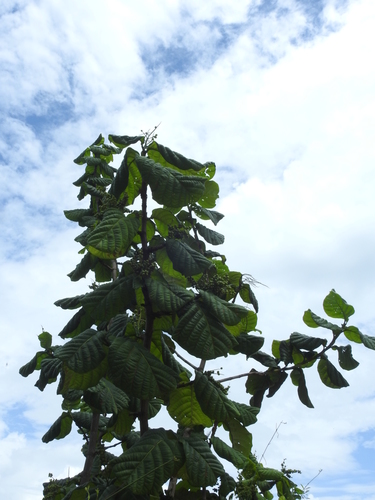
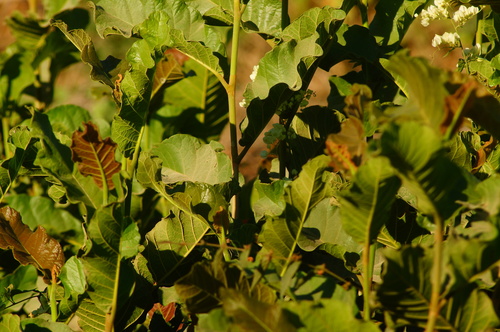
Rumex longifolius
DC.
Door-yard Dock
iNaturalist· cc-by-nc
(c) Maria_Kushcheva, some rights reserved (CC BY-NC)
iNaturalist· cc-by-nc
(c) Maria_Kushcheva, some rights reserved (CC BY-NC)
iNaturalist· cc-by-nc
(c) Maria_Kushcheva, some rights reserved (CC BY-NC)
Summary
Source: WikipediaRumex longifolius, commonly known as the dooryard dock or northern dock, is a perennial species of plant in the genus Rumex. A variety has been described: Rumex longifolius var. nanus
Description
A perennial reaching 1.2 m with hermaphroditic, wind-pollinated flowers appearing June to July. Grows in light sandy, medium loamy, and heavy clay soils with good drainage. Tolerates mildly acidic to basic soil pH. Establishes in semi-shade or full sun and prefers moist soil.
Edible Uses
Leaves are cooked and eaten as a vegetable, particularly valued for their antiscorbutic properties; they are best harvested as they first emerge from the ground. Seed is ground into a powder and used in gruel or added to cereal flours for making bread and similar foods.
Medicinal Uses
The whole plant, and especially the root, is alterative, astringent, cholagogue, deobstruent, stomachic, and tonic.
Known Hazards
Plants can contain quite high levels of oxalic acid, which is what gives the leaves of many members of this genus an acid-lemon flavour. Perfectly alright in small quantities, the leaves should not be eaten in large amounts since the oxalic acid can lock-up other nutrients in the food, especially calcium, thus causing mineral deficiencies. The oxalic acid content will be reduced if the plant is cooked. People with a tendency to rheumatism, arthritis, gout, kidney stones or hyperacidity should take especial caution if including this plant in their diet since it can aggravate their condition.
Distribution
It is a temperate plant. In Argentina it grows below 400 m above sea level.
Where It Grows
Albania, Argentina, Asia, Balkans, Britain, Chile, China, Europe, Falklands, Finland, Iceland, Japan, Korea, Mediterranean, North America, Norway, Russia, Scandinavia, South America, Turkey, Türkiye,
Cultivation
Succeeds in most soils but prefers a deep fertile moderately heavy soil that is humus-rich, moisture-retentive but well-drained and a position in full-sun or part shade.
Propagation
Sow seed in spring in situ. Can also be propagated by division in spring.
Other Uses
No dye data specific to this species has been recorded, but roots of many plants in this genus yield dark green to brown and dark grey dyes without the need for a mordant.
Notes
There are about 200 Rumex species.
Synonyms
Also Known As
Hoymole
References (11)
- Diaz-Betancourt, M., et al, 1999, Weeds as a future source for human consumption. Rev. Biol. Trop. 47(3):329-338
- Flora of China @ efloras.org Volume 5
- Hedrick, U.P., 1919, (Ed.), Sturtevant's edible plants of the world. p 583
- Kolosova, V., et al, 2020, Foraging in Boreal Forest: Wild Food Plants of the Republic of Karelia, NW Russia. Foods 2020, 9, 1015; p 19
- J. B. P. A. M. de Lamarck & A. P. de Candolle, Fl. franc. ed. 3, 5:368. 1815
Show all 11 references Hide references
- Pieroni, A., 2008, Local plant resources in the ethnobotany of Theth, a village in the Northern Albanian Alps. Genet Resour Crop Evol (2008) 55:1197–1214
- Plants for a Future database, The Field, Penpol, Lostwithiel, Cornwall, PL22 0NG, UK. http://www.scs.leeds.ac.uk/pfaf/
- Rapoport, E. H., et al, 1995, Edible Weeds: A Scarcely Used Resource. Bulletin of the Ecological Society of America. Vol. 76 No. 3 pp 163-166
- Svanberg, I., et al, 2012, Edible wild plant use in the Faroe Islands and Iceland. Acta Societatis Botanicorum Poloniae 81(4): 233-238
- Upson, R., & Lewis R., 2014, Updated Vascular Plant Checklist and Atlas for the Falkland Islands. Falklands Conservation and Kew.
- Whitney, C. W., et al, 2012, A Survey of Wild Collection and Cultivation of Indigenous Species in Iceland. Human Ecology 40:781-787