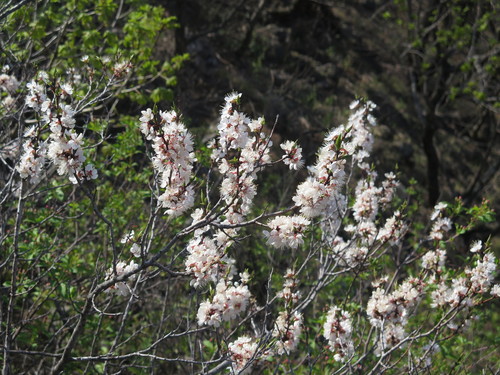
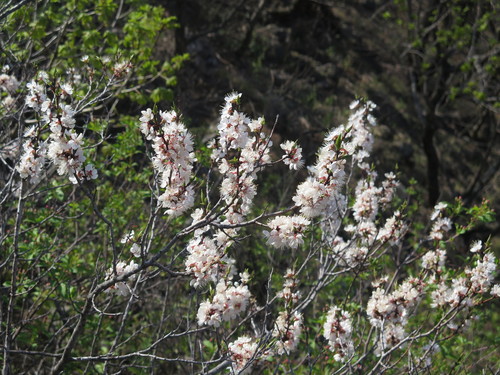
Rubus ursinus
Cham. & Schltdl.
California blackberry
wikimedia· cc-by
Leslie Seaton from Seattle, WA, USA (via Wikimedia Commons)
wikimedia· cc-by-sa
Wikimedia Commons (via Wikimedia Commons)
wikimedia· cc0
Hooker, William Jackson (via Wikimedia Commons)
iNaturalist· cc-by
(c) Marcel_Pepin, some rights reserved (CC BY), uploaded by Marcel_Pepin
iNaturalist· cc-by-nc
(c) santiagocastells, some rights reserved (CC BY-NC)
iNaturalist· cc-by-nc
(c) santiagocastells, some rights reserved (CC BY-NC)
Summary
Source: WikipediaRubus ursinus is a North American species of blackberry or dewberry, known by the common names California blackberry, California dewberry, Douglas berry, Pacific blackberry, Pacific dewberry and trailing blackberry.
Description
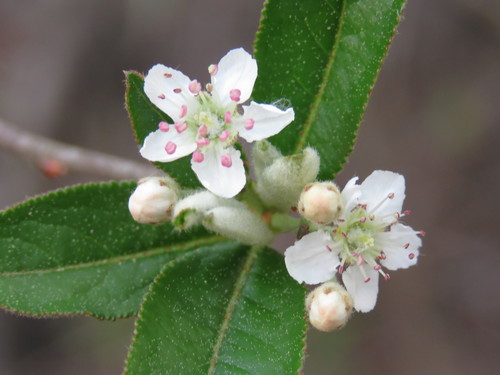
An evergreen shrub. It can be upright or lie along the ground. It can be a climber. It grows 50-90 cm high and spreads 0.9-3 m wide. The leaves have 3-5 leaflets. The are hairy above and like felt and white underneath. The male and female flowers are on separate plants. The flowers are white. The fruit is black and hairy.
Edible Uses
The fruit can be eaten raw or cooked and works well in pies and preserves. It can also be dried for later use. Flavour is generally sweet but varies considerably — the best forms produce large, well-flavoured fruit, while others may be large but sour or insipid. Half-ripe fruits can be soaked in water to make a pleasant drink. Young shoots are edible raw or cooked like asparagus, harvested in spring as they emerge from the soil while still tender. A tea can be brewed from fresh or dried leaves, and young shoots can also be used to make tea, usually combined with shoots of other Rubus species.
Traditional Uses
The fruit are eaten raw. they are also dried or made into pies, sauces, jellies and cakes. The half ripe berries are soaked in water to make a drink. The fresh or dried leaves are used for tea. The young shoots are boiled and eaten.
Medicinal Uses
The dried bark of the root is astringent and has been used to treat diarrhoea and dysentery, as has a decoction of the roots. The roots have also been used as a disinfectant wash on infected sores. Eating fresh fruit has been a traditional remedy for diarrhoea. A decoction of the entire vine treats stomach complaints, diarrhoea, and general nausea, while a decoction of the vines and roots together has been used for vomiting and spitting of blood.
Distribution
It is a temperate plant. It suits hardiness zones 7-9. In Hobart Botanical gardens.
Where It Grows
Australia, Canada, Mexico, North America*, Tasmania, USA,
Cultivation
Easily grown in a good well-drained loamy soil in sun or semi-shade. This species is the parent of many hybrid cultivated forms, including the loganberry and the primus berry. Some botanists include the cultivated loganberry (treated here as a separate species, R. loganobaccus) under this species. This species is a blackberry with biennial stems, it produces a number of new stems each year from the perennial rootstock, these stems fruit in their second year and then die. Plants in this genus are notably susceptible to honey fungus.
Propagation
Seed requires stratification and is best sown in early autumn in a cold frame. Stored seed sown after February should be stratified for one month at 3°C; sow as early as possible in the year. Prick out seedlings when large enough to handle, grow on in a cold frame, and plant into permanent positions in late spring of the following year. Tip layering in July; plant out in autumn. Division in early spring.
Other Uses
A purple to dull blue dye is obtained from the fruit.
Notes
There are about 250 Rubus species.
Dangerous Lookalikes
This plant can be confused with the following toxic species. Always verify identification carefully before consuming any wild plant.
Red Baneberry
Actaea rubra
Walter Siegmund (talk)
California blackberry
Rubus ursinus
Leslie Seaton from Seattle, WA, USA (via Wikimedia Commons)
Red Baneberry: Short herbaceous plant (no thorns), berries on thick red stems, each berry has a single seed, compound sharply-toothed leaves.
California blackberry: Thorny woody canes (brambles), aggregate berry made of many drupelets, berries pull easily from receptacle.
Also Known As
California dewberry, Douglas-berry, Pacific blackberry, Pacific dewberry, Youngberry, Western blackberry, White flowering raspberry, Zarzamora
References (16)
- Cundall, P., (ed.), 2004, Gardening Australia: flora: the gardener's bible. ABC Books. p 1285
- Elias, T.S. & Dykeman P.A., 1990, Edible Wild Plants. A North American Field guide. Sterling, New York p 185
- Esperanca, M. J., 1988. Surviving in the wild. A glance at the wild plants and their uses. Vol. 1. p 163
- Facciola, S., 1998, Cornucopia 2: a Source Book of Edible Plants. Kampong Publications, p 210
- Hedrick, U.P., 1919, (Ed.), Sturtevant's edible plants of the world. p 581
Show all 16 references Hide references
- Hussey, B.M.J., Keighery, G.J., Cousens, R.D., Dodd, J., Lloyd, S.G., 1997, Western Weeds. A guide to the weeds of Western Australia. Plant Protection Society of Western Australia. p 210
- Kermath, B. M., et al, 2014, Food Plants in the Americas: A survey of the domesticated, cultivated and wild plants used for Human food in North, Central and South America and the Caribbean. On line draft. p 766
- Lazarides, M. & Hince, B., 1993, Handbook of Economic Plants of Australia, CSIRO. p 208
- Linnaea 2:11. 1827
- Moerman, D. F., 2010, Native American Ethnobotany. Timber Press. p 494
- Paczkowska, G . & Chapman, A.R., 2000, The Western Australian Flora. A Descriptive Calatogue. Western Australian Herbarium. p 513
- Plants for a Future database, The Field, Penpol, Lostwithiel, Cornwall, PL22 0NG, UK. http://www.scs.leeds.ac.uk/pfaf/
- Turner, N., 1995, Food Plants of Coastal First Peoples. Royal BC Museum Handbook p 127
- USDA, ARS, National Genetic Resources Program. Germplasm Resources Information Network - (GRIN). [Online Database] National Germplasm Resources Laboratory, Beltsville, Maryland. Available: www.ars-grin.gov/cgi-bin/npgs/html/econ.pl (10 April 2000)
- Wiersema, J. H. & Leon, B., 2013, World Economic Plants. A Standard Reference CRC Press. 2nd Ed. p 600
- World Checklist of Useful Plant Species 2020. Royal Botanic Gardens, Kew