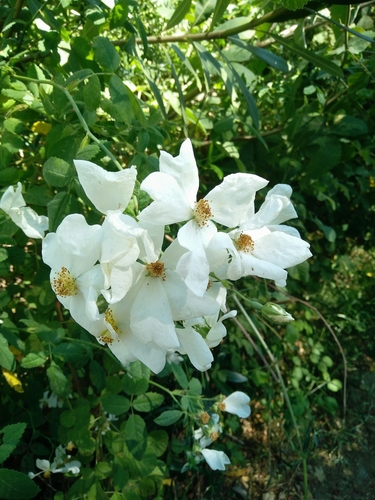
Rosa rubiginosa
L.
Sweetbrier rose, Eglantine Rose, Briar rose
iNaturalist· cc-by-sa
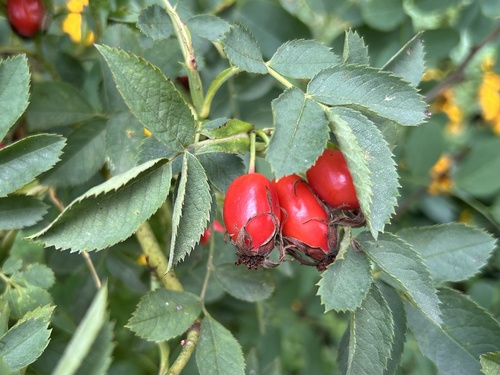
(c) Rosa_rubiginosa_mit_einigen_Knospen.jpg, some rights reserved (CC BY-SA)
iNaturalist· cc-by-nc
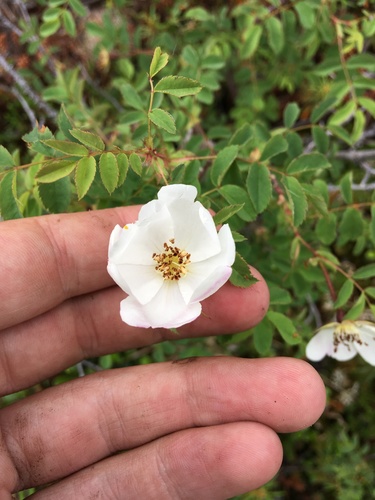
(c) Ricky Taylor, some rights reserved (CC BY-NC)
Summary
Source: WikipediaRosa rubiginosa (sweet briar, sweetbriar rose, sweet brier or eglantine; syn. R. eglanteria) is a species of rose native to Europe and western Asia.
Description
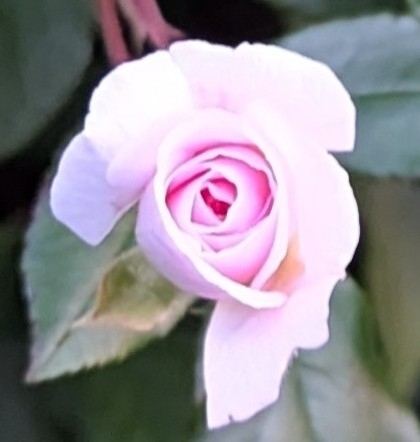
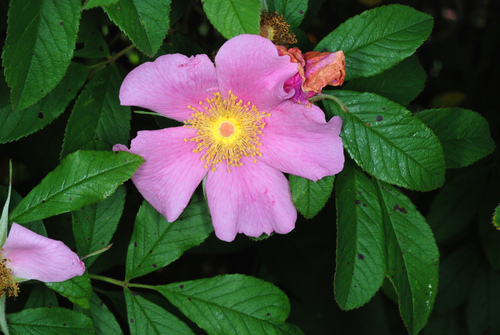
An erect shrub. It can be straggling. It grows 3 m high and spreads 3 m wide. The stem arch over and have prickles. The leaves are made up of 5-7 leaflets. There are teeth along the edges. The leaves have rusty reddish hairs underneath. It loses its leaves during the year. The leaves have an apple scent. The flowers are pink. They are 3 cm across. They occur either singly or in groups on short branches. The fruit are oval and orange-red. The fruit are called hips.
Edible Uses
The fruit is best used cooked — for making jellies and similar preparations — with flavour improving after a frost. Each hip is up to 25mm in diameter, though only a thin layer of flesh surrounds the many seeds. Care should be taken when eating the fruit — see known hazards. The fruit also makes a pleasant, fruity-flavoured tea that is rich in vitamin C. The petals can be eaten raw or cooked; remove the bitter white base before use, and they are well suited to confectionery. Young shoots can be eaten raw as they come through the ground in spring. The seeds are a good source of vitamin E and can be ground into a powder and mixed with flour or added to food as a supplement; always remove the seed hairs first.
Traditional Uses
The rose petals are used for tarts, jams and ice cream. The rose hips are used for soup, jelly and drinks. They are cooked.
This uses section is brief — help expand it
Medicinal Uses
The flowers and hips are aperient, astringent, and stomachic. An infusion of dried rose petals can treat headaches and dizziness; with honey added, the same infusion serves as a heart and nerve tonic and a blood purifier. A decoction of the petals is used to treat mouth sores. The seed is rich in vitamin E, and an oil extracted from it is used externally to treat burns, scars, and wrinkles. The fruit is a very rich source of vitamins and minerals, particularly vitamins A, C, and E, flavonoids, and other bio-active compounds, and is a fairly good source of essential fatty acids, which is unusual for a fruit. It is being investigated for its potential to reduce the incidence of cancer and to halt or reverse cancer growth.
Known Hazards
There is a layer of hairs around the seeds just beneath the flesh of the fruit. These hairs can cause irritation to the mouth and digestive tract if ingested.
Distribution
It is a temperate plant. It grows well in high rainfall areas. It grows on lime rich soils. It is often in dry rocky places. In Argentina it grows below 600 m above sea level. It suits hardiness zones 4-10. Melbourne Botanical gardens. Tasmania Herbarium.
Where It Grows
Argentina, Asia, Australia, Baltic, Britain, Canada, Caucasus, Chile, Colombia, England, Europe, Falklands, Luxembourg, Mediterranean, New Zealand, North America, Norway, Russia, Scandinavia, Slovakia, Slovenia, South Africa, South America, South America, Sweden, Tasmania, Turkey, Türkiye, USA,
Cultivation
Succeeds in most soils, preferring a circumneutral soil and a sunny position. Grows well in heavy clay soils. Dislikes water-logged soils. Grows well with alliums, parsley, mignonette and lupins. Garlic planted nearby can help protect the plant from disease and insect predation. Grows badly with boxwood. Grows well on chalk. A very ornamental plant. The leaves are apple-scented. The flowers are slightly scented. Hybridizes freely with other members of this genus. Plants in this genus are notably susceptible to honey fungus.
Propagation
Rose seed often takes two years to germinate, as it may require a warm period following a cold spell to mature the embryo and reduce the seedcoat. One approach to shorten this is to scarify the seed and place it in damp peat at 27–32°c for 2–3 weeks until it has imbibed, then keep it at 3°c for four months until germination begins. Seed harvested green — fully developed but not yet dried on the plant — and sown immediately may germinate in late winter, though this method had not been fully tested as of 1988. Seed sown fresh in a cold frame sometimes germinates in spring but may take 18 months. Stored seed should be sown as early in the year as possible and stratified for 6 weeks at 5°c; it may still take 2 years to germinate. Prick out seedlings into individual pots when large enough to handle. Plant out in summer if plants exceed 25cm, otherwise overwinter in a cold frame and plant out in late spring. Half-ripe heel cuttings taken in July in a shaded frame, overwintered and planted out in late spring, give a high success rate. Mature cuttings of pencil-thick current-season shoots, 20–25cm long, taken in early autumn and planted in a sheltered spot or cold frame, can take 12 months to establish but normally succeed at a high rate. Suckers can be divided in the dormant season and planted directly into permanent positions. Layering takes 12 months.
Other Uses
The plant makes a good low hedge. The prickles on the stems make it a useful security hedge as well.
Notes
There are about 150 Rosa species and many cultivated varieties. The hips are high in Vitamin C.
Synonyms
Also Known As
Mosqueta, Rosa mosqueta, Rosa silvestre
References (44)
- Barreau, A., et al, 2016, How Can We Teach Our Children if We Cannot Access the Forest? Generational Change in Mapuche Knowledge of Wild Edible Plants in Andean Temperate Ecosystems of Chile. Journal of Ethnobiology 36(2): 412–432
- Bodkin, F., 1991, Encyclopedia Botanica. Cornstalk publishing, p 890
- Bodkin, F., 1991, Encyclopedia Botanica. Cornstalk publishing, p 889 (As Rosa eglanteria)
- Bremness, L., 1994, Herbs. Collins Eyewitness Handbooks. Harper Collins. p 121
- Brickell, C. (Ed.), 1999, The Royal Horticultural Society A-Z Encyclopedia of Garden Plants. Convent Garden Books. p 896 (As Rosa eglanteria)
Show all 44 references Hide references
- Chamorro, M. F., & Ladio, A., 2020, Native and exotic plants with edible fleshy fruits utilized in Patagonia and their role as sources of local functional foods. BMC Complementary Medicine and Therapies. 20:155
- Cerne, M., 1992, Wild Plants from Slovenia used as Vegetables. Acta Horticulturae 318
- Cordero, S. E., Abello, L. A., & Galvez, F. L., 2017, Plantas silvestres comestibles y medicinales de Chile y otras partes del mundo. CORMA p 115
- Cundall, P., (ed.), 2004, Gardening Australia: flora: the gardener's bible. ABC Books. p 1214 (As Rosa eglanteria)
- Curtis, W.M., 1956, The Students Flora of Tasmania Vol 1 p 174
- Daly, A. B., 20014, Narrating changing foodways: wild edible plant knowledge and traditional food systems in Mapuche lands of the Andean Temperate Forests, Chile. Masters Thesis Vancouver. p 45
- Dashorst, G.R.M., and Jessop, J.P., 1998, Plants of the Adelaide Plains & Hills. Botanic Gardens of Adelaide and State Herbarium. p 74
- Elias, T.S. & Dykeman P.A., 1990, Edible Wild Plants. A North American Field guide. Sterling, New York p 223 (As Rosa eglanteria)
- Esperanca, M. J., 1988. Surviving in the wild. A glance at the wild plants and their uses. Vol. 2. p 268 (As Rosa eglanteria)
- Facciola, S., 1998, Cornucopia 2: a Source Book of Edible Plants. Kampong Publications, p 207
- Flowerdew, B., 2000, Complete Fruit Book. Kyle Cathie Ltd., London. p 174
- Harris, S., Buchanan, A., Connolly, A., 2001, One Hundred Islands: The Flora of the Outer Furneaux. Tas Govt. p 216
- Hedrick, U.P., 1919, (Ed.), Sturtevant's edible plants of the world. p 573
- Hibbert, M., 2002, The Aussie Plant Finder 2002, Florilegium. p 260 (As Rosa eglanteria)
- Hibbert, M., 2002, The Aussie Plant Finder 2002, Florilegium. p 275
- Hussey, B.M.J., Keighery, G.J., Cousens, R.D., Dodd, J., Lloyd, S.G., 1997, Western Weeds. A guide to the weeds of Western Australia. Plant Protection Society of Western Australia. p 209
- Kermath, B. M., et al, 2014, Food Plants in the Americas: A survey of the domesticated, cultivated and wild plants used for Human food in North, Central and South America and the Caribbean. On line draft. p 754
- Kremer, B.P., 1995, Shrubs in the Wild and in Gardens. Barrons. p 178
- Ladio, A., Lozada, M. & M. Weigandt, 2007, Comparison of traditional wild plant knowledge between aboriginal communities inhabiting arid and forest environments in Patagonia, Argentina. Journal of Arid Environments 69 (2007) 695–715
- Lamp, C & Collet F., 1989, Field Guide to Weeds in Australia. Inkata Press. p 242
- Lazarides, M. & Hince, B., 1993, Handbook of Economic Plants of Australia, CSIRO. p 207
- Low, T., 1992, Bush Tucker. Australia’s Wild Food Harvest. Angus & Robertson. p 73
- Luczaj, L., 2012, Ethnobotanical review of wild edible plants of Slovakia. Acta Societatis Botanicorum Poloniae 81(4):245-255
- Malezas Comestibles del Cono Sur, INTA, 2009, Buernos Aires
- Mant. pl. 2:564. 1771
- Marinelli, J. (Ed), 2004, Plant. DK. p 467 (As Rosa eglanteria)
- Martin, J. S. & Villagra M. M., 2013, Productos forestales no madereros de la Region del Maule. p 16
- Michael, P., 2007, Edible Wild Plants and Herbs. Grub Street. London. p 181
- Morley, B.D., & Toelken, H.R., (Eds), 1983, Flowering Plants in Australia. Rigby. p 145 (As Rosa eglanteria)
- Morley, B. & Everard, B., 1970, Wild Flowers of the World. Ebury press. Plate 9
- Paczkowska, G . & Chapman, A.R., 2000, The Western Australian Flora. A Descriptive Calatogue. Western Australian Herbarium. p 512
- Plants for a Future database, The Field, Penpol, Lostwithiel, Cornwall, PL22 0NG, UK. http://www.scs.leeds.ac.uk/pfaf/
- Rapoport, E. H., et al, 1995, Edible Weeds: A Scarcely Used Resource. Bulletin of the Ecological Society of America. Vol. 76 No. 3 pp 163-166
- Skinner, G. & Brown, C., 1981, Simply Living. A gatherer's guide to New Zealand's fields, forests and shores. Reed. p 51
- Stern, G., 1986, Australian Weeds. A Source of Food and Medicine. Harper & Row. p 171
- Stralsio, L., et al, 2003, Total Folate Content and Retention in Rosehips (Rosa spp.) after Drying. Journal of Agricultural and Food Chemistry. 51: 4291-4295
- Tasmanian Herbarium Vascular Plants list p 51
- Upson, R., & Lewis R., 2014, Updated Vascular Plant Checklist and Atlas for the Falkland Islands. Falklands Conservation and Kew.
- Welcome, A. K. & Van Wyk, B.-E., 2019, An inventory and analysis of the food plants of southern Africa. South African Journal of Botany 122 (2019) 136–179