Rubus tricolor
Focke
Creeping bramble
iNaturalist· cc-by-nc
(c) hattheant, some rights reserved (CC BY-NC)
iNaturalist· cc0
no rights reserved, uploaded by Stephen James McWilliam
iNaturalist· cc-by-nc
(c) rusalkii, some rights reserved (CC BY-NC)
Summary
Source: WikipediaRubus tricolor () is an evergreen prostrate shrub, native to southwestern China. Leaves are dark green above, pale green below, and stems have red bristles. It has white flowers in summer and edible red fruit. It grows approximately 0.3 m (0.98 ft) high and usually forming a vigorously spreading, dense mat. In cultivation, it is mainly used as groundcover. Common names include Chinese bramble, groundcover bramble, creeping bramble, Korean raspberry, Himalayan bramble, and groundcover raspberry. In Chinese, it is called 三色莓 ("sān sè méi").
Description
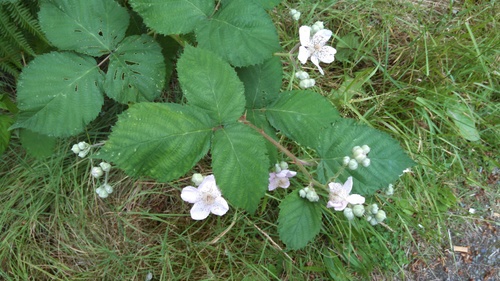
A low growing shrub. It grows 60 cm high and spreads 2.4-4.5 m wide. It can keeps its leaves all year round. The stems are bristly. The leaves are dark green and shiny. They have 3 lobes. They are like felt and white underneath. The flowers are white and saucer shaped. The occur singly or in groups of a few flowers. The fruit is red and edible.
Edible Uses
The bright red fruit, up to 17mm in diameter, can be eaten raw or cooked. The best forms produce good-sized fruits with a pleasant flavour, though some reports describe them as bland.
Medicinal Uses
None known
Distribution
It is a temperate plant. It grows on forest slopes between 1,800-3,600 m above sea level. It suits hardiness zones 7-10. In Sichuan and Yunnan.
Where It Grows
Asia, Australia, China, USA,
Cultivation
Easily grown in a good well-drained loamy soil in sun or semi-shade. Plants grow best in part or full shade and also succeed in dry shade. Established plants are fairly drought tolerant. Hardy to about -15°c. Plants are evergreen but may be deciduous in severe winters. A fast growing plant, the stems can grow by up to 2 metres per year. Plants in this genus are notably susceptible to honey fungus. A clumping mat former. Forming a dense prostrate carpet spreading indefinitely.
Propagation
Seed requires stratification and is best sown in early autumn in a cold frame. Stored seed should be sown as early as possible in the year; if sowing later than February, stratify for one month at 3°c. Prick out seedlings when large enough to handle and grow on in a cold frame, then plant out into permanent positions in late spring of the following year. Tip layer in July and plant out in autumn. Division can be done in early spring.
Other Uses
A purple to dull blue dye can be obtained from the fruit. This plant also makes a vigorous ground cover for sun or shade, rooting at intervals along the stem. It establishes strongly but requires weeding during the first year or so. It should only be grown alongside trees and other tall plants, as it will swamp lower-growing species.
Production
In China it flowers between June to July and fruits in August to September.
Notes
There are about 250 Rubus species.
Dangerous Lookalikes
This plant can be confused with the following toxic species. Always verify identification carefully before consuming any wild plant.
Red Baneberry
Actaea rubra
Walter Siegmund (talk)
Creeping bramble
Rubus tricolor
(c) hattheant, some rights reserved (CC BY-NC)
Red Baneberry: Short herbaceous plant (no thorns), berries on thick red stems, each berry has a single seed, compound sharply-toothed leaves.
Creeping bramble: Thorny woody canes (brambles), aggregate berry made of many drupelets, berries pull easily from receptacle.
Synonyms
References (5)
- Biblioth. Bot. 72:40. 1910 (Sp. rub. 40.)
- Cundall, P., (ed.), 2004, Gardening Australia: flora: the gardener's bible. ABC Books. p 1285
- Flora of China @ efloras.org Volume 9
- Jackes, D. A., 2007, Edible Forest Gardens
- Plants for a Future database, The Field, Penpol, Lostwithiel, Cornwall, PL22 0NG, UK. http://www.scs.leeds.ac.uk/pfaf/