Rubus saxatilis
L.
Stone bramble, Greenland Thornless Blackberry, Roebuck berry, Stone berry, Urgesutu gandagari
iNaturalist· cc-by-nc
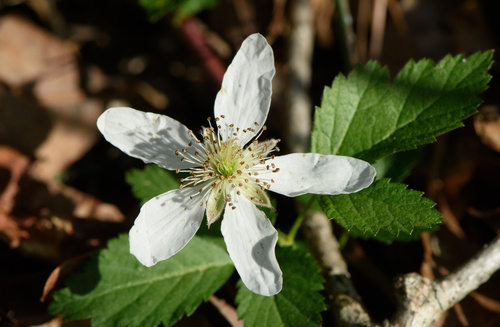
(c) Gian-Andrea Catrina, some rights reserved (CC BY-NC), uploaded by Gian-Andrea Catrina
iNaturalist· cc-by
(c) Natalya Ivanova, some rights reserved (CC BY)
Summary
Source: WikipediaRubus saxatilis, the stone bramble or roebuck berry, is a species of bramble widespread across much of Eurasia.
Description
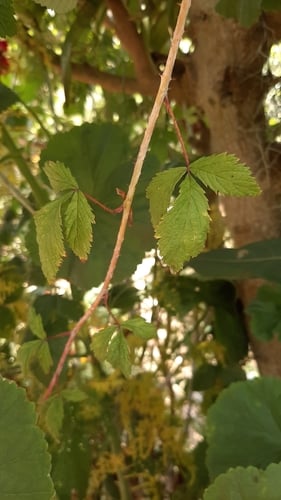
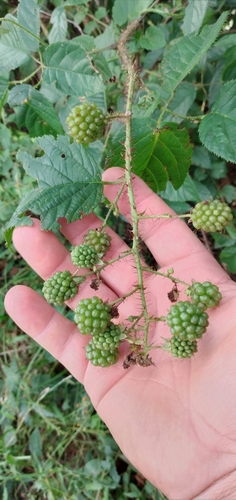
A herb. It keeps growing from year to year. It grows 10-15 cm high. The canes can be 40-100 cm long and the fruiting canes extend upwards. The stems have hairs and thorns. The leaves are compound with 3 leaflets. The leaf stalks are long. There are thin thorns under the leaf. There are 3-10 white flowers in groups. The fruit are red berries. They are 5 mm across.
Edible Uses
The fruit can be eaten raw or cooked. It has an acid flavour but is agreeable to the palate.
Traditional Uses
The fruit are eaten with sugar. They are used to make a hot drink. They are also fermented. They are also used for jam and juice. The leaves are used for a tea drink.
Medicinal Uses
A decoction of the root is useful in treating relaxed bowels and dysentery, and also in treating the spasmodic stage of whooping cough. The leaves are astringent and a decoction of them is used to treat dysentery and certain types of bleeding.
Distribution
It grows in Arctic and temperate places. In Kazakhstan it grows on stony mountain slopes. In northern China it grows below 3,000 m above sea level.
Where It Grows
Arctic, Armenia, Asia, Balkans, Belarus, Britain, Caucasus, Central Asia, China, Croatia, Estonia, Europe, Finland, Georgia, Greece, Greenland, India, Ireland, Italy, Kazakhstan, Luxembourg, Mediterranean, Mongolia, Northeastern India, Norway, Poland, Russia, Scandinavia, Slovenia, Sweden, Turkey, Türkiye,
Cultivation
Easily grown in a good well-drained loamy soil in sun or semi-shade. A calcicole plant, requiring an alkaline soil if it is to thrive. Plants in this genus are notably susceptible to honey fungus.
Propagation
Seed requires stratification and is best sown in early autumn in a cold frame. Stored seed requires one month stratification at about 3°c and should be sown as early in the year as possible. Prick out seedlings when large enough to handle and grow on in a cold frame, then plant into permanent positions in late spring of the following year. Cuttings of half-ripe wood can be taken in July/August in a frame. Tip layer in July and plant out in autumn. Division can be done in early spring or just before leaf-fall in autumn.
Other Uses
A purple to dull blue dye is obtained from the fruit.
Notes
There are about 250 Rubus species.
Dangerous Lookalikes
This plant can be confused with the following toxic species. Always verify identification carefully before consuming any wild plant.
Red Baneberry
Actaea rubra
Walter Siegmund (talk)
Stone bramble
Rubus saxatilis
(c) Gian-Andrea Catrina, some rights reserved (CC BY-NC), uploaded by Gian-Andrea Catrina
Red Baneberry: Short herbaceous plant (no thorns), berries on thick red stems, each berry has a single seed, compound sharply-toothed leaves.
Stone bramble: Thorny woody canes (brambles), aggregate berry made of many drupelets, berries pull easily from receptacle.
Also Known As
Juomoi, Kamianika, Khakhama, Koslek, Kostianika, Kostyanika, Lillakas, Skalna robida, Teie-baer
References (26)
- Aipeisova S.A., et al, 2019, Wild useful herbs of Aktobe Region (Western Kazakhstan). Ukrainian Journal of Ecology, 9(3), 329-331
- Ambasta S.P. (Ed.), 2000, The Useful Plants of India. CSIR India. p 534
- Bussman, R. W., et al, 2016, A comparative ethnobotany of Khevsureti, Samtskhe-Javakheti, Tusheti, Svaneti, and Racha-Lechkhumi, Republic of Georgia (Sakartvelo), Caucasus. Journal of Ethnobiology and Ethnomedicine.
- Bussman, R. W., et al, 2021, Unity in diversity—food plants and fungi of Sakartvelo (Republic of Georgia), Caucasus. Journal of Ethnobiology and Ethnomedicine (2021) 17:72 p 14
- Dogan, Y., et al, 2004, The Use of Wild Edible Plants in Western and Central Anatolia (Turkey). Economic Botany 58(4) pp. 684-690
Show all 26 references Hide references
- Dzhangaliev, A. D., et al, 2003, The Wild Fruit and Nut Plants of Kazakhstan, Horticultural Reviews, Vol. 29. pp 305-371
- Ertug, F, Yenen Bitkiler. Resimli Türkiye Florası -I- Flora of Turkey - Ethnobotany supplement
- Facciola, S., 1998, Cornucopia 2: a Source Book of Edible Plants. Kampong Publications, p 210
- Flora of China @ efloras.org Volume 9
- Girard, N. J., 2020, Sustainable Foraging of Wild Edible Plants in Norway. A Biocultural Approach. M. Sc. thesis Norwegian University. p 134
- http://www.botanic-gardens-ljubljana.com/en/plants
- Johansson, A., Laakso, P. and Kallio, H., 1997, Characterization of seed oils of wild, edible Finnish berries. Food Chemistry 204:300-307
- Kalle, R. & Soukand, R., 2012, Historical ethnobotanical review of wild edible plants of Estonia (1770s-1960s) Acta Societatis Botanicorum Poloniae 81(4):271-281
- Khasbagan, Hu-Yin Huai, and Sheng-Ji pei, 2000, Wild Plants in the Diet of Athorchin Mongol Herdsmen in Inner Mongolia. Economic Botany 54(4): 528-536
- Kermath, B. M., et al, 2014, Food Plants in the Americas: A survey of the domesticated, cultivated and wild plants used for Human food in North, Central and South America and the Caribbean. On line draft. p 765
- Kolosova, V., et al, 2020, Foraging in Boreal Forest: Wild Food Plants of the Republic of Karelia, NW Russia. Foods 2020, 9, 1015; p 20
- Łukasz Łuczaj and Wojciech M Szymański, 2007, Wild vascular plants gathered for consumption in the Polish countryside: a review. J Ethnobiol Ethnomedicine. 3: 17
- Luczaj, L. et al, 2013, Wild edible plants of Belarus: from Rostakinski's questionnaire of 1883 to the present. Journal of Ethnobiology and Ethnomedicine 9:21
- Plants for a Future database, The Field, Penpol, Lostwithiel, Cornwall, PL22 0NG, UK. http://www.scs.leeds.ac.uk/pfaf/
- Postman, J. D., et al, 2012, Recent NPGS Coordinated Expeditions in the Trans-Caucasus Region to Collect Wild Relatives of Temperate Fruit and Nut Crops. In Acta Horticulturae Number 948 p 191-198
- Purgar, D. D., et al, 2008, Wild Edible Species of Rubus at Nature Park Mednedvica (NW Croatia). Bulletin UASVM, Agriculture 65(1)/2008
- Sfikas, G., 1984, Trees and shrubs of Greece. Efstathiadis Group. Athens. p
- Singh, V. B., et al, (Ed.) Horticulture for Sustainable Income and Environmental Protection. Vol. 1 p 219
- Soukand, R., et al, 2017, Multi-functionality of the few: current and past uses of wild plants for food and healing in Liubań region, Belarus. Journal of Ethnobiology and Ethnomedicine (2017) 13:10
- Sp. pl. 1:494. 1753
- Svanberg, I., 2012, The use of wild plants as food in pre-industrial Sweden. Acta Societatis Botanicorum Poloniae 81(4): 317-327