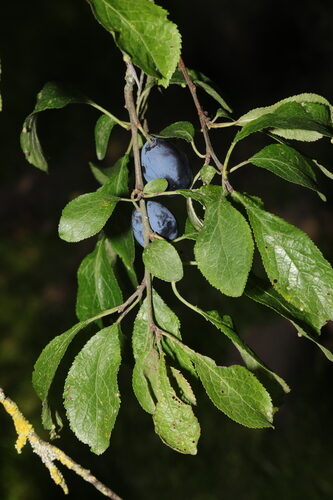
Rubus pinnatus
Willd.
South African raspberry
iNaturalist· cc-by-nc
(c) Felix Riegel, some rights reserved (CC BY-NC), uploaded by Felix Riegel
iNaturalist· cc-by-sa
(c) Tony Rebelo, some rights reserved (CC BY-SA), uploaded by Tony Rebelo
iNaturalist· cc-by-sa
(c) Tony Rebelo, some rights reserved (CC BY-SA), uploaded by Tony Rebelo
Description
A small bush or scrambler. It can grow 3.5 m high. The flowering branches have prickles. The leaves are 10-19 cm long by 8-12 cm wide. They are divided into leaflets. The flower petals are small but pink. The fruit are red.
Edible Uses
The ripe fruit are eaten raw or used for jams.
Traditional Uses
The ripe fruit are eaten raw. They are also used for jams.
This uses section is brief — help expand it
Distribution
A tropical plant. It grows in forests near streams. It grows between 1,100-2,230 m altitude. In Kenya it grows between 1,500-2,750 m altitude.
Where It Grows
Africa, Angola, Burundi, Cameroon, Central Africa, Congo DR, East Africa, Eswatini, Ethiopia, Guinea, Guinée, Kenya, Liberia, Malawi, Mozambique, Nigeria, South Africa, Southern Africa, St Helena, Swaziland, Uganda, West Africa, Zambia, Zimbabwe,
Cultivation
It can be used as a hedge plant.
Notes
There are about 250 Rubus species.
Dangerous Lookalikes
This plant can be confused with the following toxic species. Always verify identification carefully before consuming any wild plant.
Red Baneberry
Actaea rubra
Walter Siegmund (talk)
South African raspberry
Rubus pinnatus
(c) Felix Riegel, some rights reserved (CC BY-NC), uploaded by Felix Riegel
Red Baneberry: Short herbaceous plant (no thorns), berries on thick red stems, each berry has a single seed, compound sharply-toothed leaves.
South African raspberry: Thorny woody canes (brambles), aggregate berry made of many drupelets, berries pull easily from receptacle.
Synonyms
Also Known As
Amakerre, Amaqunube, Braambos, Cape bramble, Enkenene, Gumence, Gumgumence, Hagena, Ijikijolo, Iqunube, Kapete, Ligungumence, Mtoje, Mucato, Munambala, N'cato, Yekola-enjori
References (27)
- Asfaw, Z. and Tadesse, M., 2001, Prospects for Sustainable Use and Development of Wild Food Plants in Ethiopia. Economic Botany, Vol. 55, No. 1, pp. 47-62
- Chapman, J. D. & Chapman, H. M., 2001, The Forest Flora of taraba and Andamawa States, Nigeria. WWF & University of Canterbury. p 196
- Dalziel, J. M., 1937, The Useful plants of west tropical Africa. Crown Agents for the Colonies London.
- Flora Zambesiaca. http://apps.kew.org/efloras
- Fox, F. W. & Young, M. E. N., 1982, Food from the Veld. Delta Books. p 316
Show all 27 references Hide references
- Godfrey, J. et al, 2013, Harvesting, preparationand preservation of commonly consumed wild and semi-wild food plants in Bunyoro-Kitara Kingdom, Uganda. Int. J. Med. Arom. Plants. Vol.3 No.2 pp 262-282
- Jardin, C., 1970, List of Foods Used In Africa, FAO Nutrition Information Document Series No 2.p 159
- JSTOR Global Plants edible
- Kakeya, 1976,
- Long, C., 2005, Swaziland's Flora - siSwati names and Uses http://www.sntc.org.sz/flora/
- Luizza, M. W., et al., 2013, Local Knowledge of Plants and their uses among Women in the Bale Mountains, Ethiopia. Ethnobotany Research & Applications 11:315-339
- Magwede, K., van Wyk, B.-E., & van Wyk, A. E., 2019, An inventory of Vhavenḓa useful plants. South African Journal of Botany 122 (2019) 57–89
- Malaisse, F., 1997, Se nourrir en floret claire africaine. Approche ecologique et nutritionnelle. CTA., p 67
- Maundu, P. et al, 1999, Traditional Food Plants of Kenya. National Museum of Kenya. 288p
- Mutie, F. M., et al, 2023, Important Medicinal and Food Taxa (Orders and Families) in Kenya, Based on Three Quantitative Approaches. Plants 2023, 12, 1145
- Nzigidahera, B., 2006, Assessment of Socio-cultural, Economic Characteristics and Livelihood of Riparian Population of the Kibira National Park. (Rukoma-Mutana locality). UNDP p 30
- Peters, C. R., O'Brien, E. M., and Drummond, R.B., 1992, Edible Wild plants of Sub-saharan Africa. Kew. p 167
- Ruiters-Welcome, A. K., 2019, Food plants of southern Africa. Ph.D. thesis. Univ. of Johannesburg p 95
- Shava, S., 2000, The Use of Indigenous Plants as Food by a Rural Community in the Eastern Cape: an Educational Exploration. Masters Thesis Rhodes University. p 66
- Sp. pl. 2(2):1081. 1799
- Swaziland's Flora Database http://www.sntc.org.sz/flora
- Tugume, P. & Nyakoojo, C., 2020, Traditional use of wild edible plants in the communities adjacent to Mabira Central Forest Reserve, Uganda. Ethnobotany Research & Applications 20:15 (2020)
- Vinnicombe, 1976,
- Vivien, J., & Faure, J.J., 1996, Fruitiers Sauvages d'Afrique. Especes du Cameroun. CTA p 277
- Welcome, A. K. & Van Wyk, B.-E., 2019, An inventory and analysis of the food plants of southern Africa. South African Journal of Botany 122 (2019) 136–179
- White, F., Dowsett-Lemaire, F. and Chapman, J. D., 2001, Evergreen Forest Flora of Malawi. Kew. p 456
- World Checklist of Useful Plant Species 2020. Royal Botanic Gardens, Kew