Aponogeton distachyos
L.f.
Cape asparagus, Cape-pondweed
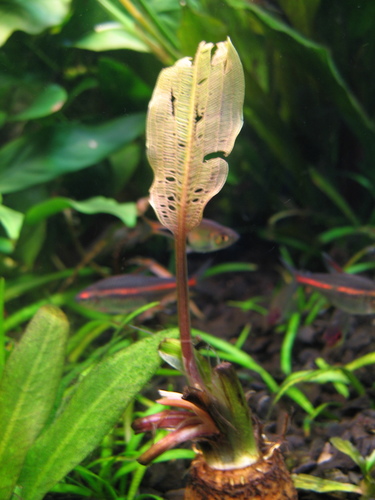
iNaturalist· cc-by-nc
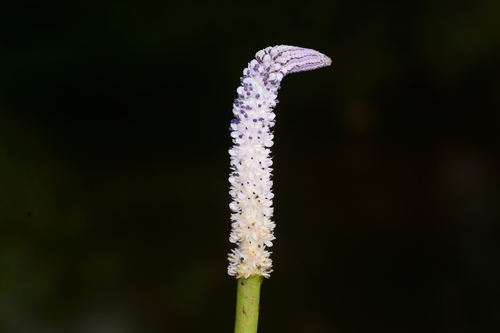
(c) Alice Shanks, some rights reserved (CC BY-NC), uploaded by Alice Shanks
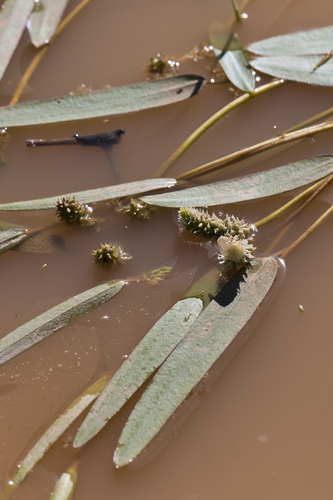
iNaturalist· cc-by-nc
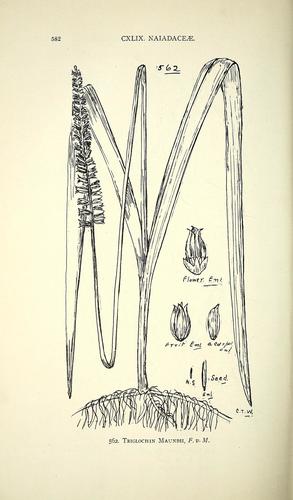
(c) Paul Masters, some rights reserved (CC BY-NC), uploaded by Paul Masters
iNaturalist· cc-by-nc
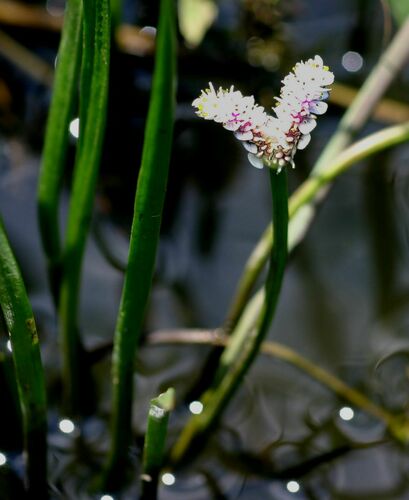
(c) Gerhard Diedericks, some rights reserved (CC BY-NC), uploaded by Gerhard Diedericks
Summary
Source: WikipediaAponogeton distachyos or Aponogeton distachyum, also known as waterblommetjie (lit. trans. water-floret), Cape-pondweed, water hawthorn, vleikos and Cape pond weed is an aquatic flowering plant.
Description
A herb which grows in water and keeps growing from year to year. It has starchy storage roots or corms. It grows 60-80 cm high and spreads 80-100 cm wide. The leaves at the base arise from these tubers. The leaf stalks can be 1 m long. The leaves are narrowly oval and floating. They are 15 cm long by 5 cm wide. The flowering stalk grows above the water. It is divided and white. Each fork is 10 cm long with 6-12 oval and white bract like bodies with small flowers near their base.
Edible Uses
Edible Parts: Flowers Root Shoots Stem Edible Uses: Tuber - roasted. Starchy. Considered to be a great delicacy. Flowering spike - pickled or used as a spinach or asparagus substitute. The young shoots are used as an asparagus substitute. The flowers are used as a flavouring.
Traditional Uses
The flowers are used as a vegetable. They can be used for pickles. The young fruit can be used as a vegetable. The roasted corms/rhizomes are eaten. The leaves are cooked and eaten.
Medicinal Uses
None known
Distribution
It suits Mediterranean climates. It is native to South Africa. It grows in still or flowing water up to about 50 cm deep. It can grow in water 2 m deep. It grows in cooler places. It suits hardiness zones 9-11. Tasmania Herbarium.
Where It Grows
Africa, Argentina, Australia, Britain, Europe, France, New Zealand, Peru, South Africa, Southern Africa, South America, Tasmania, Zambia,
Cultivation
A water plant, growing in water 15 - 60cm deep. it can also grow in wet soil but is then very restricted. It requires a rich soil. The tubers are not winter hardy. Another report says that the plants are hardy in the milder areas of Britain. They have withstood a fairly severe winter in Cornwall, when the ponds had thick ice 30cm or more deep, with very little damage. A very ornamental plant, the flowers have a hawthorn-like scent.
Propagation
Seed - best sown in a pot as soon as it is ripe and kept emmersed in 3cm of water. The seed can also be stored in water and sown in spring. It usually germinates in 1 - 2 months at 20°c. When large enough to handle, prick the seedlings out into individual pots and grow them on in just covered in water in a greenhouse for their first winter. Plant them out in late spring or early summer, after the last expected frosts. Division can be carried out at any time in the growing season, though mid to late spring is probably best. The divisions can be planted straight out into their permanent positions.
Other Uses
None known Special Uses Scented Plants
Other Information
It is a commercially cultivated vegetable. It is grown commercially in South Africa and also canned.
Notes
There are about 12-44 Aponogeton species. They are tropical and subtropical.
Synonyms
Also Known As
Cape pondlily, Waterblommetjie, Water-hawthorn, Water onion
References (38)
- Bircher, A. G. & Bircher, W. H., 2000, Encyclopedia of Fruit Trees and Edible Flowering Plants in Egypt and the Subtropics. AUC Press. p 36
- Bodkin, F., 1991, Encyclopedia Botanica. Cornstalk publishing, p 92
- Brickell, C. (Ed.), 1999, The Royal Horticultural Society A-Z Encyclopedia of Garden Plants. Convent Garden Books. p 126
- Brouk, B., 1975, Plants Consumed by Man. Academic Press, London. p 71
- Cundall, P., (ed.), 2004, Gardening Australia: flora: the gardener's bible. ABC Books. p 165
Show all 38 references Hide references
- Dashorst, G.R.M., and Jessop, J.P., 1998, Plants of the Adelaide Plains & Hills. Botanic Gardens of Adelaide and State Herbarium. p 170
- De Vynk, J. C., et al, 2016, Indigenous edible plant use by contemporary Khoe-San descendants of South Africa's Cape South Coast. South African Journal of Botany. 102 (2016) 60-69
- Facciola, S., 1998, Cornucopia 2: a Source Book of Edible Plants. Kampong Publications, p 23
- Fox, F. W. & Young, M. E. N., 1982, Food from the Veld. Delta Books. p 93
- Hedrick, U.P., 1919, (Ed.), Sturtevant's edible plants of the world. p 64
- Heywood, V.H., Brummitt, R.K., Culham, A., and Seberg, O., 2007, Flowering Plant Families of the World. Royal Botanical Gardens, Kew. p 344
- Hibbert, M., 2002, The Aussie Plant Finder 2002, Florilegium. p 30
- https://growwild.co.za Edible Indigenous plants
- Irving, M., 2009, The Forager Handbook, A Guide to the Edible Plants of Britain. Ebury Press p 319
- Jardin, C., 1970, List of Foods Used In Africa, FAO Nutrition Information Document Series No 2.p 56
- Joffe, P., 2007, Creative Gardening with Indigenous Plants. A South African Guide. Briza. p 316
- Kays, S. J., and Dias, J. C. S., 1995, Common Names of Commercially Cultivated Vegetables of the World in 15 languages. Economic Botany, Vol. 49, No. 2, pp. 115-152
- Lim, T. K., 2015, Edible Medicinal and Non Medicinal Plants. Volume 9, Modified Stems, Roots, Bulbs. Springer p 10
- Manning, J., 2007, Field Guide to Fynbos. Struik Nature p 48
- Morley, B. & Everard, B., 1970, Wild Flowers of the World. Ebury press. Plate 84
- Pemberton, R.W., 2000, Waterblommetjie (Aponogeton distachys, Aponogetonaceae), a recently domesticated aquatic Food Crop in Cape South Africa with Unusual Origins. Economic Botany 54(2) pp 144-149
- Petersen, L. M., et al, 2012, Development of a Compendium of Local, Wild-Harvested Species Used in the Informal Economy Trade, Cape Town, South Africa. Ecology and Society 17(2):26
- Plants for a Future database, The Field, Penpol, Lostwithiel, Cornwall, PL22 0NG, UK. http://www.scs.leeds.ac.uk/pfaf/
- Plowes, N. J. & Taylor, F. W., 1997, The Processing of Indigenous Fruits and other Wildfoods of Southern Africa. in Smartt, L. & Haq. (Eds) Domestication, Production and Utilization of New Crops. ICUC p 185
- Romanowski, N., 2007, Edible Water Gardens. Hyland House. p 35
- Ruiters-Welcome, A. K., 2019, Food plants of southern Africa. Ph.D. thesis. Univ. of Johannesburg p 28
- Sainty, G.R. & Jacobs, S.W.L., 1981, Waterplants of New South Wales. Water Resources Commission. NSW p 63
- Sainty, G., and Jacobs, S., 2003, Waterplants in Australia. A Field Guide. Sainty Books. p 20
- Slocum, P.D. & Robinson, P., 1999, Water Gardening. Water Lilies and Lotuses. Timber Press. p 73
- Suppl. pl. 215. 1782 ("1781") "distachyon"
- Tasmanian Herbarium Vascular Plants list p 59
- USDA, ARS, National Genetic Resources Program. Germplasm Resources Information Network - (GRIN). [Online Database] National Germplasm Resources Laboratory, Beltsville, Maryland. Available: www.ars-grin.gov/cgi-bin/npgs/html/econ.pl (10 April 2000)
- van Wyk, B., 2005, Food Plants of the World. An illustrated guide. Timber press. p 65
- van Wyk, Be., & Gericke, N., 2007, People's plants. A Guide to Useful Plants of Southern Africa. Briza. p 66
- van Wyk, B., 2000, A Photographic Guide to Wild Flowers of South Africa. Struik Nature. p 8
- van Wyk, B-E., 2011, The potential of South African plants in the development of new food and beverage products. South African Journal of Botany 77 (2011) 857–868
- Wiersema, J. H. & Leon, B., 2013, World Economic Plants. A Standard Reference CRC Press. 2nd Ed. p 60
- World Checklist of Useful Plant Species 2020. Royal Botanic Gardens, Kew