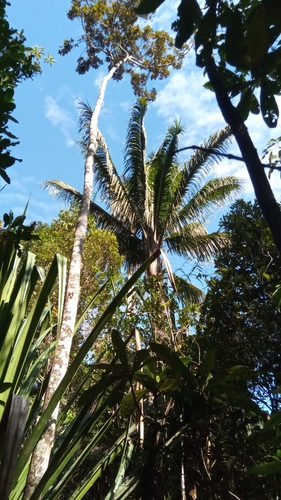
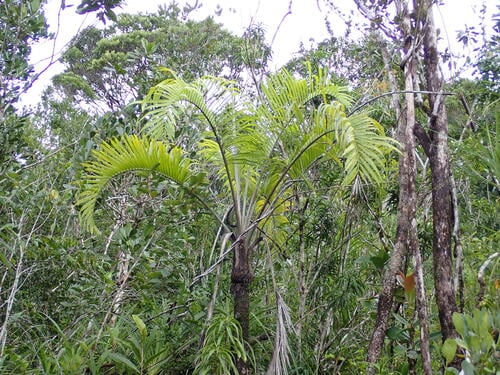
Roystonea regia
(Kunth) O. F. Cook
Cuban royal palm, Florida royal palm
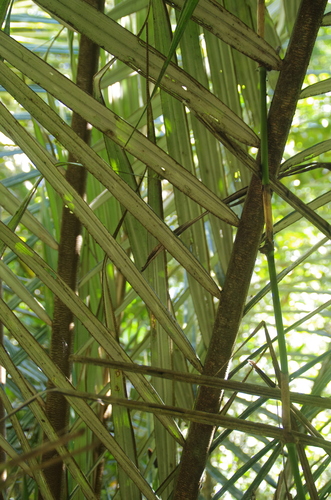
iNaturalist· cc-by-nc
(c) Bruce Holst, some rights reserved (CC BY-NC), uploaded by Bruce Holst
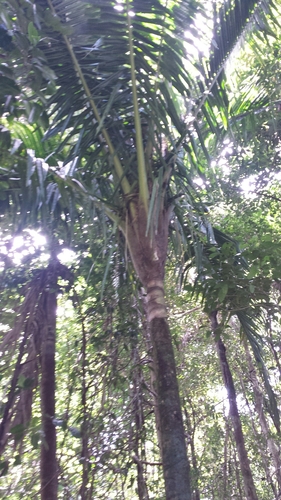
iNaturalist· cc-by-nc
(c) Bruce Holst, some rights reserved (CC BY-NC), uploaded by Bruce Holst
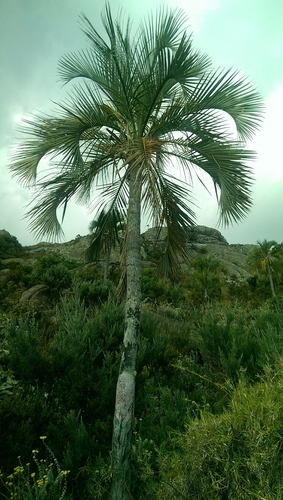
iNaturalist· cc-by-sa
(c) Douglas Goldman, some rights reserved (CC BY-SA), uploaded by Douglas Goldman
Summary
Source: WikipediaRoystonea regia, commonly known as the royal palm, Cuban royal palm, or Florida royal palm, is a species of palm native to Mexico, the Caribbean, Florida, and parts of Central America. A large and attractive palm, it has been planted throughout the tropics and subtropics as an ornamental tree. Although it is sometimes called R. elata, the conserved name R. regia is now the correct name for the species. The royal palm reaches heights from 15–24 m (50–80 ft) tall. Populations in Cuba and Florida were long seen as separate species, but are now considered a single species. Widely planted as an ornamental, R. regia is also used for thatch, construction timber, and in some forms of traditional medicine, although there is currently no valid scientific evidence to support the efficacy or use of any palm species for medicinal purposes. The fruit is eaten by birds and bats (which disperse the seeds) and fed to livestock. Its flowers are visited by birds and bats, and it serves as a roosting site and food source for a variety of animals. Roystonea regia is the national tree of Cuba, and has a religious role both in Santería and Christianity, where it is used in Palm Sunday observances.
Description
An single stemmed, evergreen palm. It grows to 30 m high and spreads 5-10 m wide. The stem is erect and smooth. It is white. It is stout and unbranched. The trunk is usually thickened near the base and in the middle before thinning towards the top. The trunk can be 0.5-0.6 m across. It has ring like markings. The leaves are divided along the stalk. The leaves are 6 m long and the leaflets are long and narrow. They are arranged in several ranks. The base sheaths the trunk below the crown. The flowers are small and white and cup-shaped. They are clustered in spikes which hang downwards. These stalks can be 1 m long. These come from just below the crown shaft. The flowers occur in 3-4 clusters with 2 boat shaped spathes. The male cluster is longer than the female. The fruit are round berries which are deep purple in colour.
Edible Uses
The central bud or cabbage is eaten as a vegetable. The ripe fruit are edible and fall naturally when ready.
Traditional Uses
The central bud or cabbage is eaten. The fruit fall when ripe and are edible.
This uses section is brief — help expand it
Medicinal Uses
Roystonea regia has been planted throughout the tropics and subtropics as an ornamental. The seed is used as a source of oil and for livestock feed. Leaves are used for thatching and the wood for construction. The roots are used as a diuretic, and for that reason they are added to tifey, a Haitian drink, by Cubans of Haitian origin. They are also used as a treatment for diabetes. Fibres extracted from the leaf sheath of R. regia have been found to be comparable with sisal and banana fibres, but lower in density, making it a potentially useful source for the use in lightweight composite materials. An extract from R. regia fruit known as D-004 reduces benign prostate hyperplasia (BPH) in rodents. D-004, is a mixture of fatty acids, is being studied as a potential alternative to finasteride for the treatment of BPH.
Distribution
It suits tropical and subtropical conditions. It does best with warmth and humidity. It does best with rich, moist soil. The soil needs to be well drained. It needs a protected, sunny position. It is damaged by drought and frost. They need temperatures above 15°C. In Cuba it grows on fertile soils up to 1000 m altitude. It suits plant hardiness zones 10-12. In XTBG Yunnan.
Where It Grows
Africa, Asia, Australia, America, Bahamas, Belize, Bermuda, Caribbean*, Central America, China, Colombia, Costa Rica, Cuba*, East Africa, Fiji, Ghana, Guatemala, Haiti*, Hawaii, Honduras, India, Indonesia, Marquesas, Mexico, Myanmar, North America, Pacific, Pakistan, Panama, Papua New Guinea, PNG, SE Asia, South America, Suriname, USA, West Africa, West Indies*, Zimbabwe,
Cultivation
Plants are grown from seed. Seed should be sown at 27°C.
Propagation
Seed - best sown when ripe, it takes about 2 months to germinate.
Other Uses
An oil is obtained from the seed. The leaves are used for thatching. The stems (the leaf stems are probably meant here) are used to make furniture. The trunks are cut into planks and used in construction and to make wharf piles and canoes.
Production
Plants respond to heavy fertiliser application especially nitrogen.
Notes
There are 10 Roystonea species. The fruit are fed to pigs.
Synonyms
Also Known As
Bottle palm, Chaguaramo, Koningspalm, Palem raja florida, Palma criolla, Palma real, Palmier Royal, Yagua
References (40)
- Ambasta S.P. (Ed.), 2000, The Useful Plants of India. CSIR India. p 531
- Balick, M.J. and Beck, H.T., (Ed.), 1990, Useful palms of the World. A Synoptic Bibliography. Colombia p 121 (As Oreodoxa regia)
- Blomberry, A. & Rodd, T., 1982, Palms. An informative practical guide. Angus & Robertson. p 162
- Bodkin, F., 1991, Encyclopedia Botanica. Cornstalk publishing, p 892
- Bole, P.V., & Yaghani, Y., 1985, Field Guide to the Common Trees of India. OUP p 19
Show all 40 references Hide references
- Brickell, C. (Ed.), 1999, The Royal Horticultural Society A-Z Encyclopedia of Garden Plants. Convent Garden Books. p 915
- Bull. Torrey Bot. Club 28:531. 1901, nom. cons.
- Burkill, H. M., 1985, The useful plants of west tropical Africa, Vol. 3. Kew.
- Cundall, P., (ed.), 2004, Gardening Australia: flora: the gardener's bible. ABC Books. p 1283
- Dharani, N., 2002, Field Guide to common Trees & Shrubs of East Africa. Struik. p 295
- Facciola, S., 1998, Cornucopia 2: a Source Book of Edible Plants. Kampong Publications, p 31 (As Roystonea elata)
- Gibbons, M., 1993, Palms. Compact study Guide and Identifier. Sandstone. p 70
- Grandtner, M. M., 2008, World Dictionary of Trees. Wood and Forest Science Department. Laval University, Quebec, Qc Canada. (Internet database http://www.wdt.qc.ca)
- Grubben, G. J. H. and Denton, O. A. (eds), 2004, Plant Resources of Tropical Africa 2. Vegetables. PROTA, Wageningen, Netherlands. p 564
- Hearne, D.A., & Rance, S.J., 1975, Trees for Darwin and Northern Australia. AGPS, Canberra p Pl 31
- Henderson, A., Galeano, G and Bernal, R., 1995, Field Guide to the Palms of the Americas. Princeton. p 135
- Heywood, V.H., Brummitt, R.K., Culham, A., and Seberg, O., 2007, Flowering Plant Families of the World. Royal Botanical Gardens, Kew. p 348
- Hibbert, M., 2002, The Aussie Plant Finder 2002, Florilegium. p 282
- Jones, D.L., 1994, Palms throughout the World. Smithtonian Institution, Washington. p 343
- Jones, D.L., 1994, Palms throughout the World. Smithtonian Institution, Washington. p 57, 342 (As Roystonea elata)
- Kermath, B. M., et al, 2014, Food Plants in the Americas: A survey of the domesticated, cultivated and wild plants used for Human food in North, Central and South America and the Caribbean. On line draft. p 757
- Krishen P., 2006, Trees of Delhi, A Field Guide. DK Books. p 310
- Llamas, K.A., 2003, Tropical Flowering Plants. Timber Press. p 117
- Lord, E.E., & Willis, J.H., 1999, Shrubs and Trees for Australian gardens. Lothian. p 99
- Marinelli, J. (Ed), 2004, Plant. DK. p 377
- Martin, F.W. & Ruberte, R.M., 1979, Edible Leaves of the Tropics. Antillian College Press, Mayaguez, Puerto Rico. p 210 (As Oreodoxa regia)
- Miguel, E., et al, 1989, A checklist of the cultivated plants of Cuba. Kulturpflanze 37. 1989, 211-357
- Morley, B. & Everard, B., 1970, Wild Flowers of the World. Ebury press. Plate 191
- Morton, 1977,
- Plants of Haiti Smithsonian Institute http://botany.si.edu
- Purseglove, J.W., 1972, Tropical Crops. Monocotyledons. Longmans p 433
- Riffle, R.L. & Craft, P., 2003, An Encyclopedia of Cultivated Palms. Timber Press. p 443
- Roa, J. A. G. & Boada, D. S. G., 2018, Fundación para el Fortalecimiento de la Fruticultura y Plantas Alimenticias no Convencionales en Colombia.
- Schuler, S., (Ed.), 1977, Simon & Schuster's Guide to Trees. Simon & Schuster. No. 64
- Smith, A.C., 1979, Flora Vitiensis Nova, Lawaii, Kuai, Hawaii, Volume 1 p 409
- Staples, G.W. and Herbst, D.R., 2005, A tropical Garden Flora. Bishop Museum Press, Honolulu, Hawaii. p 628
- Sukarya, D. G., (Ed.) 2013, 3,500 Plant Species of the Botanic Gardens of Indonesia. LIPI p 815
- Swaminathan, M.S., and Kochnar, S.L., 2007, An Atlas of major Flowering Trees in India. Macmillan. p 274
- World Checklist of Useful Plant Species 2020. Royal Botanic Gardens, Kew
- Zuchowski W., 2007, Tropical Plants of Costa Rica. A Zona Tropical Publication, Comstock Publishing. p 392