Ricinodendron heudelotii
(Baill.) Heckel
Manketti nut, Zambezi almond
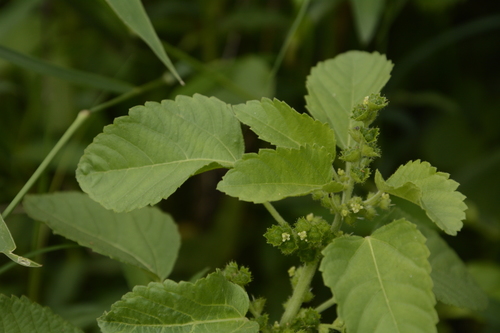
iNaturalist· cc-by-nc
(c) Robin Heymans, some rights reserved (CC BY-NC)
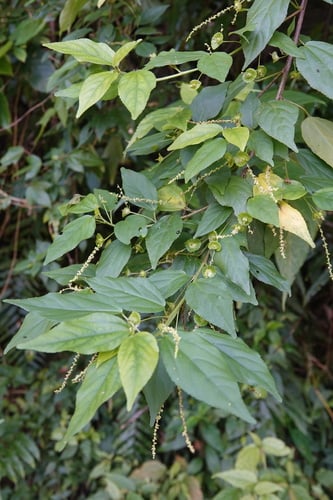
iNaturalist· cc-by-nc
(c) Carel Jongkind, some rights reserved (CC BY-NC), uploaded by Carel Jongkind
Summary
Source: WikipediaA fast-growing deciduous tree reaching 40 m tall by 25 m wide. Hardy to UK zone 10. Requires full sun and well-drained soil in mildly acid to neutral conditions, tolerating very acid soils. Prefers moist soil. Not self-fertile.
Description
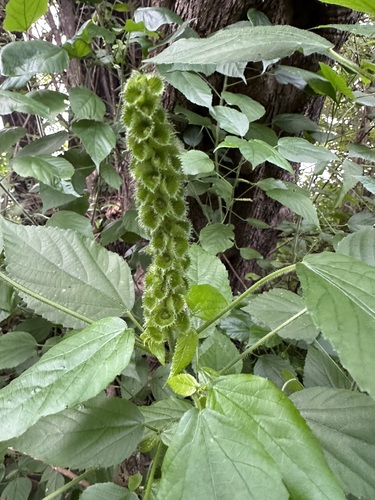
A tree. It grows 40 m high. The trunk is straight and 2.7 m across. The bark is grey and smooth. It loses its leaves during the dry season. The leaves are like fingers on a hand and alternate. There are 3-5 leaflets and these are 6-30 cm long by 3-15 cm wide. Male and female flowers are on separate trees. There are 5 petals and 5 sepals and they are united in a tube. The fruit are small and green. They are 4 cm across. They have 2 lobes. There are 1-2 nuts.
Edible Uses
The seeds are cooked and eaten, though they are not universally valued as food. Kernels may be boiled in water or in sauce, or combined with fish, meat, and other vegetables. They can also be roasted and ground into a paste for storage, then used later to make porridge during food shortages; in many areas they are regarded as a famine food. The black fruit is a 2–3-lobed drupe, 25–30mm long and 40–50mm wide, containing 2–3 globose seeds of around 15mm in diameter. Fallen fruits are collected from the ground, left to rot in piles, then washed and vigorously boiled to loosen the stones. The stones are removed, placed in cold water overnight, then boiled again vigorously until the shells crack and can be removed with a knife. The extracted seeds are then dried. The seeds contain roughly 47% by weight of a light yellow oil with a sweet taste. To obtain the oil, seeds are pounded, boiled in water, and allowed to cool; the floating oil is skimmed off, boiled again, filtered, and used for cooking. The oil's fatty acid composition is approximately: eleostearic 44%, oleic 16%, and around 10% each of palmitic, stearic, linoleic, and linolenic acids. Leaves are cooked and eaten as a protein-rich vegetable. The ash of the wood is used as a vegetable salt in cooking.
Traditional Uses
The dried kernels are ground and used in stews or eaten as a relish. They can be eaten raw or roasted. The nuts also yield an edible oil. The leaves are cooked as a vegetable. The kernels can be stored for many months.
Medicinal Uses
The stem bark is taken by enema to prevent abortion. A decoction of the stem bark is applied externally to wash and heal sores. A decoction of root bark is considered a powerful anti-dysenteric remedy. Root bark is ground to a powder, mixed with pepper and salt, and used to treat constipation. A bark decoction is used for blennorrhoea, cough, painful menstruation, and as an antidote to poison. A bark liquor is taken by pregnant women to relieve pain and prevent miscarriage, and also taken to eliminate intestinal parasites believed to cause infertility. Externally, the bark is used in lotions and baths to strengthen rachitic children and premature babies, and to relieve rheumatism and oedema. Pulped bark and leaves are applied to fungal infections, abscesses, furuncles, and buboes to promote maturation. The bark is beaten, warmed, and bound to the body to treat elephantiasis. Expressed sap is instilled into the eye to treat filaria and ophthalmia. The leaves are used for dysentery, female sterility, oedema, and stomach pain. A leaf decoction is taken orally and used in baths as a febrifuge. The roots are considered aphrodisiac in Ivory Coast. Laboratory examination of bark samples has found no active principles. Leaves and stems have been reported to contain an unidentified alkaloid. Traditional use of the seed, husk, and latex for gonorrhoea, diarrhoea, and amoebic dysentery may be related to the action of a resin found in the seed.
Distribution
A tropical plant. It is common in secondary forest. It grows between 200-500 m altitude. It requires 1,000 mm of rainfall but can grow in areas with 10,000 mm of rain per year. It needs light. It requires a temperature between 18-32°C. It needs free draining acid soils.
Where It Grows
Africa*, Angola, Asia, Benin, Cameroon, Central Africa, Central African Republic, CAR, Congo DR, Congo R, Côte d'Ivoire, East Africa, Equatorial Guinea, Gabon, Gambia, Ghana, Guinea, Guinée, Guinea-Bissau, Indonesia, Ivory Coast, Kenya, Liberia, Mozambique, Nigeria, SE Asia, Senegal, Sierra Leone, Southern Africa, Sudan, Tanzania, Togo, Uganda, West Africa, Zambia,
Cultivation
Plants are grown from seed. Seed germinate after 3-6 weeks. It can also be grown from leafy stem cutting, layering or side grafting. Trees can regenerate from the stump. (Seedlings are destroyed by a psyllid in Cameroon)
Propagation
The seed has a hard coat and benefits from scarification before sowing. Pour a small amount of near-boiling water over the seeds, taking care not to cook them, then soak in warm water for 12–24 hours. Seeds that have not swollen after soaking should be carefully nicked with a knife, avoiding the embryo, then soaked for a further 12 hours before sowing. Sow in a nursery seedbed in a reasonably open position. Germination of treated seed begins approximately 3–6 weeks after sowing. Fairly large cuttings root easily.
Other Uses
The roots penetrate deep into the soil and compete little with adjacent crops for nutrients and water in upper soil layers. The tree is a popular shade and shelter species in smallholder cocoa plantations, and there is a local belief that collar-crack disease will occur on a cacao farm if the tree is felled. When not grown in pure stands it is typically intercropped with coffee, cocoa, or bananas. The residual seed cake, while containing small amounts of toxic resin that make it unsuitable as animal feed, should serve well as a nitrogenous agricultural fertiliser. The tree is also used as a living fence and for erosion control, and its fast growth and tendency to colonise old farmland make it a valuable pioneer species. The ash of the wood provides potash used in soap-making and indigo dyeing, and as a source of vegetable salt. The seed oil, approximately 47% of seed weight and light yellow in colour, is used in varnish, soft-soap production, and waterproofing materials; however, as the shell makes up 37% of the seed's weight, total oil yield from whole seeds may be as low as 14%. The seed also contains small amounts of toxic resin. Seeds are used in rattles and as game counters. Leaves serve as wrapping material. The sawdust is extraordinarily light and suitable for use in life-saving belts, insulation materials, and sun helmets. The heartwood is dull white to pale yellow, darkening on exposure, with straight to interlocked grain, sometimes slightly wavy, and a coarse, even texture. The wood is very light, very soft, fibrous, brittle, and not durable, being susceptible to termites, powderpost beetles, and marine borers. It dries rapidly with little or no degrade and has low shrinkage, remaining moderately stable to stable once dry. It saws and works easily with ordinary tools, though there is a strong tendency to woolliness and tools must be kept very sharp; it nails and screws without splitting but holds poorly; gluing is satisfactory; turning and planing are difficult. Considered a good balsa wood substitute, it is buoyant and used for fishing-net floats and rafts. Its ease of working makes it popular for carved items such as fetish masks, spoons, ladles, plates, bowls, dippers, stools, and also rough planks and coffins. It is used to make drums noted for their resonance, and is carved into resonant parts of various musical instruments across Africa. The wood may be suitable for paper pulp. It burns rapidly and is a poor fuel.
Production
It is fast growing. Trees fruit after 8-10 years. Fruit are collected from the ground. They are put in a heap and the flesh allowed to rot to remove the stones. They are then washed and boiled and allowed to cool overnight in cold water before boiling again.
Other Information
It is reasonably commonly eaten in West Africa. It is cultivated. It is sold in local markets.
Notes
There is only one Ricindendron species. There are 2 subspecies. Caterpillars that are edible to humans feed on the new young leaves.
Nutrition
| Part | Moisture | kJ | kcal | Protein | Vit A | Vit C | Iron | Zinc |
|---|---|---|---|---|---|---|---|---|
| Seed dried | 5.5 | 2215 | 530 | 21.2 | — | — | 0.4 | — |
Synonyms
Also Known As
Agele, Akpi, Areki, Asongo, Bidjabarrana, Bobochi, Bofeko, Bohongo, Bukombola, Djansang, Eho, Erinmado, Essang nut, Essessang, Ezezang, Gobo, Itche, Kingela, Kishongo, Lesah, Lisongo, Lukombola, Mkungonolo, Mkungunolo, Mtondoro, Mtwatwa, Munguella, Musodo, N'tonte, Ndjansang, Ngoge, Ngoku, Ngongeh, Ngoza, Njansang, Nkangaula, Nyangsang, Okhuen, Okwe, Peke, Putu, Sanga sanga, Songo, Suli, Tandoa, Tonta, Ungozo, Wama, Wamma
References (47)
- Abbiw, D.K., 1990, Useful Plants of Ghana. West African uses of wild and cultivated plants. Intermediate Technology Publications and the Royal Botanic Gardens, Kew. p 49
- Alene, D. C., et al, 2006, Influence of shade on the sensitivity of seedlings of Ricinodendron heudelotii (Baill.) to attcks of Diclidophlebia xuani Messi et al. in the natural environment in Cameroon. Fruits, Vol. 61, p. 273-280
- Ambe, G., 2001, Les fruits sauvages comestibles des savanes guinéennes de Côte-d’Ivoire : état de la connaissance par une population locale, les Malinké. Biotechnol. Agron. Soc. Environ. 5(1), 43-48
- Billong Fils, P. E., et al, 2020, Ethnobotanical survey of wild edible plants used by Baka people in southeastern Cameroon. Journal or Ethnobiology and Ethnomedicine. 16:64 p 9
- Burkill, H. M., 1985, The useful plants of west tropical Africa, Vol. 2. Kew.
Show all 47 references Hide references
- Codjia, J. T. C., et al, 2003, Diversity and local valorisation of vegetal edible products in Benin. Cahiers Agricultures 12:1-12
- Dalziel, J. M., 1937, The Useful plants of west tropical Africa. Crown Agents for the Colonies London.
- Danforth, R.M., & Boren, P.D., 1997, Congo Native fruits. Twenty-five of the best. Privately published. p 67
- Davis, S.D., Heywood, V.H., & Hamilton, A.C. (eds), 1994, Centres of plant Diversity. WWF. Vol 1. p 172
- Dibong, S. D., et al, 2011, Inventory and Biodiversity of species edible wild fruits sold in the markets of Douala, Cameroon. International Journal of Applied Biology and Pharmaceutical Technology. 2(3).
- Diop, A. l., et al, 2021, Cultural importance of wild edible plants in three sympatric communities: Agni, Akyé and Gwa in the Department of Alépé (Southeast of Côte d’Ivoire). Ethnobotany Research and Applications 22:35. p 6
- Egbe, E. A., et al, 2012, Ethnobotany and Prioritization of Some Selected Tree Species in South-western Cameroon. Ethnobotany Research & Applications 10:235-246
- Engelter, C. & Wehmeyer, A. S., 1970, Fatty Acid Composition of Oils of Some Edible Seeds of Wild Plants. Journal of Agricultural and Food Chemistry. 18(1): 25-26
- Facciola, S., 1998, Cornucopia 2: a Source Book of Edible Plants. Kampong Publications, p 101
- Focho, D. A., et al, 2009, Ethnobotanical survey of Trees in Fundong, Northwest Region, Cameroon. Journal of Ethnobiology and Ethnomedicine, 5:17
- Fongnzossie Fedoung, E., et al, 2014, Density and Natural Regeneration Potential of Selected Non-timber Forest Products Species in the Semi-deciduous Rainforest of Southeastern Cameroon. African Study Monographs, Suppl. 49:69-90.
- Fongnzossie Fedoung, E., et al, 2020, Wild edible plants and mushrooms of the Bamenda Highlands in Cameroon: ethnobotanical assessment and potentials for enhancing food security. Journal of Ethnobiology and Ethnomedicine 16:12
- Gallois, S., et al, 2020, Methodological priorities in assessing wild edible plant knowledge and use – a case study among the Baka in Cameroon.
- Hart. T. B. and Hart, J. A., 1986, The Ecological Basis of Hunter-Gatherer Subsistence in African Rain Forests: The Mbuti of eastern Zaire. Human Ecology. Vol. 14, No. 1. pp 29-55
- Herzog, F., Gautier-Beguin, D. & Muller, K., Uncultivated plants for human nutrition in Cote d'Ivoire. FAO Corporate Document repository. International Conference on Domestication nd Commercialisaton of Non Timber species.
- Hoare A. L., 2007, The Use of Non-timber Forest Products in the Congo Basin. Constraints and Opportunities. Rainforest Foundation. p 11
- Hwang, L. C., et al, 2020, Traditional Botanical Uses of Non-Timber Forest Products (NTFP) in Seven Counties in Liberia. ACS Symposium Series; American Chemical Society: Washington, DC, 2020.
- Ingram, V. & Schure, J. 2010, Review of Non Timber Forest Products (NTFPs) in Central Africa, Cameroon. Center for International Forestry Research (CIFR). p 34
- Jardin, C., 1970, List of Foods Used In Africa, FAO Nutrition Information Document Series No 2.p 47
- Latham, P., 2004, Useful Plants of Bas-Congo province. Salvation Army & DFID p 237
- Leakey, R. R. B., 1999, Potential for novel food products from agroforestry trees: A review. Food Chemistry. 66:1-14
- Leakey, R. R. B., & Asaah, E. K., 2013, Underutilised Species as the Backbone of Multifunctional Agriculture – the Next Wave of Crop Domestication. Proc. 2nd Int. Symp. on Underutilized Plants Species “Crops for the Future – Beyond Food Security”. Acta Hort. 979, ISHS p 293
- Mosango, M., Szafranski, F., 1985, Plantes sauvages à fruits comestibles dans les environs de Kisangani (Zaïre). In: Journal d'agriculture traditionnelle et de botanique appliquée, 32e année, pp. 177-190
- Msuya, T. S., et al, 2010, Availability, Preference and Consumption of Indigenous Foods in the Eastern Arc Mountains, Tanzania, Ecology of Food and Nutrition, 49:3, 208-227
- Nkwatoh, A.F., Labode, P., Ebobenow, J., Nkwatoh, F.W., Ndumbe, N.L., and Ewane, M.E., 2011, Gathering Processing and Marketing of Ricinodendron species (Bail) in the humid forest zone of Cameroon. Agric. Sci. Res. Journal 1(9), pp. 213 – 220.
- Oteng-Amoako, A. A. (Ed.), 2006, 100 Tropical African Timber Trees from Ghana. Forestry Research Institute of Ghana. p 220
- Peters, C. R., O'Brien, E. M., and Drummond, R.B., 1992, Edible Wild plants of Sub-saharan Africa. Kew. p 112
- Sneyd, L. Q., 2013. Wild Food, Prices, Diets and Development: Sustainability and Food Security in Urban Cameroon. Sustainability 2013, 5, 4728-4759
- Sunderland, T. C. H., et al, 2002, Distribution, Utilisation and Sustainability of the Non-timber forest products of the Takamanda Forest Reserve, Cameroon. PROFA
- Tanno, T., 1981, Plant Utilization of the Mbuti Pygmies: With Special reference to their Material Culture and Use of Wild Vegetable Foods. Kyoto University Research. African Study Monographs 1:1-53
- Tchoundjeu, Z., and Atangana, A.R. (2006). Ricinodendron heudelotii (Baill.) Southampton Cen‐ tre for Underutilized Crops, University of Southampton: Southampton, UK; 74p.
- Tchoundjeu, Z. & Atangana, A.R., 2007. Ricinodendron heudelotii (Baill.) Pierre ex Heckel. [Internet] Record from Protabase. van der Vossen, H.A.M. & Mkamilo, G.S. (Editors). PROTA (Plant Resources of Tropical Africa), Wageningen, Netherlands. < http://database.prota.org/search.htm>. Accessed 22 October 2009
- Terashima, H., et al, 1992, Ethnobotany of the Lega in the Tropical Rainforest of Eastern Zaire (Congo): Part Two, Zone de Walikale, African Study Monographs, Suppl. 19:1-60
- Terashima, H., & Ichikawa, M., 2003, A comparative ethnobotany of the Mbuti and Efe hunter-gatherers in the Ituri Forest, Democratic Republic of Congo. African Study Monographs, 24 (1, 2): 1-168, March 2003
- Termote, C., et al, 2011, Eating from the wild: Turumbu, Mbole and Bali traditional knowledge of non-cultivated edible plants, District Tshopo, DRCongo, Gen Resourc Crop Evol. 58:585-618
- Ubom, R. M., 2010, Ethnobotany and Diversity Conservatioon in the Niger Delta, Nigeria. International Journal of Botany. 6(3): 310-322
- Vivien, J. & Faure, J.J., 1985, Abres des forets dense d'Afrique Centrale. Agence de Cooperation Culturelle et Technique. Paris. p 202
- Vivien, J., & Faure, J.J., 1996, Fruitiers Sauvages d'Afrique. Especes du Cameroun. CTA p 153
- Wickens, G.E., 1995, Edible Nuts. FAO Non-wood forest products. FAO, Rome. p 122
- World Checklist of Useful Plant Species 2020. Royal Botanic Gardens, Kew
- www.worldagroforestrycentre.org/treedb/
- Zeven, A. C. & de West, J. M. J., 1982, Dictionary of cultivated plants and their regions of diversity. Wageningen. p 126