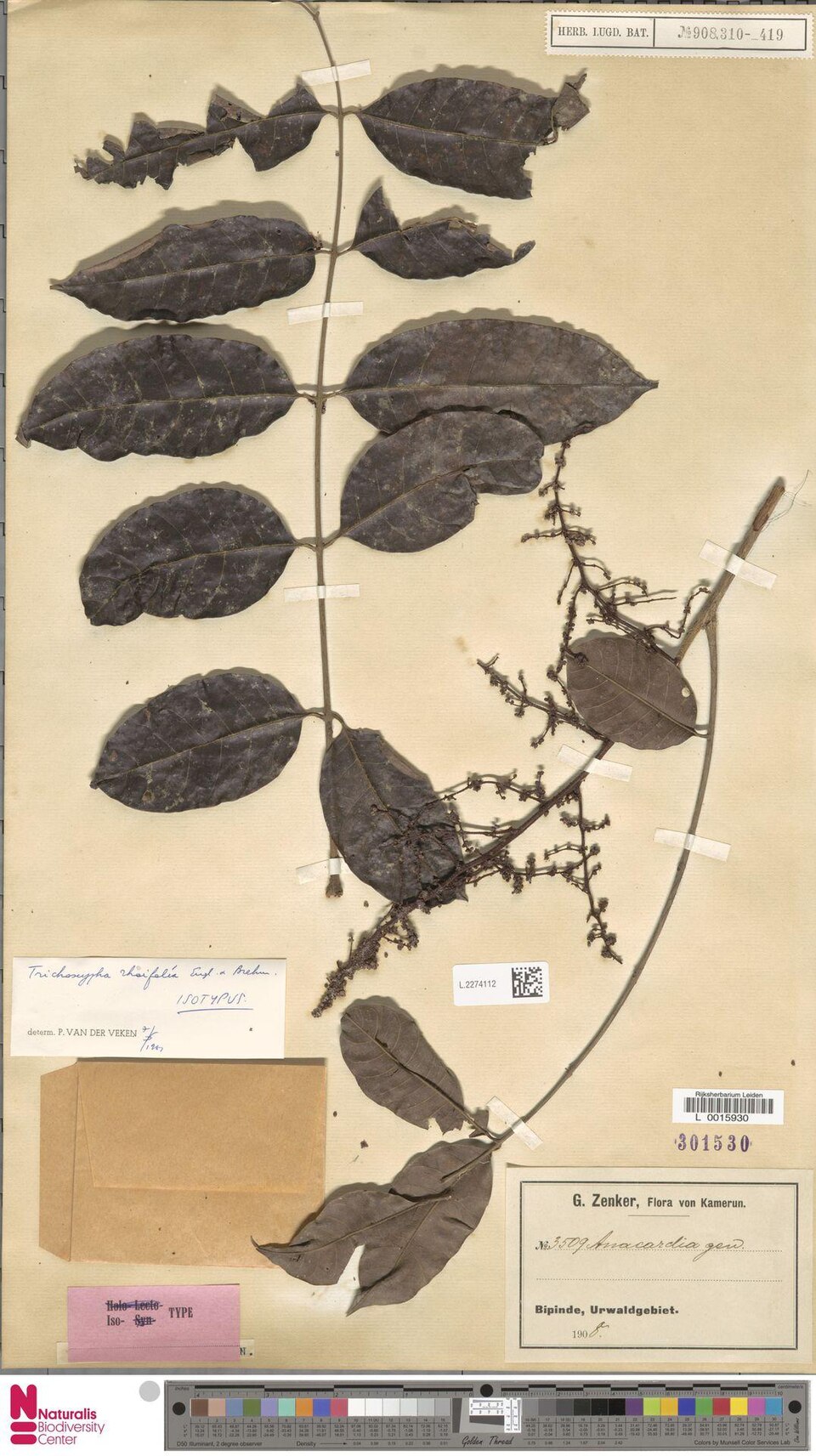
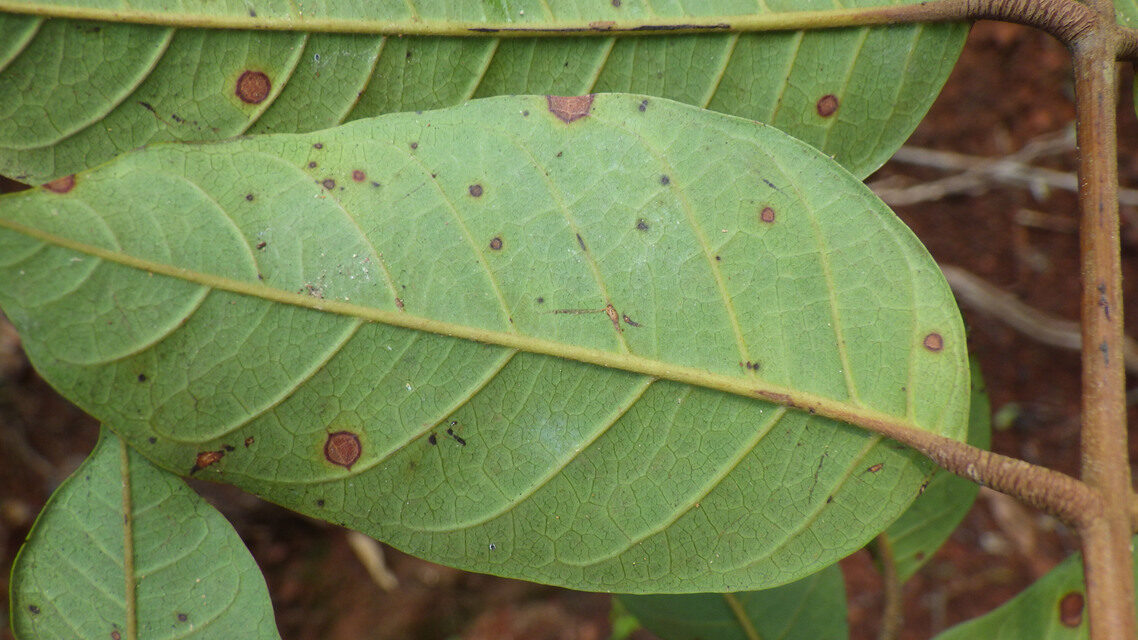
Searsia longipes
(Engl.) Moffett
Large-leaved rhus
iNaturalist· cc-by-nc
(c) Bart Wursten, some rights reserved (CC BY-NC), uploaded by Bart Wursten
iNaturalist· cc-by-nc
(c) Bart Wursten, some rights reserved (CC BY-NC)
Summary
Source: WikipediaSearsia longipes is a medium-sized, semi-deciduous, trifoliate tree of up to 10 m tall. It occurs in Africa from Burkina Faso to South Africa, as well as the islands of the Indian Ocean. In Zimbabwe it is found at altitudes between 1000 and 1680 m - in other places this species can also be found at sea level. Hostplant: The gracillaridae lepidoptera Caloptilia xanthochiria Vári, 1961 feed on this plant.
Description
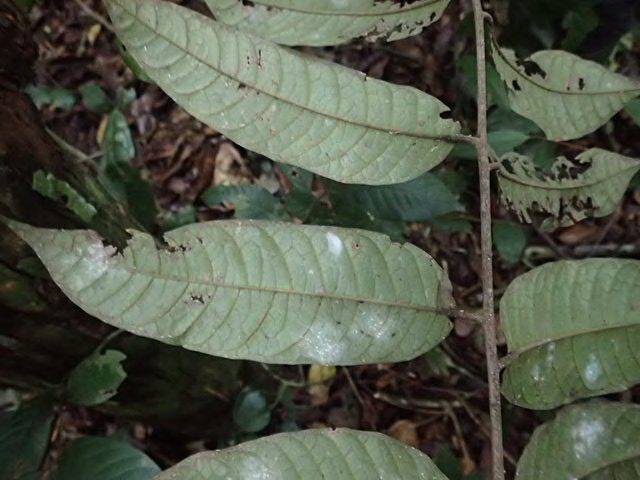
Usually it is a straggling shrub. It can be a small tree. It can grow to 5 m tall. The bark is grey and becomes rough. The leaves have 3 leaflets. The leaflets are oval and the end one is 4-13 cm long by 1.5-8 cm wide. The side leaflets are three quarters this size. The flowers are small and yellow. They grow in loose heads up to 8 cm long. These can be in the axils of leaves or at the ends of branches. The fruit is 6-7 mm across. They are reddish-brown when mature.
Edible Uses
Fruit - raw. The reddish, globose drupe is 3 - 7mm in diameter. Although small, it is carried in clusters on the plant so can be harvested fairly easily.
Medicinal Uses
A decoction of the root is drunk as a treatment for malaria. A decoction of the root, combined with the leaf sap is used as a laxative and abortifacient.
Distribution
A tropical plant. It grows in the lowlands and the highlands. It grows in open woodland and thicket. It is often along river banks. In Malawi it grows from 700-2,450 m altitude. In Zimbabwe it grows between 1,000-1,680 m above sea level.
Where It Grows
Africa, Angola, Burkina Faso, Central Africa, East Africa, Ethiopia, Guinea, Guinée, Guinea-Bissau, Kenya, Malawi, Mozambique, Nigeria, Senegal, Sierra Leone, South Africa, Southern Africa, Tanzania, West Africa, Zambia, Zimbabwe,
Cultivation
Plants can be grown from seeds.
Production
It grows fairly quickly.
Other Information
The fruit are eaten especially by children.
Notes
There are about 200 Rhus species.
Synonyms
Also Known As
Aambalaki, Aambalangw, Datlii, Emusigiloi, Inhlokotshiyane, Mchengele, Mkenikeni, Mtunumbi mgosi, Mudzambuya, Mufokosiana, Mukundi, Mutungahove, Sirong, Taa, Uaga guitel, Ungafree
References (21)
- Balemie, K., & Kebebew, F., 2006, Ethnobotanical study of wild edible plants in Derashe and Kucha Districts, South Ethiopia. Journal of Ethnobiology and Ethnomedicine. 2:53 (As Rhus longipes)
- Burkill, H. M., 1985, The useful plants of west tropical Africa, Vol. 1. Kew. (As Rhus longipes)
- Drummond, R. B., 1981, Common Trees of the Central Watershed Woodlands of Zimbabwe, National Herbarium Salisbury. p 120 (As Rhus longipes)
- Fowler, D. G., 2007, Zambian Plants: Their Vernacular Names and Uses. Kew. p 7 (As Rhus longipes)
- Herb., E. A., 1981, (As Rhus longipes)
Show all 21 references Hide references
- JSTOR Global Plants edible (As Rhus longipes)
- Lulekal, E., et al, 2011, Wild edible plants in Ethiopia: a review on their potential to combat food insecurity. Afrika Focus - Vol. 24, No 2. pp 71-121 (As Rhus longipes)
- Makonda, F. B. S., & Ruffo, C. K., 2011, Species List. NAFORMA, Tanzania (As Rhus longipes)
- Maundu, P. et al, 1999, Traditional Food Plants of Kenya. National Museum of Kenya. 288p (As Rhus longipes)
- Maroyi, A., 2011, The Gathering and Consumption of Wild Edible Plants in Nhema Communal Area, Midlands Province, Zimbabwe. Ecology of Food and Nutrition 50:6, 506-525 (As Rhus longipes)
- Maroyi, A. & Cheikhyoussef, A., 2017, Traditional knowledge of wild edible fruit in southern Africa: A comparative use patterns in Namibia and Zimbabwe. Indian Journal of Traditional Knowledge. 16(3): 385-392
- Moffett, R. O., 2007, Name changes in the Old World Rhus and recognition of Searsia (Anacardiaceae). Bothalia 37,2: 165-175 (2007)
- Mutie, F. M., et al, 2023, Important Medicinal and Food Taxa (Orders and Families) in Kenya, Based on Three Quantitative Approaches. Plants 2023, 12, 1145
- Palgrave, K.C., 1996, Trees of Southern Africa. Struik Publishers. p 482 (As Rhus longipes)
- Peters, C. R., O'Brien, E. M., and Drummond, R.B., 1992, Edible Wild plants of Sub-saharan Africa. Kew. p 51 (As Rhus longipes)
- Ruffo, C. K., Birnie, A. & Tengnas, B., 2002, Edible Wild Plants of Tanzania. RELMA p 563 (As Rhus longipes)
- Tredgold, M.H., 1986, Food Plants of Zimbabwe. Mambo Press. p 118 (As Rhus longipes)
- White, F., Dowsett-Lemaire, F. and Chapman, J. D., 2001, Evergreen Forest Flora of Malawi. Kew. p 123 (As Rhus longipes)
- Wild, 1975, (As Rhus longipes)
- World Checklist of Useful Plant Species 2020. Royal Botanic Gardens, Kew
- www.zimbabweflora.co.zw 2011 (As Rhus longipes)