Searsia lancea
(L. f.) F. A. Barkley
Willow rhus, Karee, African sumac
iNaturalist· cc-by-nc-sa
(c) Sophia, some rights reserved (CC BY-NC-SA)
iNaturalist· cc-by-nc
(c) theslowloris, some rights reserved (CC BY-NC)
iNaturalist· cc-by-nc
(c) az_loren, some rights reserved (CC BY-NC)
Summary
Source: WikipediaSearsia lancea commonly known as karee (archaically karree), is an evergreen, frost hardy, drought resistant tree, which can reach up to 8 metres (26 ft) in height with a 5-metre (16 ft) spread. It is one of the most common trees on the Highveld and in the Bushveld in South Africa, but not found in the Lowveld. In North America, where it is naturalised, it is known as African sumac and willow rhus.
Description
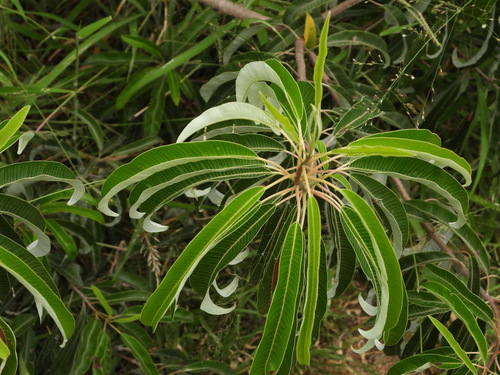
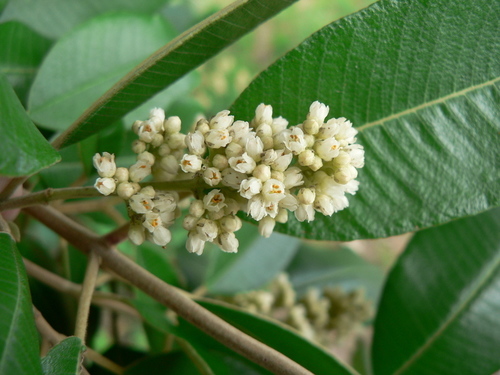
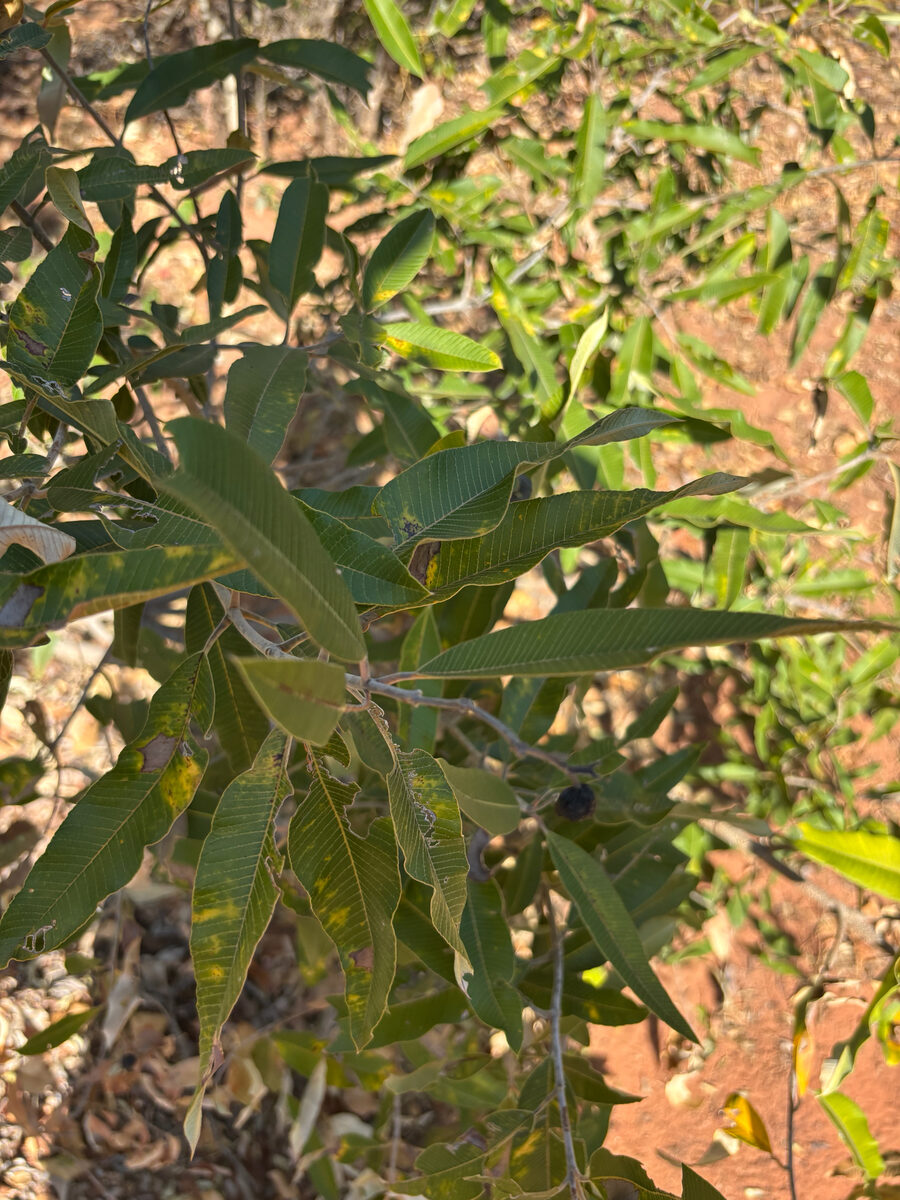
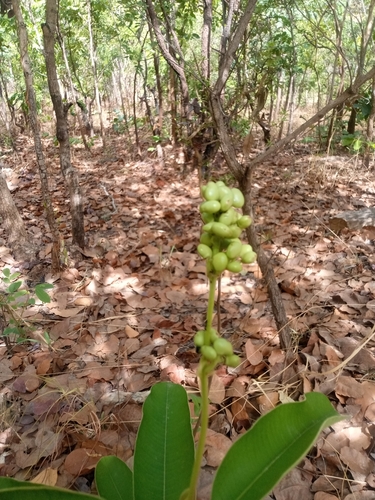
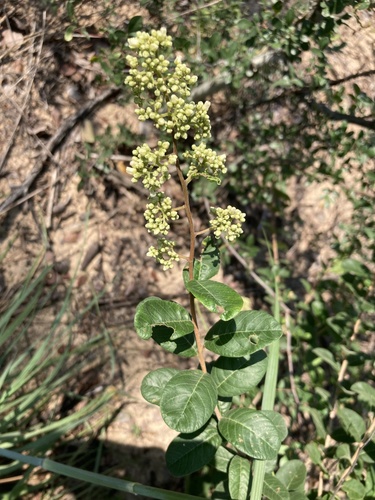
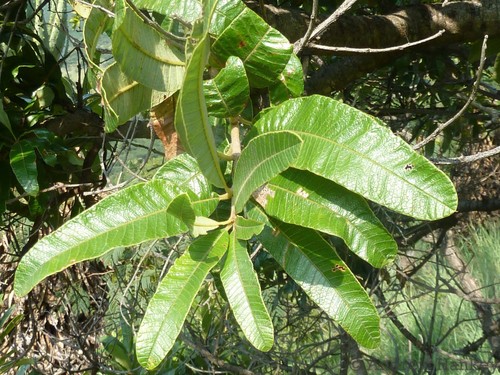
An shrub or evergreen tree. The branches droop. The crown is rounded. It can be 9 m high but also a shrubby bush. It is erect and has a single stem. It has a twisted dark brown trunk. The branches are slender and reddish. The leaves have 3 long narrow pointed leaflets. The leaflets are dark green and shiny above and pale below. They are narrowly sword shaped. They narrow to both ends. They are 6-13 cm long and the central leaflet is the largest. The midrib is raised on both sides. Male and female flowers are on separate plants. The flowers are very small and pale green. They occur in loose, much-branched sprays. They can be in the axils of leaves or at the ends of branches. The fruit is round and slightly flattened and lopsided. They are 4-5 mm across. They are green but turn yellowish-brown when ripe. It has a large seed. There is a thin layer of flesh. The outer skin is shiny brown. The fruit are edible.
Edible Uses
The fruit — a small, round, glossy tan drupe measuring 4–6mm in diameter and borne in hanging, much-branched clusters — can be fermented to make beer. Berries are typically harvested in late summer to early autumn when fully ripe, after the tree flowers in early to mid-summer.
Traditional Uses
The fruit are eaten. The rough skin is rubbed off and the inner flesh eaten. They are also pounded with water and used to make beer. The fruit are dried and used to make a tea drink. They are also used as a yeast and to curdle milk.
Medicinal Uses
The roots, leaves, and stem bark are used to treat skin diseases. A root infusion treats abdominal and chest complaints and diarrhoea, and the roots are chewed to relieve stomachache. A leaf decoction or infusion treats measles and pustules, and vapours from leaves in a hot-water bath are inhaled to treat coughs. Bark extracts have demonstrated in-vitro antibacterial activity against many gram-positive and gram-negative bacteria. The leaves yield 0.2% essential oil, with α-pinene, benzene, and d-3-carene as the main constituents. The oil shows notable antioxidant activity and dose-dependent antibacterial and antifungal activities, attributed largely to its high concentration of α-pinene (87%).
Known Hazards
The pollen is said to be allergenic.
Distribution
It is a tropical to subtropical plant. It grows in areas with an annual rainfall of 300-760 mm. It grows in poorly drained soils. It can tolerate frost. In southern Africa is grows from 100-2,300 m above sea level. It can tolerate drought. It can grow in arid places. It suits hardiness zones 9-11.
Where It Grows
Africa, Asia, Australia, Botswana, East Africa, Israel, Lesotho, Malawi, Mediterranean, Middle East, Mozambique, Myanmar, Namibia, Pakistan, SE Asia, South Africa*, Southern Africa, Zambia, Zimbabwe,
Cultivation
Plants can be grown from seed, cuttings or layering.
Propagation
Sow ripe seed in trays using a good seedling medium and transplant into larger containers when seedlings reach the two-leaf stage. Cuttings can be taken from young growth. Layering is also possible.
Other Uses
Commonly planted as a shade tree, windbreak, or ornamental in water-wise gardens, with a dense canopy well suited to erosion control and urban landscaping. The tree grows densely enough to serve as a large boundary hedge, screen, or barrier against wind, noise, and unwanted views, and helps stabilise soil while increasing rainwater infiltration, thereby reducing erosion and raising the groundwater table. It has no aggressive root system, making it safe near paving and tarred surfaces. Being hardy, frost-resistant, and evergreen, it can act as a pioneer canopy plant to shelter frost-sensitive and shade-loving species when establishing new forest in frost-prone areas. The plant is considered an indicator of underground water. The bark, twigs, and leaves are sources of tannin, and a brown dye is obtained from the bark. The reddish-brown wood is fine-textured, heavy, hard, tough, durable, sweetish and spicy in smell, works well, and takes a good polish; it is used for fence posts, tool handles, wagon parts, bowls, tobacco pipes, and bows. Flowers are rich in nectar and pollen, attracting bees, wasps, and butterflies. The fruit clusters provide food for birds and small mammals, and the dense growth offers shelter and nesting sites for birds. Fallen leaf litter provides habitat for invertebrates and shelter for overwintering insects.
Production
It is fairly fast growing.
Notes
There are about 200 Rhus species.
Synonyms
Also Known As
Jakalsbos, Kareeboom, Mosilabele, Mushakaladza
References (24)
- Cundall, P., (ed.), 2004, Gardening Australia: flora: the gardener's bible. ABC Books. p 1204 (As Rhus lancea)
- Fox, F. W. & Young, M. E. N., 1982, Food from the Veld. Delta Books. p 78 (As Rhus lancea)
- Fowler, D. G., 2007, Zambian Plants: Their Vernacular Names and Uses. Kew. p 75 (As Rhus lancea)
- Grivetti, L. E., 1980, Agricultural development: present and potential role of edible wild plants. Part 2: Sub-Saharan Africa, Report to the Department of State Agency for International Development. p 80 (As Rhus lancea)
- Hall, N. et al, 1972, The Use of Trees and Shrubs in the Dry Country of Australia, AGPS, Canberra. p 394 (As Rhus lancea)
Show all 24 references Hide references
- https://growwild.co.za Edible Indigenous plants (As Rhus lancea)
- Joffe, P., 2007, Creative Gardening with Indigenous Plants. A South African Guide. Briza. p 116 (As Rhus lancea)
- Magwede, K., van Wyk, B.-E., & van Wyk, A. E., 2019, An inventory of Vhavenḓa useful plants. South African Journal of Botany 122 (2019) 57–89
- Mannheimer, C. A. & Curtis. B.A. (eds), 2009, Le Roux and Muller's Field Guide to the Trees and Shrubs of Namibia. Windhoek: Macmillan Education Namibia. p 282
- Moffett, R. O., 2007, Name changes in the Old World Rhus and recognition of Searsia (Anacardiaceae). Bothalia 37,2: 165-175 (2007)
- Palgrave, K.C., 1996, Trees of Southern Africa. Struik Publishers. p 481 (As Rhus lancea)
- Palmer, E and Pitman, N., 1972, Trees of Southern Africa. Vol. 2. A.A. Balkema, Cape Town p 1255 (As Rhus lancea)
- Peters, C. R., O'Brien, E. M., and Drummond, R.B., 1992, Edible Wild plants of Sub-saharan Africa. Kew. p 51 (As Rhus lancea)
- Prota 7(2)
- Royal Botanic Gardens, Kew (1999). Survey of Economic Plants for Arid and Semi-Arid Lands (SEPASAL) database. Published on the Internet; http://www.rbgkew.org.uk/ceb/sepasal/internet [Accessed 28th March 2011] (As Rhus lancea)
- Ruiters-Welcome, A. K., 2019, Food plants of southern Africa. Ph.D. thesis. Univ. of Johannesburg p 16
- Suppl. pl. 184. 1782 ("1781") "lanceum" (As Rhus lancea)
- Tredgold, M.H., 1986, Food Plants of Zimbabwe. Mambo Press. p 118 (As Rhus lancea)
- van Wyk, Be., & Gericke, N., 2007, People's plants. A Guide to Useful Plants of Southern Africa. Briza. p 56, 110 (As Rhus lancea)
- van Wyk, B, van Wyk, P, and van Wyk B., 2000, Photographic guide to Trees of Southern Africa. Briza. p 10, 268
- van Wyk, B-E., 2011, The potential of South African plants in the development of new food and beverage products. South African Journal of Botany 77 (2011) 857–868
- Venter, F & J., 2009, Making the most of Indigenous Trees. Briza. p 262 (As Rhus lancea)
- Wehmeyer, A. S, 1986, Edible Wild Plants of Southern Africa. Data on the Nutrient Contents of over 300 species. (As Rhus lancea)
- World Checklist of Useful Plant Species 2020. Royal Botanic Gardens, Kew