Rhizophora apiculata
Blume
Tall-stilted Mangrove
iNaturalist· cc-by-sa
(c) Abu Hamas, some rights reserved (CC BY-SA), uploaded by Abu Hamas
iNaturalist· cc-by-nc
(c) luciacaldas, some rights reserved (CC BY-NC)
iNaturalist· cc-by-nc
(c) luciacaldas, some rights reserved (CC BY-NC)
Summary
Source: WikipediaThe tall-stilt mangrove (Rhizophora apiculata) is a species of flowering plant distributed throughout Southeast Asia and the western Pacific islands. It is located exclusively in the mangrove ecosystem due to an affinity to wet, muddy and silty sediments. Due to the high salt concentrations of the soils in these environments, it has mechanisms (ultrafiltration) in place to reduce the likely impacts associated with increased salt in plant physiology (drying plant material down causing increased evapotranspiration). Rhizophora apiculata and R. mucronata are used to make charcoal in the charcoal kilns of Kuala Sepetang in Perak, Malaysia. Rhizophora apiculata is used within mangrove plantation specifically for wood, and charcoal production in many parts of Thailand. There are alternative uses for R. apiculata, such as to reinforce nets, ropes and fishing lines, transform into charcoal or trade for income.
Description
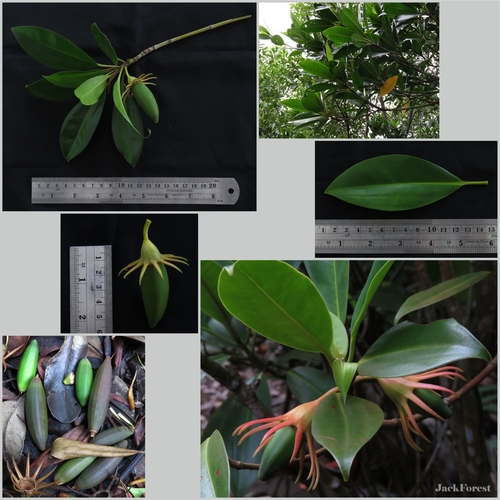
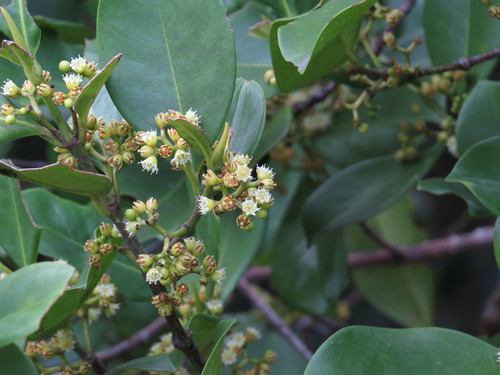
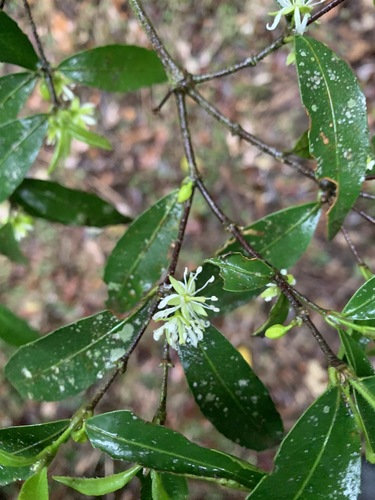
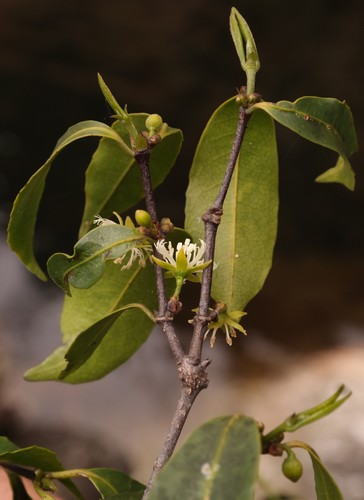
A medium height straight tree. It grows up to 5-12 m tall. It usually has prop roots covered with breathing pores. The leaves are dark green and not rolled at the edge. They are somewhat dull on top and twice as long as wide and end in a sharp tip. The leaves can be 8-19 cm long and 4-9 cm wide. The flowers are in pairs or short stalks. They are cream and 1.5 cm long. The flowers normally occur as 2 together below the oldest leaves. The fruit are relatively small 21 mm wide. The hypocotyl is green and about 280 mm long with a blunt tip.
Edible Uses
The fruit are boiled in water then eaten. The leaves and hypocotyl are also edible parts.
Traditional Uses
The fruit are boiled in water then eaten.
This uses section is brief — help expand it
Distribution
A tropical plant. It occurs in the middle to upper part of the mangrove where fresh water runoff is constant. It occurs from India, Australia to Vanuatu.
Where It Grows
Africa, Asia, Australia, Cambodia, China, Chuuk, East Africa, Guam, India, Indochina, Indonesia, Malaysia, Maldives, Micronesia, Myanmar, New Caledonia, Pacific, Pakistan, Palau, Papua New Guinea, PNG, Philippines, Pohnpei, SE Asia, Singapore, Solomon Islands, Sri Lanka, Taiwan, Thailand, Vanuatu, Vietnam, West Timor, Yap,
Cultivation
It is normally self sown.
Notes
There are 6 Rhizophora species. There are 3 species in tropical America. They are also put in the family Sonnerataceae.
Synonyms
Also Known As
Bngaol, Daboja, Jangkah, Naya kandal, Pointed Asiatic mangrove, Pukulijupa, Purirringa, Thakafathi
References (27)
- Ambasta S.P. (Ed.), 2000, The Useful Plants of India. CSIR India. p 520
- Argent, G et al, nd, Manual of the Larger and More important non Dipterocarp Trees of Central Kalimantan Indonesia. Volume 2 Forest Research Institute, Samarinda, Indonesia. p 531
- Beasley, J., 2011, Plants of Tropical North Queensland - the compact guide. Footloose publications. p 13
- Bhargava, N., 1983, Ethnobotanical Studies of the Tribes of Andaman and Nicobar Islands, India. 1. Onge. Economic Botany 37(1): 110-119
- Borrell, O.W., 1989, An Annotated Checklist of the Flora of Kairiru Island, New Guinea. Marcellin College, Victoria Australia. p 121
Show all 27 references Hide references
- Brock, J., 1993, Native Plants of Northern Australia, Reed. p 292
- Cooper, W. and Cooper, W., 2004, Fruits of the Australian Tropical Rainforest. Nokomis Editions, Victoria, Australia. p 429
- Elevitch, C.R.(ed.), 2006, Traditional Trees of the Pacific Islands: Their Culture, Environment and Use. Permanent Agriculture Resources, Holualoa, Hawaii. p 655
- Enum. pl. Javae 1:91. 1827
- Flora of Pakistan. www.eFloras.org
- Floyd, A.G., 1977, Ecology of the Tidal Forests in the Kikori-Romilly Sound Area Gulf of Papua. Ecology Report No 4 Division of Botany, Lae, Papua New Guinea. p 40
- French, B.R., 2010, Food Plants of Solomon Islands. A Compendium. Food Plants International Inc. p 377
- Frodin, D.G. & Leach, G.J., 1982, Mangroves of the Port Moresby Region, UPNG Biology Dept. Occasional Paper No.3 p 52.
- Havel, J.J., 1975, Forest Botany, Volume 3 Part 2 Botanical taxonomy. Papua New Guinea Department of Forests, p 229
- Jackes, B. R., 2010, Plants of Magnetic Island. 3rd Edition. James Cook University, Australia. p 21
- Kitalong, A. H., DeMeo, R. A., & Holm, T., 2013, A Field Guide to the Native Trees of Palau. 2nd edition. USDA p144
- Lebot, V. & Sam, C., Green desert or ‘all you can eat’? How diverse and edible was the flora of Vanuatu before human introductions?. Terra australis 52 p 410
- Lovelock, C., & Clarke, S., 1999, Field Guide to the Mangroves of Queensland. Australian Institute of Marine Science. p 48
- McClatchey, W. C., 2012, Wild food plants of Remote Oceania. Acta Societatis Botanicorum Poloniae 81(4) 371-380
- Peekel, P.G., 1984, (Translation E.E.Henty), Flora of the Bismarck Archipelago for Naturalists, Division of Botany, Lae, PNG. p 400, 398
- Plants of Papua New Guinea LAE herbarium record
- Selvam, V., 2007, Trees and shrubs of the Maldives. RAP Publication No. 2007/12 p 198
- Sujanapal, P., & Sankaran, K. V., 2016, Common Plants of Maldives. FAO & Kerala FRI, p 226
- Tiwi Plants and Animals. 2001, Aboriginal flora and fauna knowledge from Bathurst and Melville Islands, northern Australia. Northern Territory Botanical Bulletin; No. 24 p 75
- Tomlinson P.B., 1976, Rhizophora in Papua New Guinea, Science in New Guinea 4 (2): 77-90
- World Checklist of Useful Plant Species 2020. Royal Botanic Gardens, Kew
- www.manoa.hawaii.edu/botany/plants of micronesia