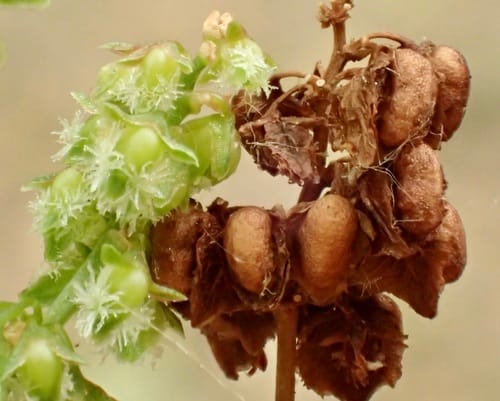
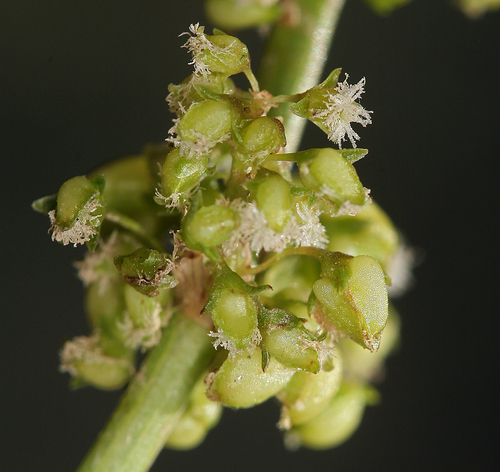
Rheum rhabarbarum
L.
Rhubarb
iNaturalist· cc-by-nc
(c) Nikolay Panasenko, some rights reserved (CC BY-NC), uploaded by Nikolay Panasenko
gbif· cc-by-nc
dylantmurray
wikimedia· cc-by
mako from Kangasala, Suomi (Finland) (via Wikimedia Commons)
iNaturalist· cc-by-nc
(c) Alexander Yakovlev, some rights reserved (CC BY-NC)
iNaturalist· cc-by-nc
(c) Alexander Yakovlev, some rights reserved (CC BY-NC)
iNaturalist· cc-by-nc
(c) Сергей, some rights reserved (CC BY-NC)
Summary
Source: WikipediaRheum rhabarbarum is a species of flowering plant in the family Polygonaceae, native to a region stretching from southern Siberia to north and central China. It has been harvested from the wild for centuries for its root, which was harvested for use as a popular medicine in Europe and Asia. It was later cultivated for its root in England and Russia. It is considered to be one of the species involved in the development of culinary rhubarb, for which the scientific name R. rhabarbarum is sometimes (erroneously) used.
Description
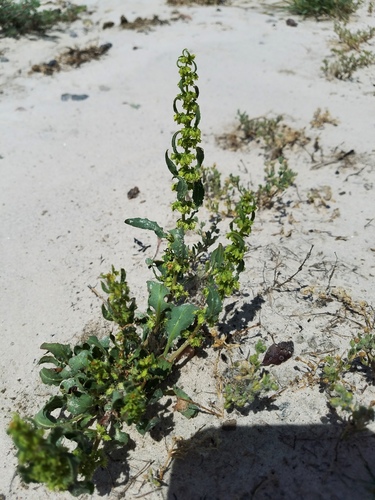
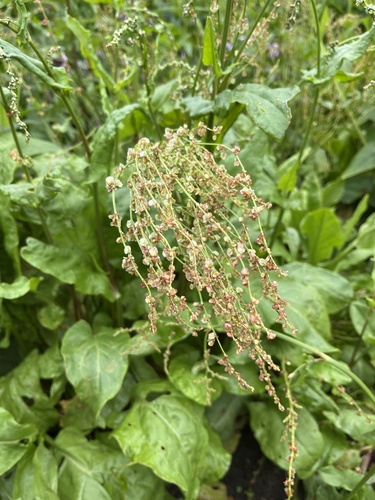
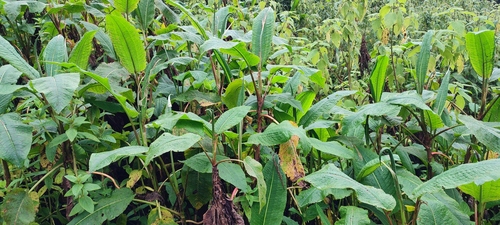
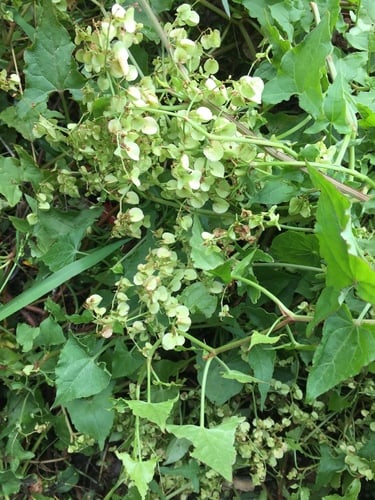
See Rheum x hybridum. Our common edible rhubarb is developed from this plant by hybridisation. A stemless herb. It is a herb that keeps growing from year to year. It grows 60-80 cm high. The rootstocks are stout and 8-12 cm across. The leaves near the base are in a ring. The leaf stalks are 15-30 cm long and fleshy. The leaves near the base are oval or triangle shaped. They are 10-16 cm long by 8-14 cm wide. They can be larger. They have shallow lobes. The edges are wavy. The flowering stems are 1-1.5 m high.
Edible Uses
The fleshy leaf stalks are cooked and typically sweetened, used in ice cream, jams, jellies, sauces, cakes, tarts, puddings, and stewed dishes.
Traditional Uses
CAUTION: The leaves contain oxalates and are poisonous. The leaf stalks are cooked and eaten. They need sweetening. They are used to flavour ice cream, jams, jellies, sauces, cakes, tarts, puddings, and are also stewed.
Known Hazards
The leaves contain oxalates and are poisonous.
Distribution
It requires cool temperate conditions. It is native to northern China and Siberia. In Hobart Botanical gardens.
Where It Grows
Asia, Australia, Balkans, Caucasus, China, Europe, Finland, Georgia, Korea, Lithuania, Macedonia, Manchuria, Mongolia, North America, Norway, Russia, Scandinavia, Siberia, Sri Lanka, Switzerland, Tasmania, USA, Uzbekistan,
Cultivation
It is grown by division of the rootstock. The flower stems are removed to give a better yield of leaf stalks next season.
Other Information
It is a commercially cultivated vegetable.
Notes
There are about 50 Rheum species. This is a wild species.
Synonyms
Also Known As
Bucharian rhubarb, Pieplant, Rabarbra, Wavy-leaved rhubarb
References (19)
- Bussman, R. W., et al, 2021, Unity in diversity—food plants and fungi of Sakartvelo (Republic of Georgia), Caucasus. Journal of Ethnobiology and Ethnomedicine (2021) 17:72 p 13
- Facciola, S., 1998, Cornucopia 2: a Source Book of Edible Plants. Kampong Publications, p 186
- Flora of China @ efloras.org Volume 5
- Girard, N. J., 2020, Sustainable Foraging of Wild Edible Plants in Norway. A Biocultural Approach. M. Sc. thesis Norwegian University. p 133
- Hedrick, U.P., 1919, (Ed.), Sturtevant's edible plants of the world. p 557 (As Rheum undulatum)
Show all 19 references Hide references
- Hu, Shiu-ying, 2005, Food Plants of China. The Chinese University Press. p 374 (As Rheum undulatum)
- Hu, Shiu-ying, 2005, Food Plants of China. The Chinese University Press. p 374
- Kays, S. J., and Dias, J. C. S., 1995, Common Names of Commercially Cultivated Vegetables of the World in 15 languages. Economic Botany, Vol. 49, No. 2, pp. 115-152
- Kiple, K.F. & Ornelas, K.C., (eds), 2000, The Cambridge World History of Food. CUP p 1843
- Lazarides, M. & Hince, B., 1993, Handbook of Economic Plants of Australia, CSIRO. p 204
- Marinelli, J. (Ed), 2004, Plant. DK. p 193 and Marinelli, J. (Ed), 2004, Plant. DK. p 193 (As Rheum undulatum)
- Moerman, D. F., 2010, Native American Ethnobotany. Timber Press. p 470
- Ochse, J. J. et al, 1931, Vegetables of the Dutch East Indies. Asher reprint. p 591
- Schneider, E., 2001, Vegetables from Amaranth to Zucchini: The essential reference. HarperCollins. p 538
- Sp. pl. 1:372. 1753
- Sp. pl. ed. 2, 1:531. 1762 - an illegitimate, superfluous name (ICBN Art. 52) for Rheum rhabarbarum L. (As Rheum undulatum)
- van Wyk, B., 2005, Food Plants of the World. An illustrated guide. Timber press. p 320
- Wiersema, J. H. & Leon, B., 2013, World Economic Plants. A Standard Reference CRC Press. 2nd Ed. p 583
- World Checklist of Useful Plant Species 2020. Royal Botanic Gardens, Kew