Vachellia leucophloea
(Roxb.) Maslin, Seigler & Ebinger
Kuteera-Gum, White-barked acacia
iNaturalist· cc-by-nc-sa
(c) Shivam Bhatt, some rights reserved (CC BY-NC-SA), uploaded by Shivam Bhatt
iNaturalist· cc-by-sa
(c) Forestowlet, some rights reserved (CC BY-SA)
iNaturalist· cc0
no rights reserved, uploaded by Pradip Krishen
Summary
Source: WikipediaVachellia leucophloea (Hindi: रेवंजा Punjabi: ਰੇਰੂ), also vernacularly as the White Bark Acacia or reonja, is a moderate-sized tree native to South and Southeast Asia.
Description
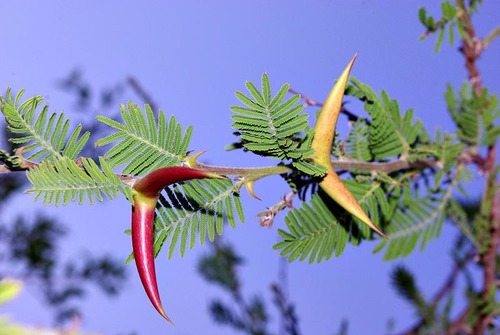
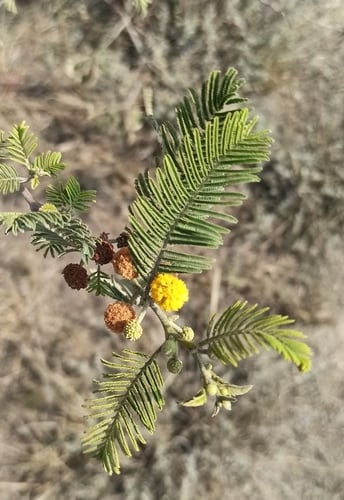
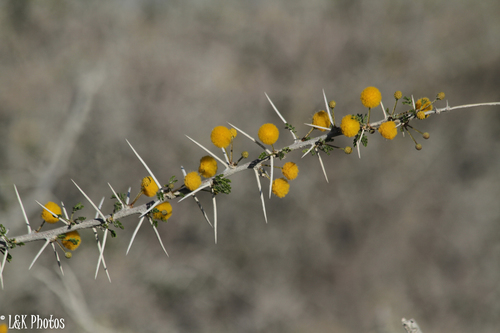
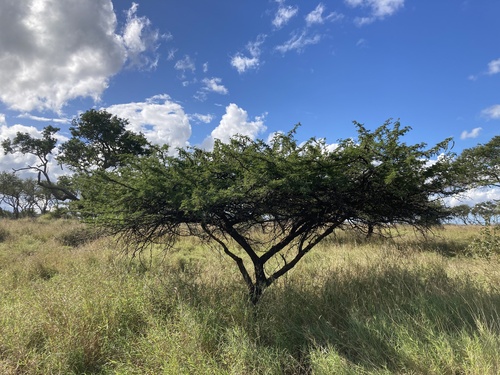
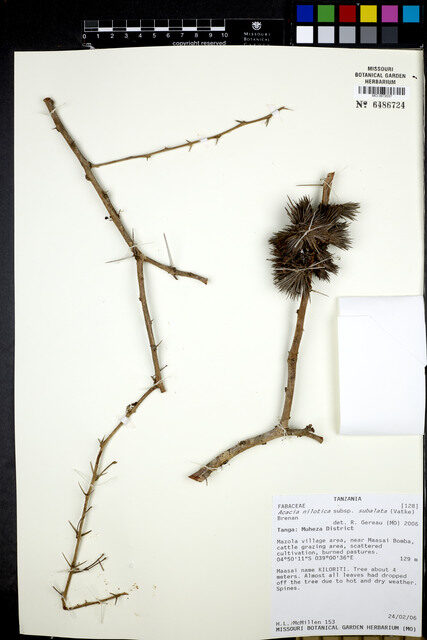
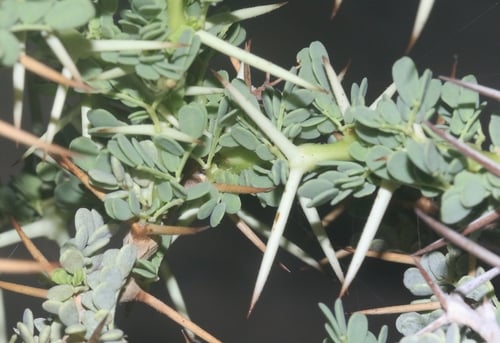
A shrub or small tree up to 10 m tall. It can grow 35 m high. It loses its leaves during the year. It is spiny. The trunk is straight. The leaves are twice divided. There are 12-30 leaflets. The flowers are dull white. They are in groups made up of several small round heads. The pods are 10-20 cm long. They have a covering over them.
Edible Uses
The bark is used to prepare a spirit from sugar and palm juice, and in times of scarcity it is ground and mixed with flour. The pods are used as a vegetable, and the seeds can be ground and mixed with flour.
Traditional Uses
The young pods and seeds are used as a vegetable. The seeds are germinated and cooked. The seeds are ground and mixed with flour. The bark is ground and mixed with flour when food is short. The bark is also used to flavour brewed spirit made from sugarcane and palm juice.
Medicinal Uses
The bark extracts of Vachellia leucophloea are used in Pakistani traditional medicine as an astringent, a bitter, a thermogenic, a styptic, a preventive of infections, an anthelmintic, a vulnerary, a demulcent, an expectorant, an antipyretic, an antidote for snake bites and in the treatment of bronchitis, cough, vomiting, wounds, ulcers, diarrhea, dysentery, internal and external hemorrhages, dental caries, stomatitis, and intermittent fevers and skin diseases. An ethanolic extract ointment has shown marked wound healing activity in trials.
Known Hazards
The seed of many Acacia species, including this one, is edible and highly nutritious, and can be eaten safely as a fairly major part of the diet. Not all species are edible, however, and some can contain moderate levels of toxins. Especially when harvesting from the wild, especial care should be taken to ensure correct identification of any plants harvested for food. Especially in times of drought, many Acacia species can concentrate high levels of the toxin Hydrogen cyanide in their foliage, making them dangerous for herbivores to eat.
Distribution
A tropical plant. It grows in wasteland and open forest. It grows in dried parts of India. In Timor it grows on heavy clay soils below 300 m altitude in the Savannah. It grows in areas with an annual rainfall between 450-1,560 mm. It grows in dry shallow soils. It can grow in arid places.
Where It Grows
Africa, Asia, Azerbaijan, Bangladesh, Cambodia, East Africa, East Timor, India, Indochina, Indonesia, Laos, Malaysia, Mauritius, Myanmar, Pakistan, SE Asia, Sri Lanka, Tanzania, Thailand, Timor-Leste,Trinidad-Tobago, Vietnam, West Timor,
Cultivation
Plants are grown from seed. The seedlings must have light. The plant can be cut back and will re-grow.
Propagation
Seed - pre-treatment is necessary to break the hard seed coat. To encourage uniform germination, seed should be scarified either by submerging in boiled water that is allowed to cool for 24 hours, or by soaking in sulphuric acid for 10-30 minutes followed by soaking in cool water for 24 hours. The visibly swollen seeds should be sown immediately. Germination can still take 75 days. Viability of dried seeds can be maintained for up to 2 years at room temperature. When sown outdoors, the seed should be sown at a depth of 1 cm in lines 20-25 cm apart. Germination begins within a week. Plants can be established by direct sowing, stump sprouts or seedlings. Direct sowing is preferred because the large roots of seedlings may hamper transplanting.
Other Uses
The source of a low quality gum that is used to adulterate gums of higher quality. A water-soluble gum of fair quality can be extracted from the stem and root bark. The leaves yield a black dye, whilst the bark produces a reddish-brown substance used to manufacture dyes and tannins. The bark contains 11 - 20% tannins, with older trees containing higher quantities. The strong but coarse fibres from the inner bark are used to make fish nets and rough rope. The heartwood is brick-red with lighter and darker streaks; it is clearly demarcated from the pale yellow sapwood. A very beautiful wood, it is strong, heavy and hard It is durable indoors, but decays quickly if in contact with moist soil. The sapwood is perishable. The heartwood seasons well and takes a good polish. Although a little hard to work, the wood is used to make decorative furniture. Other commodities produced from the wood include poles, farming implements, carts, wheels, turnery, indoor construction timbers and flooring. The utilization of this species is limited because its wood has irregular interlocked grain, a rough texture and is difficult to work. The wood is appreciated as fuel and is suitable for charcoal production. The tree is suitable as a firebreak due to its fire resistance. A good reforestation species for poor soils in low rainfall areas.
Production
It grows slowly.
Other Information
Famine food
Notes
There are about 1,350 Acacia species. Over 1,000 occur in Australia. Also as Mimosaceae.
Synonyms
Also Known As
Ai-muti, Akasia pilang, Annj, Arinj, Bilijali, Chalep deng, Haribaval, Hewar, Hivur, Hiwar, Jhira, Kabesak, Katu andara, Keo trang, Kikar, Nimbar, Pattacharaya maram, Pilang, Reru, Reunja, Ronj, Safed babul, Safed kikar, Shvetabarbura, Tanaung, Tellatuma, Velva-yalam, Velvel
References (35)
- Ambasta S.P. (Ed.), 2000, The Useful Plants of India. CSIR India. p 6 (As Acacia leucophloea)
- Ashton, M. S., et al 1997, A Field Guide to the Common Trees and Shrubs of Sri Lanka. WHT Publications Ltd. pdf p 234 (As Acacia leucophloea)
- Basha, S. K. M., Ethnobotanical Trees of Sri Lanka Malleswara Wildlife Sanctuary; Eastern Ghats, Andhra Pradesh. (As Acacia leucophloea)
- BHANDARI, (As Acacia leucophloea)
- Bircher, A. G. & Bircher, W. H., 2000, Encyclopedia of Fruit Trees and Edible Flowering Plants in Egypt and the Subtropics. AUC Press. p 4 (As Acacia leucophloea)
Show all 35 references Hide references
- Burkill, I.H., 1966, A Dictionary of the Economic Products of the Malay Peninsula. Ministry of Agriculture and Cooperatives, Kuala Lumpur, Malaysia. Vol 1 (A-H) p 21 (As Acacia leucophloea)
- Cowie, I, 2006, A Survey of Flora and vegetation of the proposed Jaco-Tutuala-Lore National Park. Timor-Lests (East Timor) www.territorystories.nt/gov.au p 50 (As Acacia leucophloea)
- Dassanayake, M. D. & F. R. Fosberg. 1980-. A revised handbook to the flora of Ceylon. (As Acacia leucophloea)
- Dobriyal, M. J. R. & Dobriyal, R., 2014, Non Wood Forest Produce an Option for Ethnic Food and Nutritional Security in India. Int. J. of Usuf. Mngt. 15(1):17-37 (As Acacia leucophloea)
- Facciola, S., 1998, Cornucopia 2: a Source Book of Edible Plants. Kampong Publications, p 151 (As Acacia leucophloea)
- Flora of Pakistan. www.eFloras.org (As Acacia leucophloea)
- Friday, J. B., 2005, Forestry and Agroforestry Trees of East Timor. http://www.ctahr.hawaii.edu/forestry/data/Timor/Timor trees.html (As Acacia leucophloea)
- GAMMIE; (As Acacia leucophloea)
- Gunjatkar, N., & Vartak, V.D., 1982, Enumeration of wild edible legumes from Pune District, Maharashtra State. J. Econ. Tax. Bot. Vol 3 pp 1-9 (As Acacia leucophloea)
- GUPTA & KANODIA, (As Acacia leucophloea)
- Hedrick, U.P., 1919, (Ed.), Sturtevant's edible plants of the world. p 20 (As Acacia leucophloea)
- http://palaeoworks.anu.edu.au/Nuno_PhD/04.pdf re Timor (As Acacia leucophloea)
- ILDIS Legumes of the World http:www;ildis.org/Legume/Web (As Acacia leucophloea)
- Kew Plants of the World Online
- Krishen P., 2006, Trees of Delhi, A Field Guide. DK Books. p 270 (As Acacia leucophloea)
- Menninger, E.A., 1977, Edible Nuts of the World. Horticultural Books. Florida p 88 (As Acacia leucophloea)
- Pham-Hoang Ho, 1999, An Illustrated Flora of Vietnam. Nha Xuat Ban Tre. p 824 (As Acacia leucophloea)
- Royal Botanic Gardens, Kew (1999). Survey of Economic Plants for Arid and Semi-Arid Lands (SEPASAL) database. Published on the Internet; http://www.rbgkew.org.uk/ceb/sepasal/internet [Accessed 26th April 2011] (As Acacia leucophloea)
- SAXENA; (As Acacia leucophloea)
- SHANKARNARAYAN & SAXENA, (As Acacia leucophloea)
- Siemonsma, J. S. & Kasem Piluek, eds. 1993. Vegetables. In: Plant Resources of South-East Asia (PROSEA) 8:311 (As Acacia leucophloea)
- Singh, H.B., Arora R.K.,1978, Wild edible Plants of India. Indian Council of Agricultural Research, New Delhi. p 78, 82 (As Acacia leucophloea)
- Singh, V. and Singh, P., 1981, Edible Wild Plants of Eastern Rajasthan. J. Econ. Tax. Bot. Vol 2 pp 197-207 (As Acacia leucophloea)
- Sp. pl. 4(2):1083. 1806 (As Acacia leucophloea)
- Sukarya, D. G., (Ed.) 2013, 3,500 Plant Species of the Botanic Gardens of Indonesia. LIPI p 100 (As Acacia leucophloea)
- Usher, G., 1974, A Dictionary of Plants Used by Man. Constable. p 13 (As Acacia leucophloea)
- WATT. (As Acacia leucophloea)
- Westphal, E. and P. C. M. Jansen, eds. 1989. A selection. In: Plant Resources of South-East Asia (PROSEA) A:28. (As Acacia leucophloea)
- Wild edible plants of Himachal Pradesh (As Acacia leucophloea)
- World Checklist of Useful Plant Species 2020. Royal Botanic Gardens, Kew