Rhaphiolepis umbellata
(Thunb.) Makino
Japanese hawthorn, Yeddo hawthorn
iNaturalist· cc-by-nc
(c) pei613, some rights reserved (CC BY-NC)
iNaturalist· cc-by-nc
(c) hoho0831, some rights reserved (CC BY-NC)
iNaturalist· cc-by-nc
(c) shingha4223, some rights reserved (CC BY-NC)
Summary
Source: WikipediaRhaphiolepis umbellata or Sexton's bride is a species of flowering plant in the family Rosaceae, native to Korea, Japan and Taiwan. Growing to 1.5 m (5 ft) tall and wide, it is an evergreen shrub with glossy oval leaves, and scented white flowers, sometimes tinged with pink, in early summer. This plant has gained the Royal Horticultural Society's Award of Garden Merit. It is used in Japan as an astringent and a dyeing agent. The bark contains (−)-catechin 7-O-β-d-glucopyranoside and (+)-catechin 5-0-β-d-glucopyranoside.
Description
A bushy shrub. It grows 2-3 m tall. It spreads 2 m wide. The young stems have a dense covering of woolly hairs but these fall off. The leaf blade is broadly oval or half round and 4-9 cm long by 2.5-5 cm wide. It narrows into the leaf stalk. The leaf edges curve back slightly. There can be some teeth near the tip. The flowering shoot is stiff and branched. It is 4-8 cm long. There are usually 5-20 flowers. The flowers have a scent. The flower stalks are 3-10 mm long. The petals are broad and oval and 7-10 mm long. They are rounded and white. The fruit is flattened round shape or pear shape and 7-8 mm long. It is blue-black.
Edible Uses
The seeds can be ground and used as a flour. They are regarded as a famine food, used only when other options are exhausted.
Traditional Uses
The fruit are cooked and eaten. They are also used for jam. The seeds are edible.
This uses section is brief — help expand it
Medicinal Uses
None known
Distribution
It is a warm temperate to subtropical plant. It grows in thickets near the seashore. It suits hardiness zones 8-11. Tasmanian Botanical Gardens. Wittunga Botanical Gardens. Arboretum Tasmania.
Where It Grows
Africa, Asia, Australia, Britain, Canada, China, East Africa, Europe, Hawaii, Indonesia, Japan*, Korea, Mozambique, Norfolk Island, North America, Pacific, SE Asia, Slovenia, Taiwan, Tasmania, USA,
Cultivation
Plants can be grown from seeds.
Propagation
Seed is best sown as soon as it is ripe in a shady position in a warm greenhouse. Stored seed should be sown in February or March in a warm greenhouse. Germination is variable. Prick seedlings into individual pots when large enough to handle and grow on in the greenhouse for at least their first winter. Plant out into permanent positions in late spring or early summer, after the last expected frosts. Cuttings of half-ripe wood, 5cm with a heel, can be taken in September or October in a frame, with a fair success rate. Layering is also an option.
Other Uses
The plant can be used for informal hedging in frost-free or nearly frost-free areas. A brown dye is obtained from the bark.
Production
In China plants flower in April to June and fruit in September to November.
Synonyms
Also Known As
Bunga yedo, Kokutan
References (9)
- Bot. Mag. (Tokyo) 16:13. 1902 "Raphiolepis"
- Cundall, P., (ed.), 2004, Gardening Australia: flora: the gardener's bible. ABC Books. p 1140
- Flora of Australia Volume 49, Oceanic Islands 1, Australian Government Publishing Service, Canberra. (1994) p 164
- Flora of China @ efloras.org Volume 9
- Hibbert, M., 2002, The Aussie Plant Finder 2002, Florilegium. p 246
Show all 9 references Hide references
- http://www.botanic-gardens-ljubljana.com/en/plants
- Plants for a Future database, The Field, Penpol, Lostwithiel, Cornwall, PL22 0NG, UK. http://www.scs.leeds.ac.uk/pfaf/
- Staples, G.W. and Herbst, D.R., 2005, A tropical Garden Flora. Bishop Museum Press, Honolulu, Hawaii. p 478 (Drawing)
- Sukarya, D. G., (Ed.) 2013, 3,500 Plant Species of the Botanic Gardens of Indonesia. LIPI p 698
More from Rosaceae
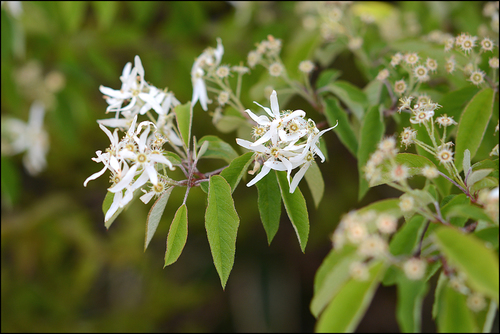
Amelanchier asiatica
Korean juneberry, Service Berry, Shad Bush
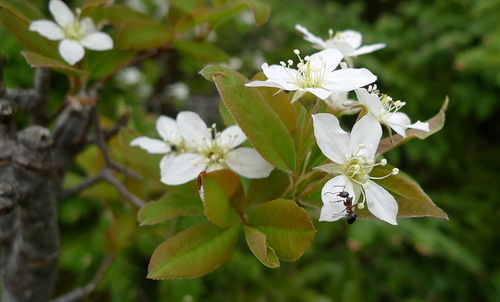
Amelanchier bartramiana
Mountain serviceberry, Bartram shadblow
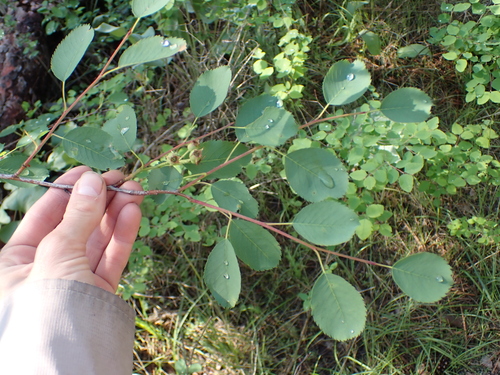
Amelanchier basalticola
Dwarf Service-berry;
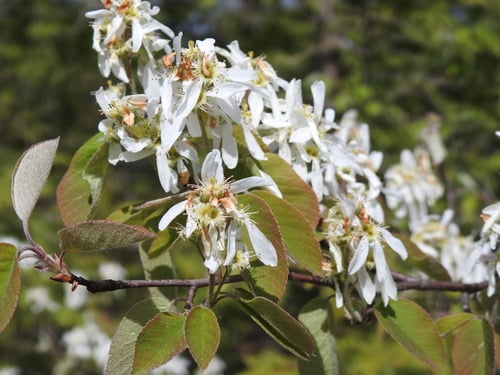
Amelanchier canadensis
Downy shadblow, Canadian serviceberry
Amelanchier confusa
Swedish honeysuckle
Amelanchier cusickii
Cusick's serviceberry