Pyrus regelii
Rehder
Regel's pear
iNaturalist· cc-by-nc
(c) vladimir_epiktetov, some rights reserved (CC BY-NC), uploaded by vladimir_epiktetov
wikimedia· cc0
Alexandre Joseph Désiré Bivort (1809-1872) (via Wikimedia Commons)
Description
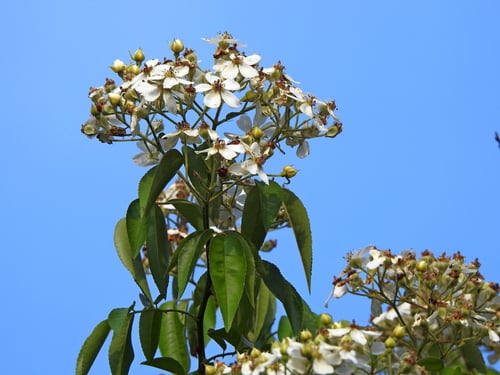
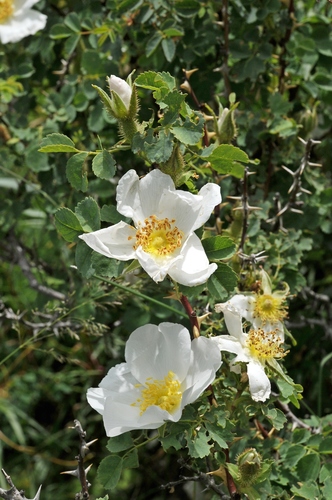
A low tree. It grows 3-6 m high. The branches are spreading. The shoots are reddish-brown. The leaves vary in shape. They are leathery and shiny. On one tree the leaves can be entire or have lobes like fingers on a hand. The flowers are in small groups. They are white and 2-4 cm long. The fruit are greenish-yellow. There are 4-6 seeds. The seeds are dark brown and 7 mm x 10 mm.
Edible Uses
The fruit, about 3cm in diameter, can be eaten raw or cooked.
Traditional Uses
The fruit are hard but become softer and edible after storage.
This uses section is brief — help expand it
Medicinal Uses
None known
Distribution
It is a temperate plant. It grows in Kazakhstan it grows in mountain savannah. It grows on dry stony slopes. They are grow up to 1,200 m altitude. It is drought resistant.
Where It Grows
Asia, Central Asia, Kazakhstan, Kyrgyzstan, Russia, Tajikistan, Turkestan,
Cultivation
Plants can be grown by seed. Plants can be used as rootstocks for drought tolerance.
Propagation
Seed is best sown in a cold frame as soon as it is ripe in autumn, when it will typically germinate in mid to late winter. Stored seed requires 8–10 weeks of cold stratification at 1°C and should be sown as early in the year as possible. Temperatures above 15–20°C can induce a secondary dormancy. Prick out seedlings into individual pots once large enough to handle, and grow on in light shade in a cold frame or greenhouse through their first year. Plant out in late spring or early summer the following year.
Other Uses
This species is used as a rootstock.
Other Information
It is cultivated.
References (5)
- Arora, R. K., 2014, Diversity in Underutilized Plant Species - An Asia-Pacific Perspective. Bioversity International. p 84
- Dzhangaliev, A. D., et al, 2003, The Wild Fruit and Nut Plants of Kazakhstan, Horticultural Reviews, Vol. 29. pp 305-371
- J. Arnold Arbor. 20:97. 1939
- Plants for a Future database, The Field, Penpol, Lostwithiel, Cornwall, PL22 0NG, UK. http://www.scs.leeds.ac.uk/pfaf/
- Zeven, A. C. & de West, J. M. J., 1982, Dictionary of cultivated plants and their regions of diversity. Wageningen. p 86