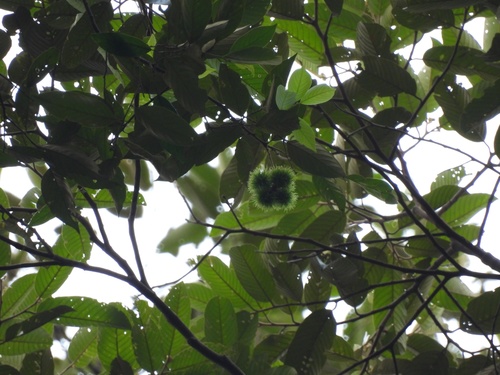
Quercus garryana
Douglas ex Hook.
Oregon Oak, Oregon white oak, Garry oak, Western oak
iNaturalist· cc-by-nc
(c) Steve Ansell, some rights reserved (CC BY-NC)
iNaturalist· cc-by-nc
(c) morninglight, some rights reserved (CC BY-NC)
Summary
Source: WikipediaQuercus garryana is an oak tree species found most commonly in the Pacific Northwest, with a range stretching from southern California to southwestern British Columbia. It is commonly known as the Garry oak, Oregon white oak or Oregon oak. It is named for Nicholas Garry, deputy governor of the Hudson's Bay Company.
Description
A small tree. It grows to 20 m high. The trunk is 150 cm across. The leaves are thick and stiff. They are 7-10 cm long. There are 5-7 lobes. These are rounded and have deep notches. The upper surface is shiny green and dull green underneath. The stalk is 1-3 cm long. The acorns are 25-30 mm long. They can occur singly or in pairs. The stalks are 1-3 cm long.
Edible Uses
The acorn can be eaten raw or cooked and has a sweet flavour. Size varies by report — up to 25mm long in some accounts, up to 32mm long and 25mm wide in others. The seed can be ground into flour for making bread, or used as a thickener for soups and stews. The seeds have a high tannin content; these bitter compounds can be leached out by thoroughly washing the dried, ground seed in water, though minerals are also lost. Whole seeds may take several days or weeks to leach properly; wrapping them in a cloth bag and placing in a running stream is one traditional method. Ground meal leaches faster. A taste test confirms when enough tannin has been removed. Traditionally, seeds were buried in boggy ground over winter and dug up in spring once most of the astringency had gone. The roasted seed makes a coffee substitute.
Traditional Uses
The acorns need to be leached to remove the tannin then roasted and ground to flour for use in cakes, breads and muffins. It is also used as a thickener for sauces and soups.
Medicinal Uses
Any galls that form on the tree are strongly astringent and have been used in the treatment of haemorrhages, chronic diarrhoea, and dysentery. A decoction of the bark has been used to treat tuberculosis. An infusion of the plant has been drunk by a mother before the birth of her first child, and the pounded bark has been rubbed on the abdomen and sides of the mother before her first delivery.
Known Hazards
The mildly sweet (but perhaps unpalatable) acorns are edible, ideally after leaching. The bitterness of the toxic tannic acid would likely prevent anyone from eating enough to become ill. Native Americans ate the acorns raw and roasted, also using them to make a kind of flour. The hardwood is hard and heavily ring-porous. It has distinctive growth rings and prominent rays. Heartwood can be a deep chocolate brown color and sapwood will vary from golden brown to nearly white. This makes it particularly attractive to woodworkers; however, it can be difficult to use in woodworking without experiencing warping and cracking. Although it was popularly used around the turn of the 20th century, historically the tree has not been regarded as having significant commercial value and is frequently destroyed as land is cleared for development. The wood is suitable for making fence posts. With similar qualities to those of other white oaks, the wood has been used experimentally in Oregon for creating casks in which to age wine. In Washington, it has been used for aging single malt whiskey since the 2010s. Oregon white oak barrels are said to give the whiskey "burnt sugar notes, marshmallow sweetness, and a light floral character that showcases the best of the Garry oak". When used as firewood, Oregon white oak produces 28 million British thermal units per cord (2.3 MWh/m3) burned.
Distribution
It is a temperate plant. It grows on dry rocky ground. It will also grow on coastal sites as long as it is not affected by tidal flooding. It cannot tolerate shade. It suits hardiness zones 5-10.
Where It Grows
Australia, Canada, North America, USA,
Cultivation
Prefers a good deep fertile loam which can be on the stiff side. Lime tolerant. Young plants tolerate reasonable levels of side shade. Tolerates moderate exposure, surviving well but being somewhat stunted. Prefers warmer summers than are usually experienced in Britain, trees often grow poorly in this country and fail to properly ripen their wood resulting in frost damage overwinter. A slow-growing and drought tolerant tree, it can live for 500 years. Seed production is cyclic, with a year of high production being followed by 2 - 3 years of lower yields. The tree flowers on new growth produced in spring, the seed ripening in its first year. Intolerant of root disturbance, trees should be planted in their permanent positions whilst young. Hybridizes freely with other members of the genus. Plants in this genus are notably resistant to honey fungus.
Propagation
Acorns lose viability quickly if allowed to dry out. They can be stored moist and cool over winter, but are best sown as soon as ripe in an outdoor seed bed with protection from mice and squirrels. Small quantities can be sown in deep pots in a cold frame. Because plants develop a deep taproot early, they should be moved to permanent positions as soon as possible — seed sown in situ produces the best trees. Do not leave trees in a nursery bed for more than 2 growing seasons, as they transplant very poorly after that point.
Other Uses
A mulch of the leaves repels slugs and grubs, though fresh leaves should not be used as they can inhibit plant growth. Oak galls, produced by the larvae of various insects, can be harvested after the insect pupates and leaves — they are a rich source of tannin that also functions as a dyestuff. The wood is hard, heavy, strong, tough, close-grained, durable, and easy to split. It is used for furniture, cabinetmaking, and general construction, as well as for fence posts and fuel.
Production
It is a slow growing tree. It grows for 200 years.
Notes
There are about 600 Quercus species.
Nutrition
| Part | Moisture | kJ | kcal | Protein | Vit A | Vit C | Iron | Zinc |
|---|---|---|---|---|---|---|---|---|
| Spp - Nuts | 27.9 | 1619 | 387 | 6.15 | 4 | 0 | 0.79 | 0.51 |
References (17)
- Beckstrom-Sternberg, Stephen M., and James A. Duke. "The Foodplant Database." http://probe.nalusda.gov:8300/cgi-bin/browse/foodplantdb.(ACEDB version 4.0 - data version July 1994)
- Bodkin, F., 1991, Encyclopedia Botanica. Cornstalk publishing, p 862
- Brickell, C. (Ed.), 1999, The Royal Horticultural Society A-Z Encyclopedia of Garden Plants. Convent Garden Books. p 854
- Cundall, P., (ed.), 2004, Gardening Australia: flora: the gardener's bible. ABC Books. p 1124
- Facciola, S., 1998, Cornucopia 2: a Source Book of Edible Plants. Kampong Publications, p 115
Show all 17 references Hide references
- Farrar, J.L., 1995, Trees of the Northern United States and Canada. Iowa State University press/Ames p 264
- Fl. bor.-amer. 2:159. 1838
- Grandtner, M. M., 2008, World Dictionary of Trees. Wood and Forest Science Department. Laval University, Quebec, Qc Canada. (Internet database http://www.wdt.qc.ca)
- Hedrick, U.P., 1919, (Ed.), Sturtevant's edible plants of the world. p 545
- Kermath, B. M., et al, 2014, Food Plants in the Americas: A survey of the domesticated, cultivated and wild plants used for Human food in North, Central and South America and the Caribbean. On line draft. p 734
- MacKinnon, A., et al, 2009, Edible & Medicinal Plants of Canada. Lone Pine. p 58
- Menninger, E.A., 1977, Edible Nuts of the World. Horticultural Books. Florida p 19
- Moerman, D. F., 2010, Native American Ethnobotany. Timber Press. p 461
- Plants for a Future database, The Field, Penpol, Lostwithiel, Cornwall, PL22 0NG, UK. http://www.scs.leeds.ac.uk/pfaf/
- Turner, N., 1995, Food Plants of Coastal First Peoples. Royal BC Museum Handbook p 97
- Wickens, G.E., 1995, Edible Nuts. FAO Non-wood forest products. FAO, Rome. p 127
- www.desert-tropicals.com