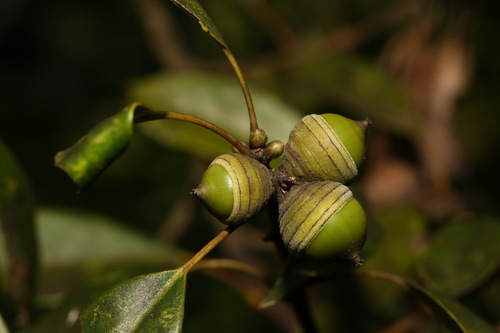
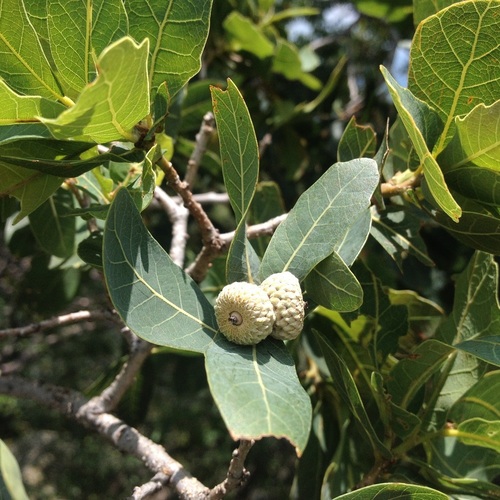
Quercus oblongifolia
Torr.
Mexican blue oak, Live oak, Evergreen oak
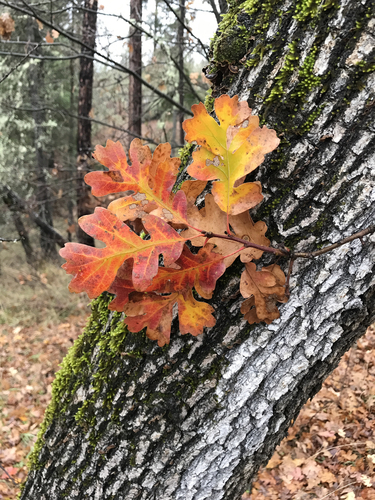
iNaturalist· cc0
no rights reserved, uploaded by aiwendil
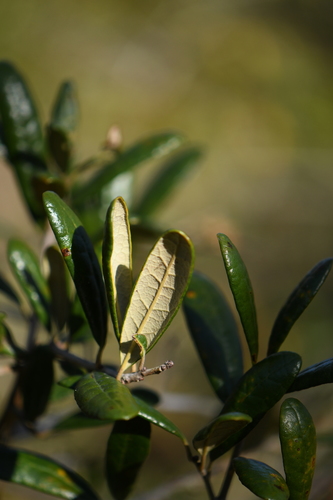
iNaturalist· cc-by-nc
(c) Andrew Hipp, some rights reserved (CC BY-NC), uploaded by Andrew Hipp
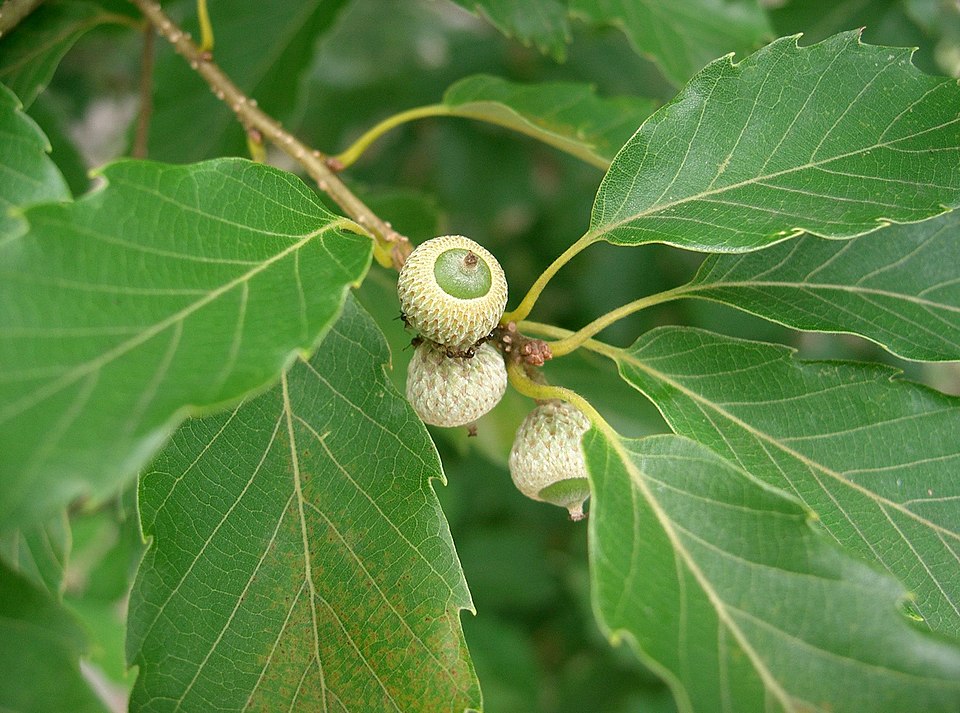
iNaturalist· cc-by-nc
(c) Andrew Hipp, some rights reserved (CC BY-NC), uploaded by Andrew Hipp
Summary
Source: WikipediaQuercus oblongifolia, commonly known as the Mexican blue oak, Arizona blue oak, Blue live oak or Sonoran blue oak, is an evergreen small tree or large shrub in the white oak group.
Description
Evergreen shrub growing to 8 m tall with year-round seed production, flowering in May. Monoecious and wind-pollinated. Tolerates medium loamy to heavy clay soils across mildly acid to basic pH ranges. Grows in semi-shade or full sun and prefers moist soil. Hardy to UK zone 7, withstands strong winds but not coastal exposure.
Edible Uses
The seed can be eaten raw or cooked and was a staple food for some native North American Indian tribes. It is very sweet, measuring up to 2cm long and 8mm wide. The seed can be dried and ground into a powder for use as a thickening agent in stews or mixed with cereals for bread. Where any bitterness is present, tannins can be leached out by washing thoroughly in running water, though minerals are also lost. Both whole seeds and ground powder can be leached — whole seeds may take several days or weeks, and a traditional method was to place them wrapped in a cloth bag in a running stream. Ground powder leaches more quickly. A taste test confirms when enough tannin has been removed. The traditional preparation involved burying seeds in boggy ground over winter and digging up the germinating seeds in spring, by which point most astringency would have gone. The roasted seed also works as a coffee substitute.
Traditional Uses
The acorns are used for food. The hulls are removed, the acorns parched, and ground into meal and eaten.
This uses section is brief — help expand it
Medicinal Uses
Any galls produced on the tree are strongly astringent and can be used in the treatment of haemorrhages, chronic diarrhoea, and dysentery.
Distribution
It is a warm temperate to tropical plant.
Where It Grows
Central America, Mexico, North America, USA,
Cultivation
Prefers a good deep fertile loam which can be on the stiff side. Young plants tolerate reasonable levels of side shade. Tolerates moderate exposure, surviving well but being somewhat stunted. Prefers warmer summers than are usually experienced in Britain, trees often grow poorly in this country and fail to properly ripen their wood resulting in frost damage overwinter. The tree flowers on new growth produced in spring, the seed ripening in its first year. Intolerant of root disturbance, trees should be planted in their permanent positions whilst young. Hybridizes freely with other members of the genus. Plants in this genus are notably resistant to honey fungus.
Propagation
Seed loses viability quickly if allowed to dry out. It can be stored moist and cool over winter, but is best sown as soon as it is ripe in an outdoor seed bed with protection from mice and squirrels. Small quantities can be sown in deep pots in a cold frame. Because plants develop a deep taproot, they should be moved to their permanent positions as soon as possible — seeds sown in situ produce the best trees. Do not leave trees in a nursery bed for more than 2 growing seasons, as they will transplant very poorly.
Other Uses
A mulch of leaves placed around plants repels slugs, grubs, and similar pests. Fresh leaves should not be used as they can inhibit plant growth. Oak galls, formed by insect larvae feeding within them, are a rich source of tannin once the insect has left, and can also be used as a dyestuff. The wood is very heavy, hard, strong, and brittle, and is sometimes used as a fuel.
Notes
There are about 600 Quercus species.
Synonyms
References (6)
- Beckstrom-Sternberg, Stephen M., and James A. Duke. "The Foodplant Database." http://probe.nalusda.gov:8300/cgi-bin/browse/foodplantdb.(ACEDB version 4.0 - data version July 1994)
- Hedrick, U.P., 1919, (Ed.), Sturtevant's edible plants of the world. p 546
- Menninger, E.A., 1977, Edible Nuts of the World. Horticultural Books. Florida p 19
- Moerman, D. F., 2010, Native American Ethnobotany. Timber Press. p 463
- Plants for a Future database, The Field, Penpol, Lostwithiel, Cornwall, PL22 0NG, UK. http://www.scs.leeds.ac.uk/pfaf/
Show all 6 references Hide references
- Wickens, G.E., 1995, Edible Nuts. FAO Non-wood forest products. FAO, Rome. p 129