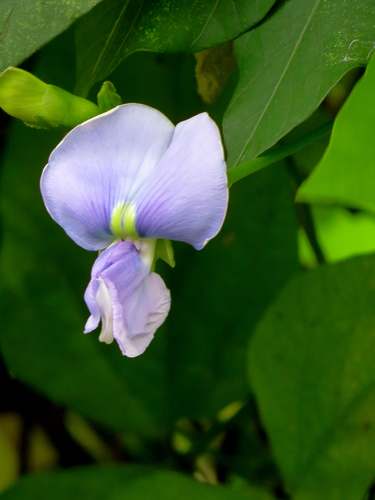
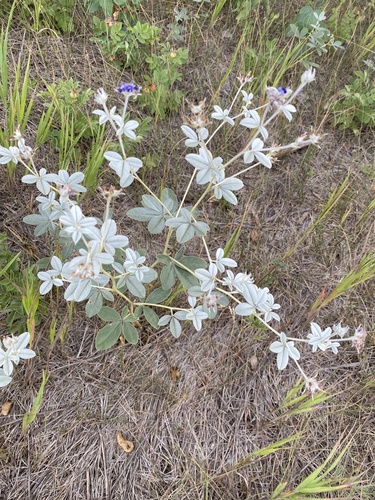
Hoita orbicularis
(Lindl.) Rydb.
Roundleaf leather root
iNaturalist· cc-by
(c) Jerry Kirkhart, some rights reserved (CC BY)
iNaturalist· cc-by-nc-sa
(c) 2011 Barry Breckling, some rights reserved (CC BY-NC-SA)
iNaturalist· cc-by-nc-sa
(c) 2011 Barry Breckling, some rights reserved (CC BY-NC-SA)
Summary
Source: WikipediaHoita orbicularis is a species of legume known by the common name roundleaf leather-root. It is endemic to California, where it is relatively widespread throughout the state's mountain ranges, growing most often in moist habitat. It is a perennial herb growing prostrate or nearly so at ground level with large leaves each made up of three round leaflets up to 11 centimetres (4+1⁄4 in) long each. The herbage is glandular and often hairy. The inflorescence is an erect raceme which may be up to 35 centimetres (13+2⁄3 in) long. Each of the many flowers is one or two centimeters long, pealike, and generally a shade of light to medium purple in color. The fruit is a hairy, veiny legume pod just under 1 centimetre (1⁄2 in) long.
Description
A bean family herb. It keeps growing from year to year. It grows near ground level and has large leaves with 3 round leaflets. They are 11 cm long and wide. The flowering shoots can be 35 cm long. The pod is 1 cm long.
Edible Uses
The leaves are eaten as a green.
Traditional Uses
Leaves are eaten as a green.
This uses section is brief — help expand it
Distribution
It suits a Mediterranean climate. It grows in California. It grows in wetlands.
Where It Grows
North America, USA,
Synonyms
References (4)
- Beckstrom-Sternberg, Stephen M., and James A. Duke. "The Foodplant Database." http://probe.nalusda.gov:8300/cgi-bin/browse/foodplantdb.(ACEDB version 4.0 - data version July 1994) (As Psoralea orbicularis)
- Edward's Bot. Reg. 23: t. 1971. 1837 (As Psoralea orbicularis)
- Moerman, D. F., 2010, Native American Ethnobotany. Timber Press. p 267
- Plants for a Future database, The Field, Penpol, Lostwithiel, Cornwall, PL22 0NG, UK. http://www.scs.leeds.ac.uk/pfaf/ (As Psoralea orbicularis)