Pseudolachnostylis maprouneifolia
Pax
Kudu-berry
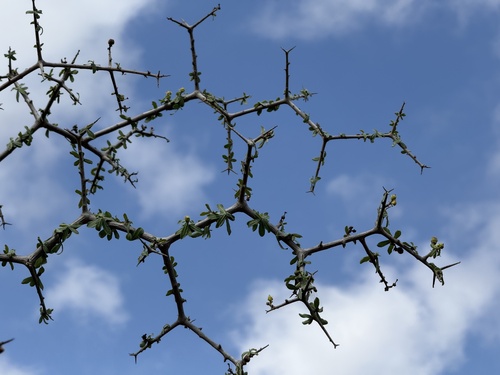
iNaturalist· cc-by-nc
(c) Bart Wursten, some rights reserved (CC BY-NC)
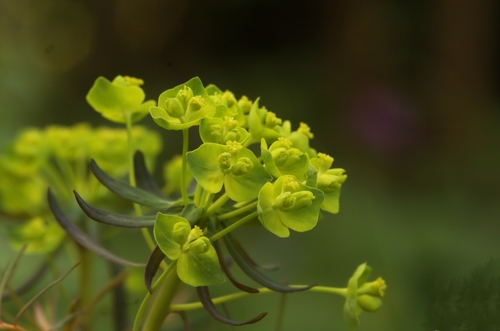
iNaturalist· cc-by-nc-sa
(c) David Hoare, some rights reserved (CC BY-NC-SA), uploaded by David Hoare
iNaturalist· cc-by-nc
(c) Bart Wursten, some rights reserved (CC BY-NC)
Description
An attractive rounded tree. It grows 4-6 m high. It can be 12 m high. The bark is light brown and cracked. The leaves are alternate and simple. The are roundly oval. They are 2.5-8 cm long by 2-6 cm wide. They are blue green and paler underneath. The leaf stalk is 1.5 cm long. The flowers are greenish-white in clusters of a few flowers in the axils of leaves. These are 2-3 cm long. The sexes are separate on different trees. The fruit is round and 2 cm across. They are pale yellow when mature. There are 3 varieties.
Edible Uses
The fruits are edible. The yellowish green, yellow or pinkish green fruit is an ovoid to rounded drupe-like capsule 15 - 20mm long containing 3 - 7 seeds.
Traditional Uses
The fruit are eaten raw. They are also used for alcoholic drinks.
This uses section is brief — help expand it
Medicinal Uses
A root decoction is taken as a purgative to treat stomach-ache and abdominal problems. The smoke of burning roots is inhaled to treat pneumonia. A root infusion is taken to treat abdominal pain, gonorrhoea and female sterility. An infusion of the roots, mixed with those of Lannea schimperi, kamwamadzi, mbundaculu, and sometimes with flour, is drunk as a cure for diorrhoea or dysentery. The pulp of peeled roots is applied to leprous sores. Dried, pulverized root is sniffed to treat nosebleed and headache. It is sprinkled on fresh wounds to heal them. In Tanzaniathe roots and bark mixed with poisonous insects are burned and the ashes applied to incisions as a cure for tumours. The pulverized bark mixed in porridge is taken to treat pneumonia, tuberculosis and aenemia. A bark extract is drunk or dried powdered root mixed in porridge is taken to treat diarrhoea, dysentery and as an aphrodisiac. A bark infusion is taken to treat dizziness and vomiting. The leaves pounded together with leaves, bark and roots of pigeon pea (Cajanus cajan) in water are used as ear drops to treat earache. The leaves are boiled and the strained liquid is rubbed into incisions on the side to treat pain in the side. A leaf decoction is taken to treat cough and fever.
Distribution
A tropical plant. It grows in deciduous woodland and wooded grassland and on rocky outcrops. It will grow over a range of altitudes. It grows from 200-1,600 m altitude. It will re-grow after fire. It can grow in arid places. Brisbane Botanical Gardens.
Where It Grows
Africa, Angola, Australia, Botswana, Burundi, Central Africa, Congo, East Africa, Malawi, Mozambique, Namibia, South Africa, Southern Africa, Tanzania, Zambia, Zimbabwe,
Cultivation
Plants are grown from seed. Soaking seed in hot water and allowing it to cool for 24 hours improves germination. Plants can be pruned or cut back and allowed to re-grow.
Propagation
Seed - sow in a nursery seedbed. The seed naturally passes through the gut of a creature before germinating and does not germinate so well if it has not had this treatment. An alternative way of improving the germination rate is by pouring a small amount of nearly boiling water on the seeds (being careful not to cook them!) and then soaking them for 12 - 24 hours in warm water before sowing them. Seeds can be stored for later use.
Other Uses
The fruits are used to dye bark cloth. The wood is moderately heavy, with an even texture. It is used to make toys, joinery, turnery and handicrafts. The woodis used as firewood and to make charcoal.
Notes
There is only one Pseudolachnostylis species.
Nutrition
| Part | Moisture | kJ | kcal | Protein | Vit A | Vit C | Iron | Zinc |
|---|---|---|---|---|---|---|---|---|
| Fruit | 60 | 147 | 35 | 3.3 | — | — | 2.7 | 2.6 |
Synonyms
Also Known As
Duiker food, Koedoebessie, Mojaphitu, Mokonu, Mokongu, Mokunya bambi, M'tolo, Msolo, Msono, Mudyamhembwe, Mukuvazviyo, Musangati, Mutolo, Mutsonzowa, Umqobampunzi
References (16)
- Drummond, R. B., 1981, Common Trees of the Central Watershed Woodlands of Zimbabwe, National Herbarium Salisbury. p 110
- Fowler, D. G., 2007, Zambian Plants: Their Vernacular Names and Uses. Kew. p 27
- Mannheimer, C. A. & Curtis. B.A. (eds), 2009, Le Roux and Muller's Field Guide to the Trees and Shrubs of Namibia. Windhoek: Macmillan Education Namibia. p 246
- Mbuya, L.P., Msanga, H.P., Ruffo, C.K., Birnie, A & Tengnas, B., 1994, Useful Trees and Shrubs for Tanzania. Regional Soil Conservation Unit. Technical Handbook No 6. p 416
- Palgrave, K.C., 1996, Trees of Southern Africa. Struik Publishers. p 396
Show all 16 references Hide references
- Peters, C. R., O'Brien, E. M., and Drummond, R.B., 1992, Edible Wild plants of Sub-saharan Africa. Kew. p 112
- Reis, S. V. and Lipp, F. L., 1982, New Plant Sources for Drugs and Foods from the New York Botanical Garden herbarium. Harvard. p 161
- Roodt, V., 1998, Trees & Shrubs of the Okavango Delta. Medicinal Uses and Nutritional value. The Shell Field Guide Series: Part 1. Shell Botswana. p 193
- Royal Botanic Gardens, Kew (1999). Survey of Economic Plants for Arid and Semi-Arid Lands (SEPASAL) database. Published on the Internet; http://www.rbgkew.org.uk/ceb/sepasal/internet [Accessed 16th April 2011]
- Ruiters-Welcome, A. K., 2019, Food plants of southern Africa. Ph.D. thesis. Univ. of Johannesburg p 86
- Schmelzer, G.H., 2007. Pseudolachnostylis maprouneifolia Pax. [Internet] Record from Protabase. Schmelzer, G.H. & Gurib-Fakim, A. (Editors). PROTA (Plant Resources of Tropical Africa), Wageningen, Netherlands. < http://database.prota.org/search.htm>. Accessed 22 October 200919 October 2009.
- van Wyk, B, van Wyk, P, and van Wyk B., 2000, Photographic guide to Trees of Southern Africa. Briza. p 253
- Welcome, A. K. & Van Wyk, B.-E., 2019, An inventory and analysis of the food plants of southern Africa. South African Journal of Botany 122 (2019) 136–179
- Williamson, J., 2005, Useful Plants of Malawi. 3rd. Edition. Mdadzi Book Trust. p 208
- World Checklist of Useful Plant Species 2020. Royal Botanic Gardens, Kew
- www.zimbabweflora.co.zw 2011