Prunus domestica subsp. insititia
(L.) Bonnier & Layens
Bullace, Damson
iNaturalist· cc-by-nc
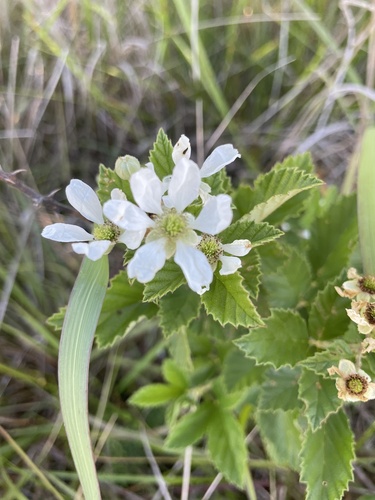
(c) fahrenheit_66, some rights reserved (CC BY-NC), uploaded by fahrenheit_66
iNaturalist· cc-by-sa
(c) Ввласенко, some rights reserved (CC BY-SA)
iNaturalist· cc-by-nc-nd
(c) Andreas, some rights reserved (CC BY-NC-ND)
Summary
Source: WikipediaPrunus domestica is a species of flowering plant in the family Rosaceae. A deciduous tree, it includes many varieties of the fruit trees known as plums in English, though not all plums belong to this species. The greengages and damsons also belong to subspecies of P. domestica.
Description
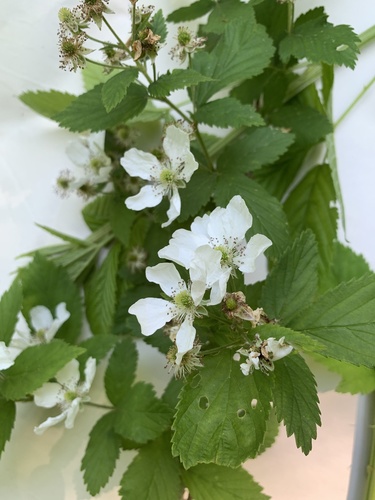
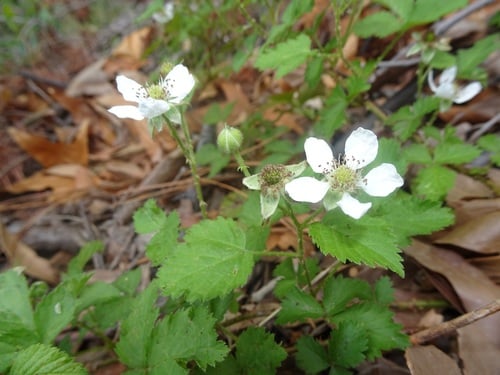
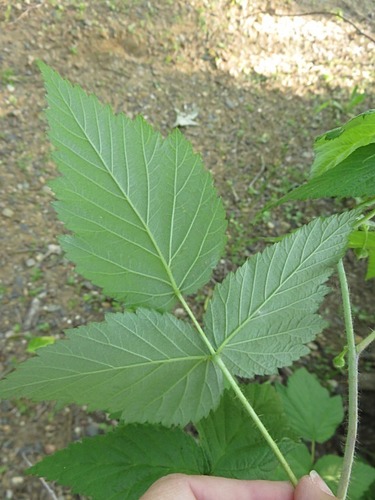
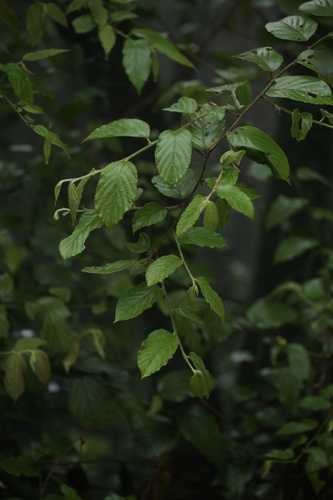
A deciduous tree. It grows 7 m tall. It is a broad spreading shape. The bark is dark grey and smooth but becomes cracked with age. The leaves are narrowly oval and 7.5 cm long by 5 cm wide. They have an abrupt short point at the tip. The leaves have blunt teeth. The leaves are matt green above and are on often spiny shoots. The flowers are 2.5 cm across and white with 5 petals. The flowers occur singly or in small clusters of up to 3. The fruit are rounded. They are 5 cm long. The fruit is small and dark blue. The stone inside is nearly round and clings to the flesh.
Edible Uses
The pulp is edible and usually sweet, though some varieties are sour and require cooking with sugar to make them palatable. Plums are grown commercially in orchards, but modern rootstocks, together with self-fertile strains, training and pruning methods, allow single plums to be grown in relatively small spaces. Their early flowering and fruiting means that they require a sheltered spot away from frosts and cold winds. Most prunes (dried plums) are made from fruits of this species.
Traditional Uses
The fruit are eaten raw. It is more often eaten in preserves. The leaves are used for tea like drinks.
This uses section is brief — help expand it
Distribution
It is a temperate plant. It can resist disease and cold. It suits plant hardiness zones 5-9. In Hobart Botanical Gardens.
Where It Grows
Africa, Andorra, Asia, Australia, Balkans, Britain, Bulgaria, Caucasus, China, Estonia, Europe, Finland, Georgia, Greece, Himalayas, Hungary, India, Isle of Man, Macedonia, Mediterranean, Middle East, North Africa, Scandinavia, Spain, Switzerland, Syria, Tasmania, Tunisia, Turkey, Türkiye, USA,
Notes
There are about 200 Prunus species.
Synonyms
Also Known As
Andriniega, Kreegipuu, Trankosliva
References (36)
- Ambasta, S.P. (Ed.), 2000, The Useful Plants of India. CSIR India. p 495 (As Prunus insititia)
- Arora, R. K., 2014, Diversity in Underutilized Plant Species - An Asia-Pacific Perspective. Bioversity International. p 83
- Blamey, M and Grey-Wilson, C., 2005, Wild flowers of the Mediterranean. A & C Black London. p 77 (As Prunus domestica ssp. insititia)
- Bodkin, F., 1991, Encyclopedia Botanica. Cornstalk publishing, p 841 (As Prunus insititia)
- BOUQUET, (As Prunus insititia)
Show all 36 references Hide references
- Bremness, L., 1994, Herbs. Collins Eyewitness Handbooks. Harper Collins. p 76 (As Prunus domestica ssp. insititia)
- Bussman, R. W., et al, 2016, A comparative ethnobotany of Khevsureti, Samtskhe-Javakheti, Tusheti, Svaneti, and Racha-Lechkhumi, Republic of Georgia (Sakartvelo), Caucasus. Journal of Ethnobiology and Ethnomedicine. (As Prunus insititia)
- Bussman, R. W. et al, 2017, Ethnobotany of Samtskhe-Javakheti, Sakartvelo (Republic of Georgia), Caucasus. Indian Journal of Traditional Knowledge Vol. 16(1) pp 7-24 (As Prunus insititia)
- Bussman, R. W., et al, 2021, Unity in diversity—food plants and fungi of Sakartvelo (Republic of Georgia), Caucasus. Journal of Ethnobiology and Ethnomedicine (2021) 17:72 p 14 (As Prunus insititia)
- Cheifetz, A., (ed), 1999, 500 popular vegetables, herbs, fruits and nuts for Australian Gardeners. Random House p 225 (As Prunus insititia)
- Coombes, A.J., 2000, Trees. Dorling Kindersley Handbooks. p 261 (As Prunus insititia)
- Curtis, W.M., 1956, The Students Flora of Tasmania Vol 1 p 174 (As Prunus insititia)
- Denes, A., et al, 2012, Wild plants used for food by Hungarian ethnic groups living in the Carpathian Basin. Acta Societatis Botanicorum Poloniae 81 (4): 381-396
- Facciola, S., 1998, Cornucopia 2: a Source Book of Edible Plants. Kampong Publications, p 203 (As Prunus insititia)
- Flora of China. Vol. 9 p 402
- Flowerdew, B., 2000, Complete Fruit Book. Kyle Cathie Ltd., London. p 38 (As Prunus insititia)
- Hedrick, U.P., 1919, (Ed.), Sturtevant's edible plants of the world. p 524 (As Prunus insititia)
- Heywood, V.H., Brummitt, R.K., Culham, A., and Seberg, O. 2007, Flowering Plant Families of the World. Royal Botanical Gardens, Kew. p 282 (As Prunus insititia)
- Hibbert, M., 2002, The Aussie Plant Finder 2002, Florilegium. p 241 (As Prunus insititia)
- Ill. Handb. Laubholzk. 1:630. 1906
- Jackes, D. A., 2007, Edible Forest Gardens
- John, L., & Stevenson, V., 1979, The Complete Book of Fruit. Angus & Robertson p 234 (As Prunus insititia)
- Kalle, R. & Soukand, R., 2012, Historical ethnobotanical review of wild edible plants of Estonia (1770s-1960s) Acta Societatis Botanicorum Poloniae 81(4):271-281
- Kiple, K.F. & Ornelas, K.C., (eds), 2000, The Cambridge World History of Food. CUP p 1767 (As Prunus insititia)
- Maghradze, D. et al, 2012, Minor and Underutilized Fruits in Georgia and Their Wild Relatives. In Acta Horticulturae Number 948 p 41-47
- Menendez-Baceta, G., et al, 2012, Wild edible plants traditionally gathered in Gorbeialdea (Biscay, Basque Country) Genetic Resources and Crop Evolution 59:1329-1347
- Nedelcheva A., 2013, An ethnobotanical study of wild edible plants in Bulgaria. EurAsian Journal of BioSciences 7, 77-94
- Pardo-de-Santayana, M., et al, 2005, The gathering and consumption of wild edible plants in the Campoo (Cantabria, Spain). International Journal of Food Sciences and Nutrition. 56(7): 529-542 (As Prunus insititia)
- Pardo-de-Santayana, M., et al, 2007, Traditional knowledge of wild edible plants used in the northwest of the Iberian Peninsula (Spain and Portugal): a comparative study. Journal of Ethnobiology and Ethnomedicine 2007, 3:27 (As Prunus insititia)
- Plants for a Future, The Field, Penpol, Lostwithiel, Cornwall, PL22 0NG, UK. http://www.scs.leeds.ac.uk/pfaf/ (As Prunus insititia)
- Sfikas, G., 1984, Trees and shrubs of Greece. Efstathiadis Group. Athens. p 68 (As Prunus domestica ssp. insititia)
- Small, E., 2009, Top 100 Food Plants. The world's most important culinary crops. NRC Research Press. p 435
- Tasmanian Herbarium Vascular Plants list p 51 (As Prunus domestica ssp. insititia)
- Tardio, J., et al, Ethnobotanical review of wild edible plants in Spain. Botanical J. Linnean Soc. 152 (2006), 27-71 (As Prunus institia)
- USDA, ARS, National Genetic Resources Program. Germplasm Resources Information Network - (GRIN). [Online Database] National Germplasm Resources Laboratory, Beltsville, Maryland. Available: www.ars-grin.gov/cgi-bin/npgs/html/econ.pl (10 April 2000) (As Prunus domestica ssp. insititia)
- Watkins, R., 1979, Cherry, plum, peach, apricot and almond, in Simmonds, N.W., (ed), Crop Plant Evolution. Longmans. London. p 242 (As Prunus insititia)