Prunus cerasus
L.
Sour cherry, Morello cherry, Pie cherry
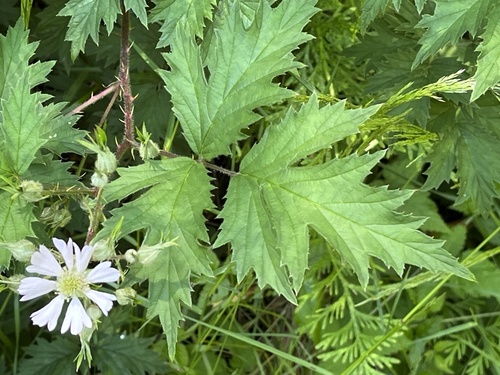
iNaturalist· cc0
no rights reserved
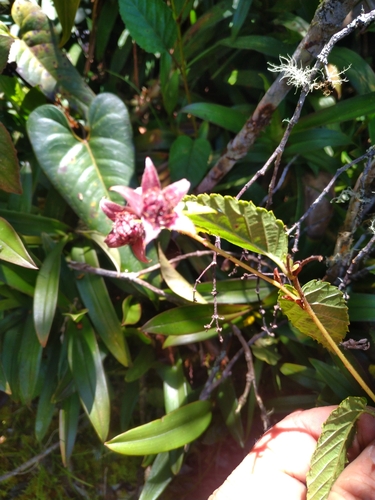
iNaturalist· cc-by-nc
(c) stephenkloiber, some rights reserved (CC BY-NC)
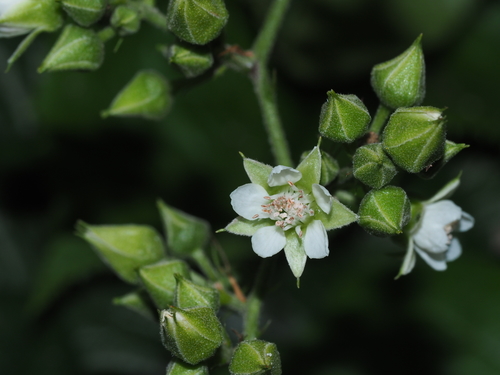
iNaturalist· cc-by-nc
(c) aneezablade, some rights reserved (CC BY-NC)
Summary
Source: WikipediaPrunus cerasus (sour cherry, tart cherry, or dwarf cherry) is an Old World species of Prunus in the subgenus Cerasus (cherries). It has two main groups of cultivars: the dark-red Morello cherry and the lighter-red Amarelle cherry. The sour pulp is edible.
Description
A small deciduous tree. It grows 2-8 m high. It is a broad spreading shape. The bark is purple-brown and has orange lenticels across it. The leaves are oval and have a blunt point. They are 7.5 cm long by 5 cm wide. They are double toothed. The leaf stalks are without glands and are hairless. The buds are cone shaped. They are shiny reddish-brown. The flowers are white and in small long stalked clusters. These are on short leafy shoots. The flowers are 2 cm across. The fruit are 2 cm across. They are bright red to black.
Edible Uses
The fruit is pleasantly acid, about 18mm in diameter with one large seed, and can be eaten fresh, used in pies and preserves, or dried for later use. The seed can be eaten raw or cooked, though it should be avoided if it tastes too bitter; it also yields an edible oil that, once refined, can be used as a salad oil. The leaves make a serviceable tea substitute, and a gum obtained from the trunk is used for chewing.
Traditional Uses
Fruit can be eaten raw. They are acidic. They are often cooked into pies, preserves, puddings, and canned. They produce a colourless juice. The seeds yield an oil used in salads. The crushed seeds in a muslin bag are used to flavour jam. The fruit are candied (crystallised) and also preserved in syrup or brandy. They are processed into jam. They are used for cherry brandy and liqueurs. The leaves are used as a substitute for tea. They are also added to lacto-fermented cucumbers. And used for flavouring in pickles.
Medicinal Uses
The bark is astringent, bitter, and febrifuge. An infusion of the bark has been used to treat fevers, coughs, and colds. Root bark has been used as a wash for old sores and ulcers. The seed is nervine. Like all members of the genus, this species contains amygdalin and prunasin, which break down in water to form hydrocyanic acid (prussic acid or cyanide). In small amounts this exceedingly poisonous compound stimulates respiration, improves digestion, and gives a sense of well-being.
Known Hazards
Although no specific mention has been seen for this species, it belongs to a genus where most, if not all members of the genus produce hydrogen cyanide, a poison that gives almonds their characteristic flavour. This toxin is found mainly in the leaves and seed and is readily detected by its bitter taste. It is usually present in too small a quantity to do any harm but any very bitter seed or fruit should not be eaten. In small quantities, hydrogen cyanide has been shown to stimulate respiration and improve digestion, it is also claimed to be of benefit in the treatment of cancer. In excess, however, it can cause respiratory failure and even death.
Distribution
It is a cold temperate plant. In the Indian Himalayas it grows between 3,000-3,500 m above sea level. It suits hardiness zones 3-9.
Where It Grows
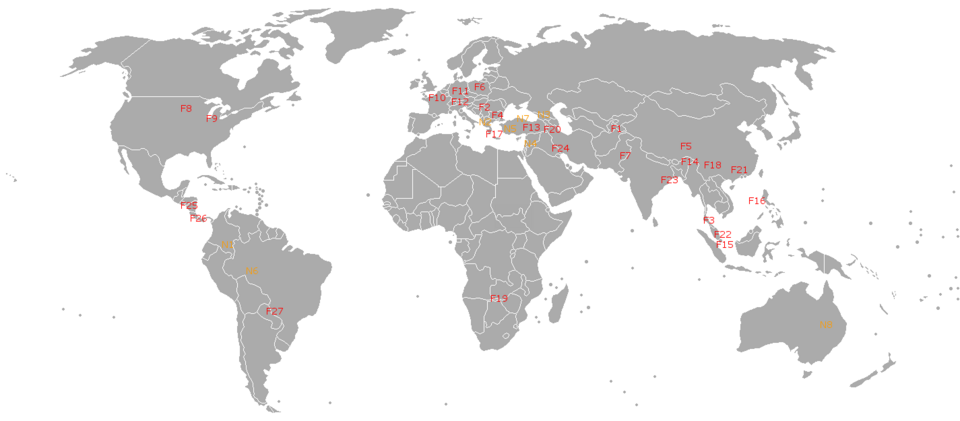
Afghanistan, Africa, Albania, Argentina, Armenia, Asia, Australia, Austria, Azerbaijan, Balkans, Britain, Bulgaria, Canada, Caucasus, Central Asia, Croatia, Czech, Denmark, East Africa, Ecuador, Estonia, Europe, Finland, France, Georgia, Germany, Greece, Himalayas, Hungary, India, Indochina, Ireland, Italy, Kazakhstan, Korea, Latvia, Lithuania, Macedonia, Mediterranean, Moldova, North America, Norway, Pakistan, Portugal, Scandinavia, SE Asia, Serbia, South Africa, Southern Africa, South America, Spain, Sweden, Switzerland, Tajikistan, Tasmania, Turkey, Türkiye, Ukraine, USA, Vietnam, Zimbabwe,
Cultivation
Thrives in a well-drained moisture-retentive loamy soil. Prefers some lime in the soil but is likely to become chlorotic if too much lime is present. Prefers an acid soil according to another report. Succeeds in sun or partial shade though it fruits better in a sunny position. Plants are succeeding in a fairly exposed maritime position at Rosewarne in N. Cornwall. Plants are hardy to about -20°c. Long cultivated for its edible fruit, there are many named varieties. See separate entries for the various sub-species. It is also a parent, with P. avium, of many cultivars of sweet cherries. Many cultivars will succeed on a north or east facing wall. Most members of this genus are shallow-rooted and will produce suckers if the roots are damaged. Plants produce suckers freely. Plants in this genus are notably susceptible to honey fungus. A sprouting standard sending up shoots from the base.
Propagation
Seed requires 2–3 months of cold stratification and is best sown in a cold frame as soon as it is ripe. Stored seed should be sown in a cold frame as early in the year as possible, with protection from mice. Germination can be slow, sometimes taking 18 months. Prick seedlings into individual pots when large enough to handle, overwinter in a greenhouse or cold frame, then plant out in late spring or early summer the following year. Cuttings of half-ripe wood with a heel can be taken in July/August in a frame. Softwood cuttings from vigorous plants can be taken in spring to early summer in a frame. Layering can be done in spring. Suckers can be divided during the dormant season and planted directly into permanent positions.
Other Uses
Plants can be grown as a hedge, tolerating fairly exposed positions, and serve as an excellent nectar plant, yielding both nectar and pollen. The seed also yields a drying oil used in cosmetics. The kernels contain an almond-flavoured fatty oil (24–35%) used in soap manufacture and suitable for burning, though it contains a large quantity of amygdalin and becomes more bitter over time. According to American data, 1,000 tons of stones yields 448 tons of kernels, which can produce 96,235.5 kg (95,563 litres) of syrup, 22,736 litres of spirits, 338,130 litres of gum, 200 tons of powder, 3 tons of essential oil, and 4.134 tons of fatty oil. The gum from the stem functions as an adhesive and is used in cloth manufacture. Green dye can be obtained from the leaves, and a dark grey to green dye from the fruit. The plant is used as a rootstock for cultivated cherries and in sweet cherry breeding programmes. The bark contains 5–7% tannins, including some quercetin. The yellowish-red wood is compact, fairly heavy, and suitable for woodwork and lathework including pipes, cigarette holders, and barrel hoops.
Production
Fruit are often mechanically harvested by shaking.
Other Information
It is a cultivated food plant.
Notes
There are about 200 Prunus species. It is a tetraploid plant.
Nutrition
| Part | Moisture | kJ | kcal | Protein | Vit A | Vit C | Iron | Zinc |
|---|---|---|---|---|---|---|---|---|
| Fruit dried | 8.9 | 1331 | 318 | 1.9 | — | — | — | — |
| Fruit fresh | 86.1 | 209 | 50 | 1 | 128 | 10 | 0.32 | 0.1 |
Synonyms
Also Known As
Alubali, Amareno, Cereza acida, Cerazo, Cerise aigre, Ciliegia acida, Dwarf cherry, Gilas, Ginja garrafal, Griotte, Guinda, Guindo, Jera-sayna, Kentish cherry, Kirsebaer, Kirsipuu, Marasco, Olchi, Red cherry, Sanka outou, Sauerkirsche, Suan gui ying tao, Tart cherry, Ulchi, Vadmeggy, Visnja, Weichsel
References (65)
- Altschul, S.V.R., 1973, Drugs and Foods from Little-known Plants. Notes in Harvard University Herbaria. Harvard Univ. Press. Massachusetts. no. 1480 (As Prunus vulgaris)
- Ambasta, S.P. (Ed.), 2000, The Useful Plants of India. CSIR India. p 494
- Bianchini, F., Corbetta, F., and Pistoia, M., 1975, Fruits of the Earth. Cassell. p 146
- Bodkin, F., 1991, Encyclopedia Botanica. Cornstalk publishing, p 841
- Bussman, R. W., et al, 2016, A comparative ethnobotany of Khevsureti, Samtskhe-Javakheti, Tusheti, Svaneti, and Racha-Lechkhumi, Republic of Georgia (Sakartvelo), Caucasus. Journal of Ethnobiology and Ethnomedicine.
Show all 65 references Hide references
- Bussman, R. W. et al, 2017, Ethnobotany of Samtskhe-Javakheti, Sakartvelo (Republic of Georgia), Caucasus. Indian Journal of Traditional Knowledge Vol. 16(1) pp 7-24
- Bussman, R. W., et al, 2021, Unity in diversity—food plants and fungi of Sakartvelo (Republic of Georgia), Caucasus. Journal of Ethnobiology and Ethnomedicine (2021) 17:72 p 14
- Chamorro, M. F., & Ladio, A., 2020, Native and exotic plants with edible fleshy fruits utilized in Patagonia and their role as sources of local functional foods. BMC Complementary Medicine and Therapies. 20:155
- Cheifetz, A., (ed), 1999, 500 popular vegetables, herbs, fruits and nuts for Australian Gardeners. Random House p 224
- Cundall, P., (ed.), 2004, Gardening Australia: flora: the gardener's bible. ABC Books. p 1093
- Denes, A., et al, 2012, Wild plants used for food by Hungarian ethnic groups living in the Carpathian Basin. Acta Societatis Botanicorum Poloniae 81 (4): 381-396
- Dolina, K. & Luczaj, L., 2014, Wild food plants used on the Dubrovnik coast (south-eastern Croatia) Acta Soc Bot Pol 83(3):175–181
- Enum. pl. Transsilvaniae 954 (Index). 1866, nom. inval. (As Prunus vulgaris)
- Ertug, F., 2000, An Ethnobotanical Study in Central Anatolia (Turkey). Economic Botany Vol. 54. No. 2. pp. 155-182 (Also as Cerasus vulgaris)
- Esperanca, M. J., 1988. Surviving in the wild. A glance at the wild plants and their uses. Vol. 2. p 92
- Facciola, S., 1998, Cornucopia 2: a Source Book of Edible Plants. Kampong Publications, p 201
- Farrar, J.L., 1995, Trees of the Northern United States and Canada. Iowa State University press/Ames p 375
- Flowerdew, B., 2000, Complete Fruit Book. Kyle Cathie Ltd., London. p 50
- Girard, N. J., 2020, Sustainable Foraging of Wild Edible Plants in Norway. A Biocultural Approach. M. Sc. thesis Norwegian University. p 135
- Gonzalez, J. A., et al, 2011, The consumption of wild and semi-domesticated edible plants in the Arribes del Duero (Salamanca-Zamora, Spain): an ananalysis of traditional knowledge. Genetic Resources and Crop Evolution 58:991-1006
- Glowinski, L., 1999, The Complete Book of Fruit Growing in Australia. Lothian. p 67
- Hedrick, U.P., 1919, (Ed.), Sturtevant's edible plants of the world. p 522
- Heywood, V. H. & Zohary, D.,1995, A Catalogue of the Wild Relatives of Cultivated Plants Native to Europe. Flora Mediterranea 5 - 1995, p 395
- Hibbert, M., 2002, The Aussie Plant Finder 2002, Florilegium. p 241
- Irving, M., 2009, The Forager Handbook, A Guide to the Edible Plants of Britain. Ebury Press p 272
- Jackes, D. A., 2007, Edible Forest Gardens
- Jardin, C., 1970, List of Foods Used In Africa, FAO Nutrition Information Document Series No 2.p 156
- John, L., & Stevenson, V., 1979, The Complete Book of Fruit. Angus & Robertson p 104
- Kalle, R. & Soukand, R., 2012, Historical ethnobotanical review of wild edible plants of Estonia (1770s-1960s) Acta Societatis Botanicorum Poloniae 81(4):271-281
- Kargioglu, M., et al, 2008, An Ethnobotanical Survey of Inner-West Anatolia, Turkey. Human Ecology 36:763-777 (As Cerasus vulgaris)
- Khan, D. & Shaukat, S.S., 2006, The Fruits of Pakistan: Diversity, Distribution, Trends of Production and Use. Int. J. Biol. Biotech., 3(3):463-499
- Kiple, K.F. & Ornelas, K.C., (eds), 2000, The Cambridge World History of Food. CUP p 1751, 1854
- Ladio, A., Lozada, M. & M. Weigandt, 2007, Comparison of traditional wild plant knowledge between aboriginal communities inhabiting arid and forest environments in Patagonia, Argentina. Journal of Arid Environments 69 (2007) 695–715
- Lazarides, M. & Hince, B., 1993, Handbook of Economic Plants of Australia, CSIRO. p 199
- Little, E.L., 1980, National Audubon Society Field Guide to North American Trees. Alfred A. Knopf. p 497
- Lord, E.E., & Willis, J.H., 1999, Shrubs and Trees for Australian gardens. Lothian. p 67
- Mabey, R., 1973, Food for Free. A Guide to the edible wild plants of Britain, Collins. p 171
- Macmillan, H.F. (Revised Barlow, H.S., et al) 1991, Tropical Planting and Gardening. Sixth edition. Malayan Nature Society. Kuala Lumpur. p 317 (As Prunus vulgaris)
- Menendez-Baceta, G., et al, 2012, Wild edible plants traditionally gathered in Gorbeialdea (Biscay, Basque Country) Genetic Resources and Crop Evolution 59:1329-1347
- Moerman, D. F., 2010, Native American Ethnobotany. Timber Press. p 440
- Pardo-de-Santayana, M., et al, 2005, The gathering and consumption of wild edible plants in the Campoo (Cantabria, Spain). International Journal of Food Sciences and Nutrition. 56(7): 529-542
- Pardo-de-Santayana, M., et al, 2007, Traditional knowledge of wild edible plants used in the northwest of the Iberian Peninsula (Spain and Portugal): a comparative study. Journal of Ethnobiology and Ethnomedicine 2007, 3:27
- Pham-Hoang Ho, 1999, An Illustrated Flora of Vietnam. Nha Xuat Ban Tre. p 804
- Pieroni, A., 1999, Gathered wild food plants in the Upper Valley of the Serchio River (Garfagnana), Central Italy. Economic Botany 53(3) pp 327-341
- Pieroni A, Nebel S, Santoro RF, Heinrich M., 2005, Food for two seasons: culinary uses of non-cultivated local vegetables and mushrooms in a south Italian village. Int J Food Sci Nutr. 56(4):245-72
- Pieroni, A. & Soukand, R., 2017, Are Borders more Important than Geographical Distance? The Wild Food Ethnobotany of the Boykos and its Overlap with that of the Bukovinian Hutsuls in Western Ukraine. Journal of Ethnobiology 37(2): 326–345
- Pieroni, A. & Soukand, R., 2017, The disappearing wild food and medicinal plant knowledge in a few mountain villages of North-Eastern Albania. Journal of Applied Botany and Food Quality 90, 58 - 67
- Plants for a Future database, The Field, Penpol, Lostwithiel, Cornwall, PL22 0NG, UK. http://www.scs.leeds.ac.uk/pfaf/
- Pruse, B., et al, 2021, Active Wild Food Practices among Culturally Diverse Groups in the 21st Century across Latgale, Latvia. Biology 2021, 10, 551.
- Rivera, C., et al, 2005, The Ethnobotanical Study of Local Mediterranean Food Plants as Medicinal Resources in Southern Spain. Journal of Physiologyand Pharmacology. 56, Suppl. 1, 97-114
- Ruiters-Welcome, A. K., 2019, Food plants of southern Africa. Ph.D. thesis. Univ. of Johannesburg p 94
- Sansanelli, S., et al, 2014, Wild food plants traditionall consumed in the area of Bologna (Emilia Romagna region, Italy). Journal of Ethnobiology and Ethnomedicine 10:69
- Sharma, L. et al, 2018, Diversity, distribution pattern, endemism and indigenous uses of wild edible plants in Cold Desert Biosphere Reserve of Indian Trans Himalaya. Indian Journal of Traditional Knowledge. Vol 17(1) January 2018 pp 122-131
- Small, E., 2009, Top 100 Food Plants. The world's most important culinary crops. NRC Research Press. p 169
- Sp. pl. 1:474. 1753
- Svanberg, I. et al, 2012, Uses of tree saps in northern and eastern parts of Europe. Acta Societatis Botanicorum Poloniae 81 (4): 343-357
- Tardio, J., et al, Ethnobotanical review of wild edible plants in Spain. Botanical J. Linnean Soc. 152 (2006), 27-71
- Torre, de la, L., et al, 2008, Enciclopedia de las Plantas Útiles del Ecuador. Herbario QCA. Pontificia Universidad Católica del Ecuador. p 532
- USDA, ARS, National Genetic Resources Program. Germplasm Resources Information Network - (GRIN). [Online Database] National Germplasm Resources Laboratory, Beltsville, Maryland. Available: www.ars-grin.gov/cgi-bin/npgs/html/econ.pl (10 April 2000)
- van Wyk, B., 2005, Food Plants of the World. An illustrated guide. Timber press. p 307
- Watkins, R., 1979, Cherry, plum, peach, apricot and almond, in Simmonds, N.W., (ed), Crop Plant Evolution. Longmans. London. p 242
- Welcome, A. K. & Van Wyk, B.-E., 2019, An inventory and analysis of the food plants of southern Africa. South African Journal of Botany 122 (2019) 136–179
- Wiersema, J. H. & Leon, B., 2013, World Economic Plants. A Standard Reference CRC Press. 2nd Ed. p 560
- World Checklist of Useful Plant Species 2020. Royal Botanic Gardens, Kew
- Zeven, A. C. & de West, J. M. J., 1982, Dictionary of cultivated plants and their regions of diversity. Wageningen. p 101