Potamogeton pectinatus
L.
Fennel-leaved pondweed, Sago pondweed
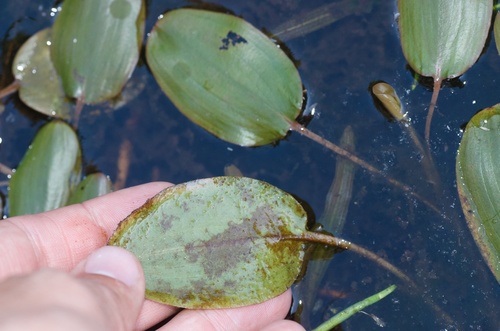
iNaturalist· cc-by-nc
(c) cambala, some rights reserved (CC BY-NC)
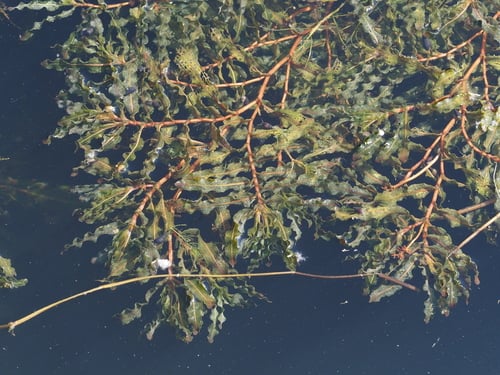
iNaturalist· cc-by-nc
(c) Nick Furlan, some rights reserved (CC BY-NC)
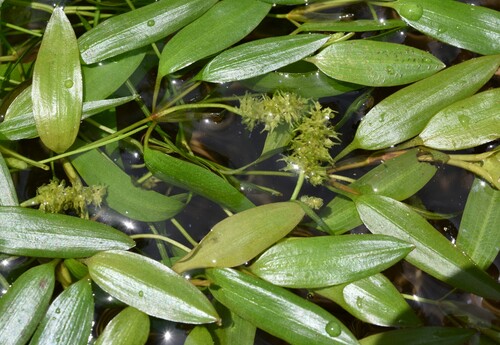
iNaturalist· cc-by-nc
(c) Nick Furlan, some rights reserved (CC BY-NC)
Summary
A fast-growing perennial aquatic plant with flowers from May to September. Hermaphroditic, water-pollinated, and valued for attracting wildlife. Adapts to light sandy, medium loamy, and heavy clay soils, including very alkaline conditions, across mildly acidic to basic pH ranges. Requires full sun and grows in water.
Description
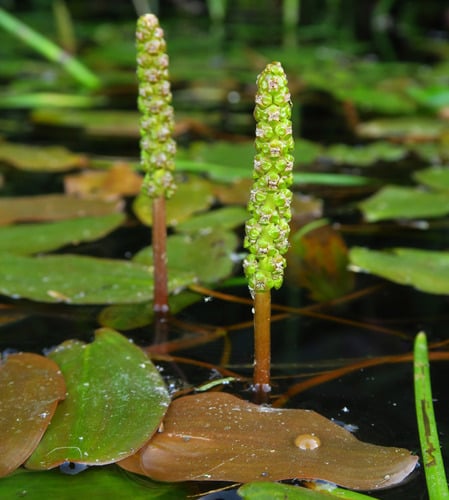
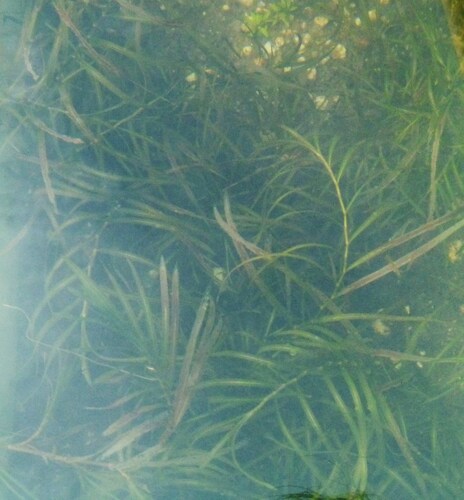
A herb which grows under water. It keeps growing from year to year. It has long creeping, tuber like rhizomes or underground stems. These can stick 1 m into mud. The stems are 3 m long and branched. The leaves are 1.5-15 cm long by 0.2 cm wide. The base is joined to the sheath. The flower spikes are 1.5-6 cm long. The flower can be above, on, or under the water. The flowers have both sexes. The fruit carpels are 2-4 mm long.
Edible Uses
Leaves and stems are edible, though no further details are recorded. The root is eaten raw and has a nutty taste; the outer rind should be removed before eating.
Traditional Uses
The rootstocks contain starch. The whole plant is eaten.
This uses section is brief — help expand it
Medicinal Uses
A decoction of the plant is used to treat a feverish liver.
Distribution
A temperate plant. It grows in moderately deep still water. The water can be 1-4 m deep. It will grow in water from 10°C to 25°C. It can grow in salty water.
Where It Grows
Africa, Asia, Australia, Belize, Britain, Central America, China, East Africa, Europe, Guatemala, Himalayas, India, Iran, Iraq, Luxembourg, Mexico, Middle East, Mozambique, Myanmar, Nepal, North America, Pakistan, Scandinavia, SE Asia, South America, Sweden, Taiwan, Tasmania, USA,
Cultivation
A submerged aquatic plant that can be used as an oxygenator of ponds. It is best given a loam based medium in full sun. A polymorphic species. A fast growing plant in need of constant checking to make sure it does not overrun the pond. It provides a very good food source for ducks and other water fowl. Plants do not flower every year. Hybridizes freely with other members of this genus, the resulting progeny is usually sterile.
Propagation
No specific information is available for this species, but the recommended approach is to sow seed in a pot standing in its own depth of water in a greenhouse as soon as ripe, since stored seed is likely to lose viability quickly. Prick out seedlings when large enough to handle and gradually increase the water depth around the pot until plants are covered by a few centimetres. Grow on in a sunny greenhouse position through the first winter, continuing to increase water depth as plants develop. Plant out into permanent positions in early summer. Alternatively, divide plants in spring or take cuttings of erect shoots during the growing season.
Other Uses
None known.
Production
There can be 36,000 tubers in 24 square metres of plants.
Other Information
It is eaten locally.
Notes
There are about 100 Potamogeton species.
Synonyms
Also Known As
Comb pondweed
References (16)
- Ambasta, S.P. (Ed.), 2000, The Useful Plants of India. CSIR India. p 486
- Dashorst, G.R.M., and Jessop, J.P., 1998, Plants of the Adelaide Plains & Hills. Botanic Gardens of Adelaide and State Herbarium. p 170
- Flora of Pakistan. www.eFloras.org
- Hibbert, M., 2002, The Aussie Plant Finder 2002, Florilegium. p 239
- Hu, Shiu-ying, 2005, Food Plants of China. The Chinese University Press. p 282
Show all 16 references Hide references
- Kermath, B. M., et al, 2014, Food Plants in the Americas: A survey of the domesticated, cultivated and wild plants used for Human food in North, Central and South America and the Caribbean. On line draft. p 681
- Paczkowska, G. & Chapman, A.R., 2000, The Western Australian Flora. A Descriptive Catalogue. Western Australian Herbarium. p 123
- Plants for a Future database, The Field, Penpol, Lostwithiel, Cornwall, PL22 0NG, UK. http://www.scs.leeds.ac.uk/pfaf/
- Recher, P, 2001, Fruit Spirit Botanical Gardens Plant Index. www.nrg.com.au/~recher/ seedlist.html p 7
- Romanowski, N., 2007, Edible Water Gardens. Hyland House. p 113
- Sainty, G.R. & Jacobs, S.W.L., 1981, Waterplants of New South Wales. Water Resources Commission. NSW p 375
- Slocum, P.D. & Robinson, P., 1999, Water Gardening. Water Lilies and Lotuses. Timber Press. p 85
- Sp. pl. 1:127. 1753
- Standley, P. & Steyermark, J., 1958, Flora of Guatemala. Fieldiana: Botany, Volume 24 part 1 p 71
- Stephens, K.M., & Dowling, R.M., 2002, Wetland Plants of Queensland. A field guide. CSIRO p 81
- Tasmanian Herbarium Vascular Plants list p 91