Portulacaria afra
(Linnaeus) Jacquin
Jade plant, Elephant's food
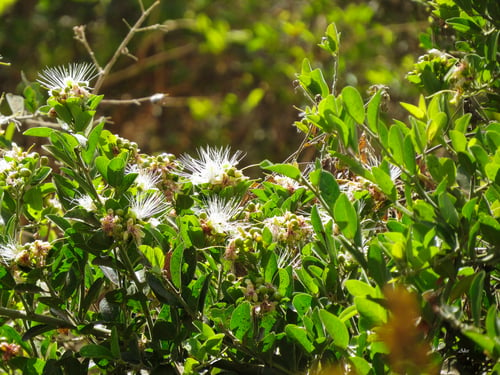
iNaturalist· cc-by
(c) Shaun Swanepoel, some rights reserved (CC BY), uploaded by Shaun Swanepoel
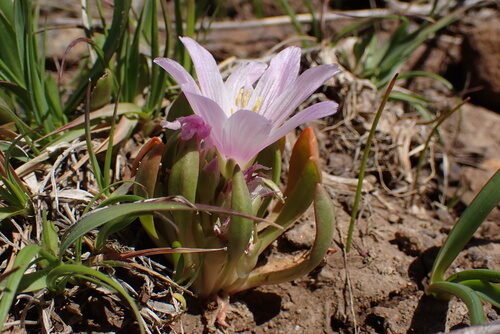
iNaturalist· cc-by-nc
(c) Abdul-lateef Ismail, some rights reserved (CC BY-NC), uploaded by Abdul-lateef Ismail
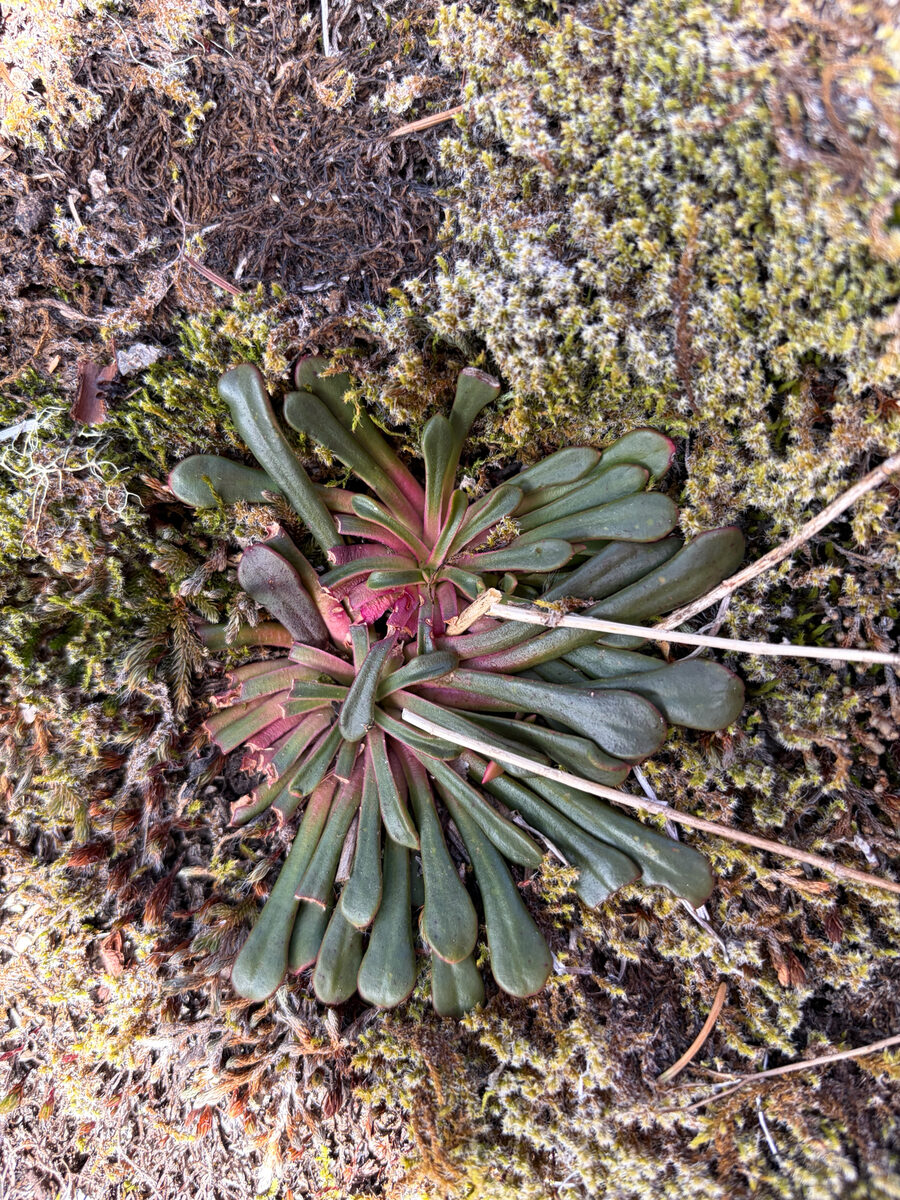
iNaturalist· cc-by
(c) Shaun Swanepoel, some rights reserved (CC BY), uploaded by Shaun Swanepoel
Summary
Source: WikipediaPortulacaria afra (known as elephant bush, porkbush, purslane tree, dwarf jade and spekboom in Afrikaans) is a small-leaved succulent plant found in South Africa. These succulents commonly have a reddish stem and green leaves, but a variegated cultivar is often seen in cultivation. They are simple to care for and make easy houseplants for a sunny location. In frost-free regions they may be used in outdoor landscaping.
Description
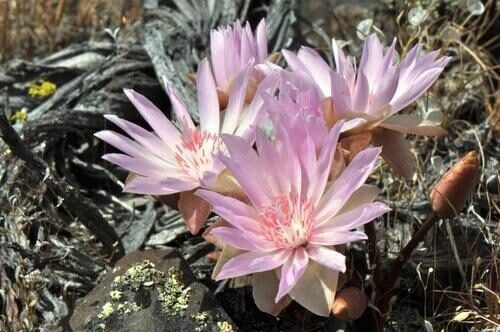
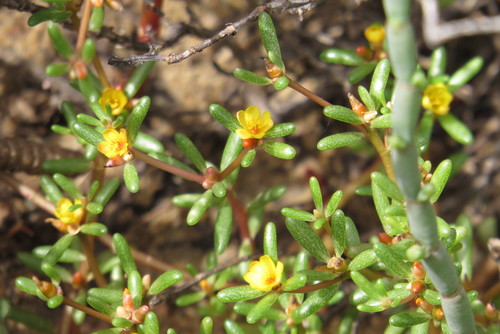
A small juicy leafed tree. It grows to about 1-4.5 m tall. The branches are grey and shiny. The new stems are reddish-brown. The roots are thick and clasp rocks. The leaves are flat and fleshy. They are simple and oval. They are slightly pointed and narrow to the base. They occur in opposite pairs at right angles down the twigs. The twigs are red. The leaves are edible. The flowers are star like and small. The flowers are pink or purple. The fruit is small and three winged. They are transparent and have a single seed inside. The leaves are edible.
Edible Uses
In Southern Africa it is commonly eaten, usually as one component of a salad or a soup. It should not be confused with the jade plant, which is mildly toxic. P. afra is also used to feed livestock during periods of drought due to its succulent nature. Most commonly used for cattle and goats, these plants also act as a supplemental source of water on top of their nutritional benefits for livestock.
Traditional Uses
The leaves can be eaten raw. They are tart and used in small amounts in salads. They are a thirst suppresant.
This uses section is brief — help expand it
Medicinal Uses
This is one of the many plants used as a traditional treatment for skin conditions used by people in rural areas that do not have easy access to more modern medicine.
Distribution
A tropical plant. It grows in drier places. It can be damaged by frost. It can stand high temperatures. It grows in areas with an annual rainfall 250-750 mm. It grows between sea level and 1,000 m above sea level. It can grow in arid places. Melbourne Botanical Gardens. It suits hardiness zones 9-11.
Where It Grows
Africa, Asia, Australia, East Africa, Eswatini, Hawaii, India, Kenya, Malawi, Mozambique, Pacific, Slovenia, South Africa, Southern Africa, Swaziland, USA, Zambia, Zimbabwe,
Cultivation
Plants can be grown from cuttings. One year old wood is best to use. The plants can be pruned into a hedge. Many branches on trees come into contact with the soil and form roots. These natural layers can be used for planting. They can also be grown from seed.
Propagation
Seed - Cuttings, even when quite large, root easily. They can be planted directly into the ground where they are to be grown. Alternatively, the cuttings can be taken in the normal fashion and allowed to dry out for a day or two in a cool dry place and then planted in washed river sand and kept in a shady position until they are rooted and ready to be planted out. They root quickly and can usually be planted out after four to six weeks.
Other Uses
The plant can be used as a soil binder to prevent erosion. The plant can be used as a screen or a clipped hedge. At least one form of the plant can be grown as a prostrate, low-growing ground cover.
Production
Plants grow quickly.
Other Information
The leaves are especially eaten by children.
Notes
There is probably only one Portulacaria species. The leaves are claimed to increase nursing mother's milk supply.
Nutrition
| Part | Moisture | kJ | kcal | Protein | Vit A | Vit C | Iron | Zinc |
|---|---|---|---|---|---|---|---|---|
| Leaves | 84 | 212 | 51 | 1.4 | — | 40.6 | 1.1 | 0.4 |
Synonyms
Also Known As
Grmasti tolščak, Igwanisha, Isicococo, Isidibiti esikhulu, Porkbush, Sidonwane, Spekboom
References (36)
- Ambasta, S.P. (Ed.), 2000, The Useful Plants of India. CSIR India. p 486
- Andersohn, G., 1983, Cacti and Succulents. EP Publishing. p 297
- Anderson, M., 2002, The World Encyclopedia of Cacti and Succulents. Hermes House, New York. p 198
- Bodkin, F., 1991, Encyclopedia Botanica. Cornstalk publishing, p 825
- Collectanea 1:160, t. 22. 1787 ("1786")
Show all 36 references Hide references
- Cundall, P., (ed.), 2004, Gardening Australia: flora: the gardener's bible. ABC Books. p 1074
- Facciola, S., 1998, Cornucopia 2: a Source Book of Edible Plants. Kampong Publications, p 187
- Fox, F. W. & Young, M. E. N., 1982, Food from the Veld. Delta Books. p 308
- Grubben, G. J. H. and Denton, O. A. (eds), 2004, Plant Resources of Tropical Africa 2. Vegetables. PROTA, Wageningen, Netherlands. p 564
- Hibbert, M., 2002, The Aussie Plant Finder 2002, Florilegium. p 239
- https://growwild.co.za Edible Indigenous plants
- http://www.botanic-gardens-ljubljana.com/en/plants
- Jardin, C., 1970, List of Foods Used In Africa, FAO Nutrition Information Document Series No 2.p 96
- Joffe, P., 2007, Creative Gardening with Indigenous Plants. A South African Guide. Briza. p 236
- Long, C., 2005, Swaziland's Flora - siSwati names and Uses http://www.sntc.org.sz/flora/
- Lord, E.E., & Willis, J.H., 1999, Shrubs and Trees for Australian gardens. Lothian. p 252
- Palgrave, K.C., 1996, Trees of Southern Africa. Struik Publishers. p 162
- Palmer, E and Pitman, N., 1972, Trees of Southern Africa. Vol. 1. A.A. Balkema, Cape Town p 567
- Peters, C. R., O'Brien, E. M., and Drummond, R.B., 1992, Edible Wild plants of Sub-saharan Africa. Kew. p 163
- Royal Botanic Gardens, Kew (1999). Survey of Economic Plants for Arid and Semi-Arid Lands (SEPASAL) database. Published on the Internet; http://www.rbgkew.org.uk/ceb/sepasal/internet [Accessed 6th June 2011]
- Ruiters-Welcome, A. K., 2019, Food plants of southern Africa. Ph.D. thesis. Univ. of Johannesburg p 51
- Schmidt, E., Lotter, M., & McCleland, W., 2007, Trees and shrubs of Mpumalanga and Kruger National Park. Jacana Media p 106
- Shava, S., 2000, The Use of Indigenous Plants as Food by a Rural Community in the Eastern Cape: an Educational Exploration. Masters Thesis Rhodes University. p 66
- Silbaeur, 1965, 1981,
- Staples, G.W. and Herbst, D.R., 2005, A tropical Garden Flora. Bishop Museum Press, Honolulu, Hawaii. p 466 (Drawing)
- Story, 1958,
- Swaziland's Flora Database http://www.sntc.org.sz/flora
- Terra, G.J.A., 1973, Tropical Vegetables. Communication 54e Royal Tropical Institute, Amsterdam, p 68
- Van Wyk, Br. and van Wyk P., 2009, Field Guide to Trees of Southern Africa. Struik Nature. p 46
- van Wyk, Be., & Gericke, N., 2007, People's plants. A Guide to Useful Plants of Southern Africa. Briza. p 74
- van Wyk, B, van Wyk, P, and van Wyk B., 2000, Photographic guide to Trees of Southern Africa. Briza. p 241
- Van Wick, B. & Van Wick, P., 2009, Filed Guide to Trees of Southern Africa, Struik Nature. p 46
- Venter, F & J., 2009, Making the most of Indigenous Trees. Briza. p 242
- Wehmeyer, A. S, 1986, Edible Wild Plants of Southern Africa. Data on the Nutrient Contents of over 300 species
- Welcome, A. K. & Van Wyk, B.-E., 2019, An inventory and analysis of the food plants of southern Africa. South African Journal of Botany 122 (2019) 136–179
- World Checklist of Useful Plant Species 2020. Royal Botanic Gardens, Kew