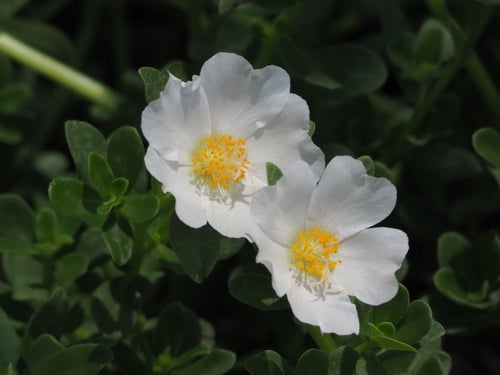
Portulaca grandiflora
(L.), (Hook.) Geesink
Rose moss, Sun plant
iNaturalist· cc-by-nc
(c) nancy_izquierdo, some rights reserved (CC BY-NC), uploaded by nancy_izquierdo
iNaturalist· cc-by-nc
(c) nancy_izquierdo, some rights reserved (CC BY-NC), uploaded by nancy_izquierdo
Summary
Source: WikipediaPortulaca grandiflora is a succulent flowering plant in the purslane family Portulacaceae, native to southern Brazil, Argentina, and Uruguay and often cultivated in gardens. It has many common names, including rose moss, eleven o'clock, Mexican rose, moss rose, sun rose, rose Jepun, table rose, rock rose, and moss-rose purslane. Despite these names and the superficial resemblance of some cultivars' flowers to roses, it is not a true rose, nor even a part of the rose family or rosid group; rather, it is much more closely related to carnations and cacti. It is also seen in South Asia and widely spread in most of the cities with old 18th- and 19th-century architecture in the Balkans.
Description
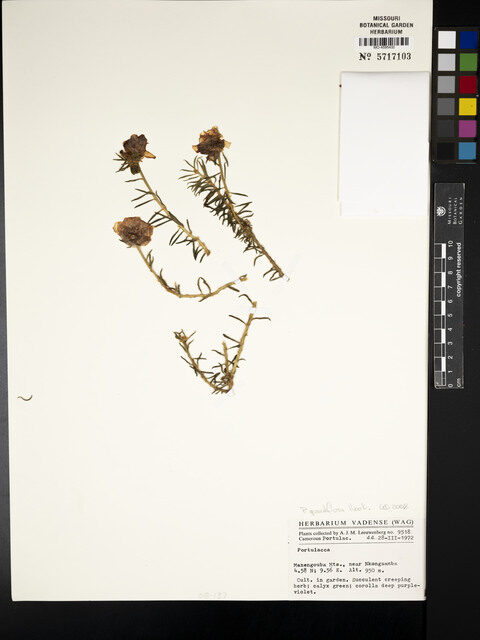
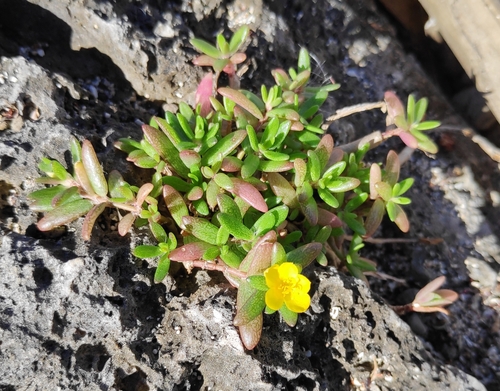
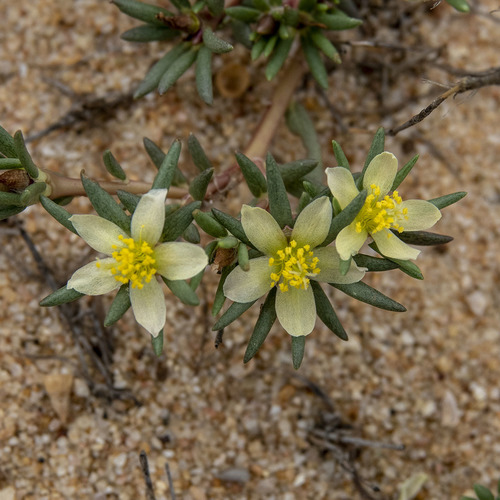
A herb. It grows each year from seed. It grows 10-30 cm high. It spreads 15-30 cm wide. The stems lie along the ground. They are purple-red and with many branches. There are hairs clustered at the nodes. The leaves are crowded at the tips of the stem. The leaves are 10-25 mm long by 2-3 mm wide. The flowers are large. They are 2-4 cm across. They open at midday. The flowers can be red, purple, yellow or white. The fruit is a capsule with very small seeds. They are kidney shaped and less than 1 mm across.
Edible Uses
Leaves can be eaten raw or cooked. Seeds are also edible raw or cooked — they can be ground into a powder for use in soups or mixed into cereals, though their small size makes them somewhat fiddly to work with. The root is edible when cooked.
Traditional Uses
The seeds are eaten raw or cooked. They can be ground into powder and used in soups. The leaves are eaten raw or cooked. The root is eaten cooked. Caution: It can contain oxalates.
Medicinal Uses
The whole plant is depurative and is used in treating hepatitis, liver cirrhosis with ascites, and swelling and pain in the pharynx. Fresh juice from the leaves and stems is applied externally as a lotion to snake and insect bites, burns, scalds, and eczema.
Distribution
It is a tropical and subtropical plant. It is best in dry poor soil. They can tolerate drought. It is damaged by frost. It needs well-drained soil. It needs full sun. It is cultivated in China. It suits hardiness zones 8-10.
Where It Grows
Africa, Argentina, Asia, Australia, Bangladesh, Brazil, Burkina Faso, Central Asia, China, Cuba, Dominican Republic, East Africa, Europe, Fiji, France, Ghana, Haiti, Hawaii, India, Indochina, Indonesia, Iraq, Italy, Kiribati, Korea, Lesser Antilles, Marquesas, Mediterranean, Middle East, Myanmar, Nauru, Nigeria, North America, Pacific, Pakistan, Puerto Rico, Rotuma, SE Asia, Sierra Leone, Singapore, South Africa, Southern Africa, South America, Tajikistan, Tonga, Tuvalu, Uruguay, USA, Vanuatu, Vietnam, Virgin Islands, West Africa, West Indies, Zimbabwe,
Cultivation
Plants are grown from seed. The seed are scattered and simply pressed into the soil lightly. Seedlings can be transplanted. Plants are spaced 15 cm apart.
Propagation
Sow seed in early spring in a greenhouse, pricking out seedlings into individual pots once large enough to handle. Plant out after the last expected frosts. Seed can also be sown directly in situ in late spring, though plants will not reach the same size as those started under cover.
Other Uses
None known.
Production
It is slow growing.
Notes
Used as a medicine in Indonesia. There are about 200 Portulaca species. They are mostly in the tropics and subtropics. It is ornamental and medicinal in China.
Dangerous Lookalikes
This plant can be confused with the following toxic species. Always verify identification carefully before consuming any wild plant.
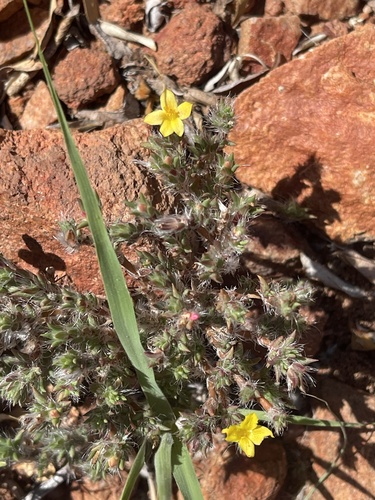
Spotted Spurge
Euphorbia maculata
Hardyplants at English Wikipedia
Rose moss
Portulaca grandiflora
(c) nancy_izquierdo, some rights reserved (CC BY-NC), uploaded by nancy_izquierdo
Spotted Spurge: Milky white latex sap when broken, thinner leaves often with dark spot, prostrate growth, tiny flowers.
Rose moss: Clear sap, thick succulent leaves, reddish smooth stems, yellow flowers.
Synonyms
Also Known As
Ban zhi lian, Da hua ma chi xian, Debois, Doboiy, Eleven-O'Clock, Garden portulaca, Goduma payala, Katuli, Le-nhi, Moss rose, Muoi-gio, Portulaka, Taing-lon-chantha, Te Boi, Velecvetni tolščak
References (20)
- Ambasta, S.P. (Ed.), 2000, The Useful Plants of India. CSIR India. p 485
- Andersohn, G., 1983, Cacti and Succulents. EP Publishing. p 297
- Beckstrom-Sternberg, Stephen M., and James A. Duke. "The Foodplant Database." http://probe.nalusda.gov:8300/cgi-bin/browse/foodplantdb.(ACEDB version 4.0 - data version July 1994)
- Bot. Mag. 56: t. 2885. 1829
- Brickell, C. (Ed.), 1999, The Royal Horticultural Society A-Z Encyclopedia of Garden Plants. Convent Garden Books. p 823
Show all 20 references Hide references
- Burnie, G.(Ed.), 2003, Annuals and Bulbs. The Gardener's Handbooks. Fog City Press. p 211
- Cundall, P., (ed.), 2004, Gardening Australia: flora: the gardener's bible. ABC Books. p 1074
- Flora of Pakistan. www.eFloras.org
- Heywood, V.H., Brummitt, R.K., Culham, A., and Seberg, O., 2007, Flowering Plant Families of the World. Royal Botanical Gardens, Kew. p 265
- http://www.botanic-gardens-ljubljana.com/en/plants
- Kuhnlein, H. V., et al, 2009, Indigenous Peoples' food systems. FAO Rome p 193
- Lu De-Quan, Portulacaceae, Flora of China.
- Plants for a Future database, The Field, Penpol, Lostwithiel, Cornwall, PL22 0NG, UK. http://www.scs.leeds.ac.uk/pfaf/
- Plants of Haiti Smithsonian Institute http://botany.si.edu/antilles/West Indies
- Smith, A.C., 1981, Flora Vitiensis Nova, Lawaii, Kuai, Hawaii, Volume 2 p 277
- Staples, G.W. and Herbst, D.R., 2005, A tropical Garden Flora. Bishop Museum Press, Honolulu, Hawaii. p 464
- Thaman, R. R., 1987, Plants of Kiribati: A listing and analysis of vernacular names. Atoll Research Bulletin No. 296
- Ullah, M. O., et al, 2013, Anti-bacterial activity and brine shrimp lethality bioassay of methanolic extracts of fourteen different edible vegetables from Bangladesh. Asia Pacific Journal of Tropical Biomedicine. 3(1): 1-7 (As grandifolia)
- Wijayakusuma, H.M.H., et al, 1996, Tanaman Berkhasiat Obat Di Indonesia. Pustaka Kartini. p 108
- World Checklist of Useful Plant Species 2020. Royal Botanic Gardens, Kew