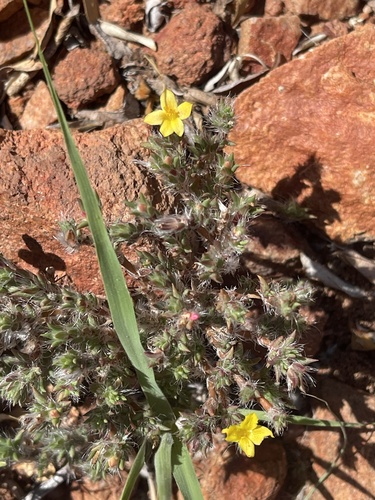
Portulaca pilosa
L.
Hairy portulaca
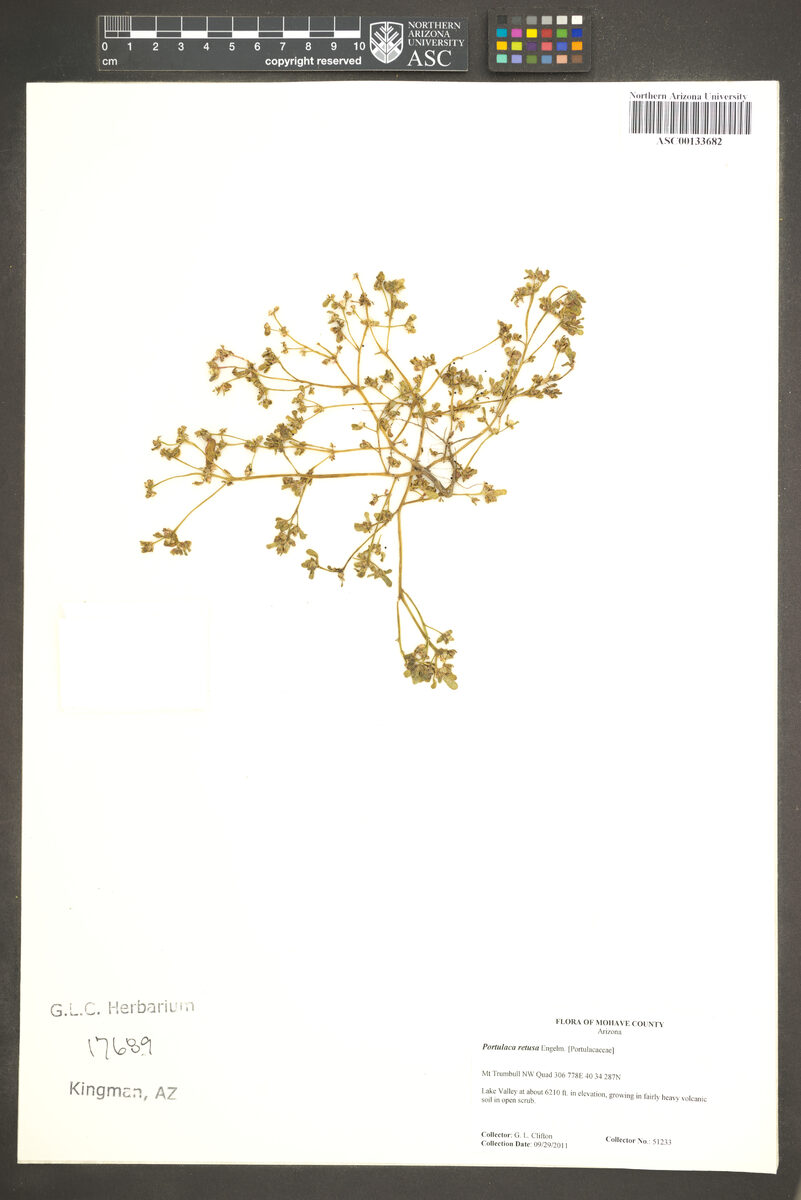
iNaturalist· cc0
no rights reserved, uploaded by 葉子
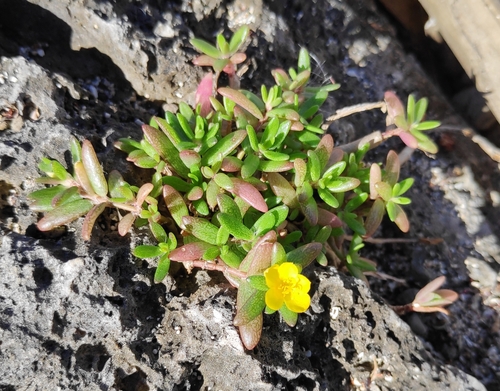
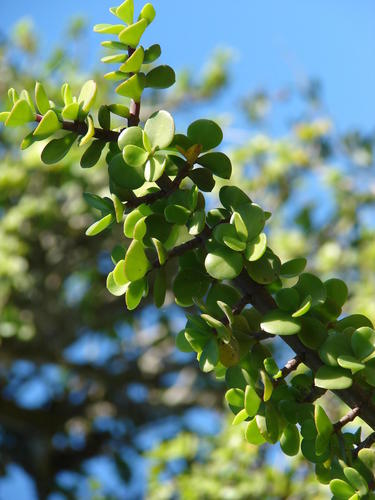
iNaturalist· cc-by-nc
(c) Kenneth Bader, some rights reserved (CC BY-NC), uploaded by Kenneth Bader
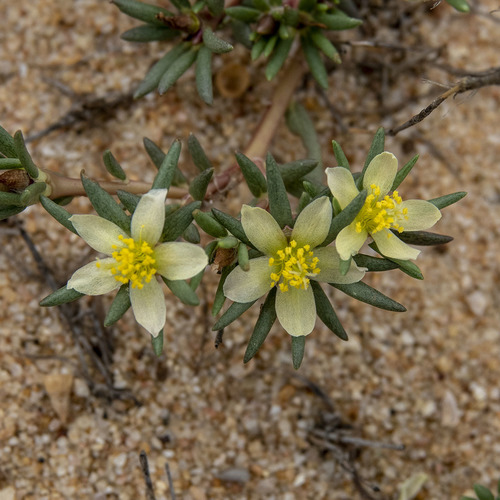
iNaturalist· cc-by-sa
(c) Douglas Goldman, some rights reserved (CC BY-SA), uploaded by Douglas Goldman
Summary
Source: WikipediaPortulaca pilosa is a species of flowering succulent plant in the purslane family, Portulacaceae, which is native to the Americas. Its common names include pink purslane, kiss-me-quick and hairy pigweed. Its range extends from the southern United States and the Caribbean to as far south as Brazil. It is a succulent plant with linear leaves and pink flowers.
Description
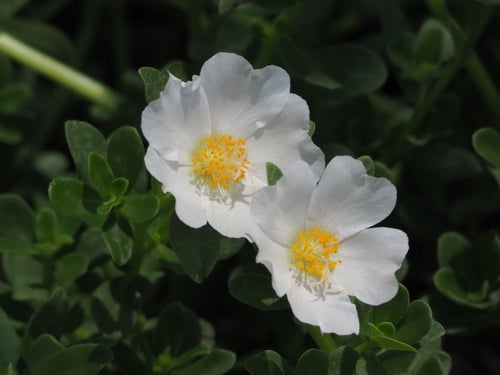
An annual herb. It is soft and succulent. It has a taproot and can keep growing for a few years. It lies along the ground. It is 5-20 cm high and 30-50 cm wide. The leaves are narrow and hairy. They are 10-20 mm long by 1-4 mm wide. The flowers are pink or yellow. They are small and about 2 cm across. The fruit is a straw yellow capsule with very tiny seeds.
Edible Uses
The leaves are cooked as a green vegetable, used for bitter herbal tea, and eaten in various preparations. The root tubers are used in savory dishes. Seeds are also edible.
Traditional Uses
The leaves are bitter. They are cooked and eaten and also used for herbal tea. The leaves are used as a green vegetable. The root tubers are used for savoury preparations.
Medicinal Uses
It has been said that the species of Portulaca pilosa in Brazil has been used as a traditional remedy to cause diuresis, antipyresis and analgesia. Studies have shown that its extracts have renal effects. It has also been seen that in rats, such extracts cause an increase in potassium excretion without a concomitant change in water diuresis or sodium excretion.
Distribution
A tropical plant. It grows in a range of tropical places. It grows near rocks along rocky coastlines. It is common in dry open places. It needs well drained soil and a sunny position. It can grow in arid places. It can grow in salty soils.
Where It Grows
Africa, Asia, Australia, Bahamas, Botswana, Brazil, Central America*, China, Cuba, Dominican Republic, Fiji, Guatemala, Guiana, Guianas, Guyana, Haiti, Hawaii, India, Indochina, Indonesia, Jamaica, Laos, Lesser Antilles, Malaysia, Mexico*, Myanmar, North America, Pacific, Pakistan, Philippines, Puerto Rico, SE Asia, South Africa, Southern Africa, South America*, Sri Lanka, Suriname, Thailand, Tokelau, Tropical America, Uruguay, USA, Venezuela, Vietnam, Virgin Islands, West Indies,
Cultivation
Plants can be grown from seed.
Notes
There are about 200 Portulaca species. They are mostly in the tropics and subtropics.
Dangerous Lookalikes
This plant can be confused with the following toxic species. Always verify identification carefully before consuming any wild plant.
Spotted Spurge
Euphorbia maculata
Hardyplants at English Wikipedia
Hairy portulaca
Portulaca pilosa
no rights reserved, uploaded by 葉子
Spotted Spurge: Milky white latex sap when broken, thinner leaves often with dark spot, prostrate growth, tiny flowers.
Hairy portulaca: Clear sap, thick succulent leaves, reddish smooth stems, yellow flowers.
Nutrition
| Part | Moisture | kJ | kcal | Protein | Vit A | Vit C | Iron | Zinc |
|---|---|---|---|---|---|---|---|---|
| 62.8 | 432 | 103 | 1.8 | — | — | 21.8 | 1.4 | — |
Synonyms
Also Known As
'akulikuli, Djanggara, Mao ma chi zian, Pilnanginma, Safed mushali, Sam long, Tamole
References (31)
- Ambasta, S.P. (Ed.), 2000, The Useful Plants of India. CSIR India. p 486
- Burkill, I.H., 1966, A Dictionary of the Economic Products of the Malay Peninsula. Ministry of Agriculture and Cooperatives, Kuala Lumpur, Malaysia. Vol 2 (I-Z) p 1833
- Cancilla, D., 2018, Ethnobotanical and Ethnozoological Values Desktop Assessment - Eliwana Project. p 14
- Cherikoff V. & Isaacs, J., The Bush Food Handbook. How to gather, grow, process and cook Australian Wild Foods. Ti Tree Press, Australia p 164, 190
- Crawford, I. M., 1982, Traditional Aboriginal Plant Resources in the Kalumburu Area: Aspects in Ethno-economics. Records of the Western Australian Museum Supplement No. 15
Show all 31 references Hide references
- Elliot, W.R., & Jones, D.L., 1997, Encyclopedia of Australian Plants suitable for cultivation. Vol 7. Lothian. p 445
- Estrada-Castillon, E., et al, 2014, Ethnobotany in Rayones, Nuevo Leon, Mexico. Journal of Ethnobiology and Ethnomedicine, 10:62 (As Portulaca mundula)
- Flora of Pakistan. www.eFloras.org
- Henty, E.E., 1980, Harmful Plants in Papua New Guinea. Botany Bulletin No 12. Division Botany, Lae, Papua New Guinea. p 120
- Hussey, B.M.J., Keighery, G.J., Cousens, R.D., Dodd, J., Lloyd, S.G., 1997, Western Weeds. A guide to the weeds of Western Australia. Plant Protection Society of Western Australia. p 202
- Kenneally, K.E., Edinger, D. C., and Willing T., 1996, Broome and Beyond, Plants and People of the Dampier Peninsula, Kimberley, Western Australia. Department of Conservation and Land Management. p 168
- Kermath, B. M., et al, 2014, Food Plants in the Americas: A survey of the domesticated, cultivated and wild plants used for Human food in North, Central and South America and the Caribbean. On line draft. p 679
- Latz, P.K., 1996, Bushfires and Bushtucker: Aboriginal plant use in Central Australia. IAD Press Alice Springs p 251
- Lu De-Quan, Portulacaceae, Flora of China.
- Martin, F.W. & Ruberte, R.M., 1979, Edible Leaves of the Tropics. Antillian College Press, Mayaguez, Puerto Rico. p 215
- McMakin, P.D., 2000, Flowering Plants of Thailand. A Field Guide. White Lotus. p 79
- Paczkowska, G . & Chapman, A.R., 2000, The Western Australian Flora. A Descriptive Calatogue. Western Australian Herbarium. p 463
- Parham, B. E. V., 1971, The Vegetation of the Tokelau Islands with special reference to the Plants of Nukunonu Atoll. New Zealand Journal of Botany. 9:4, 576-609
- Pham-Hoang Ho, 1999, An Illustrated Flora of Vietnam. Nha Xuat Ban Tre. p 734
- Plants of Haiti Smithsonian Institute http://botany.si.edu/antilles/West Indies
- RIRDC, 2010, New Root Vegetables fo the Native Food Industry, Australian Government RIRDC Publication 9/161
- Royal Botanic Gardens, Kew (1999). Survey of Economic Plants for Arid and Semi-Arid Lands (SEPASAL) database. Published on the Internet; http://www.rbgkew.org.uk/ceb/sepasal/internet [Accessed 6th June 2011]
- Smith, A.C., 1981, Flora Vitiensis Nova, Lawaii, Kuai, Hawaii, Volume 2 p 277
- Staples, G.W. and Herbst, D.R., 2005, A tropical Garden Flora. Bishop Museum Press, Honolulu, Hawaii. p 466
- Terra, G.J.A., 1973, Tropical Vegetables. Communication 54e Royal Tropical Institute, Amsterdam, p 68
- Smith, N and Wightman, G.M., 1990, Ethnobotanical Notes from Belyuen Northern Territory Australia. Northern Territory Botanical Bulletin No 10. Parks and Wildlife Commission of the Northern Territory. p 21, 22
- Smith, N. M., 1991, Ethnobotanical Field Notes from the Northern Territory, Australia, J. Adelaide Bot. Gard. 14(1): 1-65
- Sp. pl. 1:445. 1753
- Vigilante, T., et al, 2013, Island country: Aboriginal connections, values and knowledge of the Western Kimberley islands in the context of an island biological survey. Records of the Western Australian Museum Supplement 81: 145-182
- Wightman, Glenn et al. 1992. Mudburra Ethnobotany: Aboriginal Plant Use from Kulumindini (Elliott) Northern Australia. Northern Territory Botanical Bulletin No 14. Parks and Wildlife Commission of the Northern Territory. p 28
- World Checklist of Useful Plant Species 2020. Royal Botanic Gardens, Kew