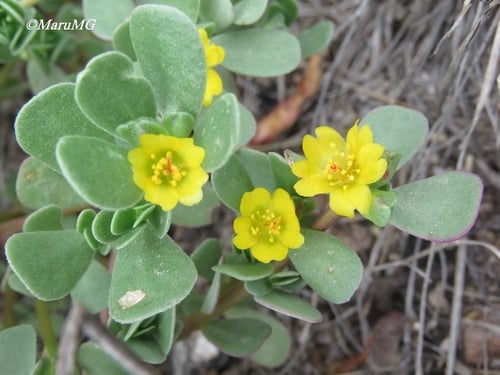
Portulaca oleracea var. sativa
DC.
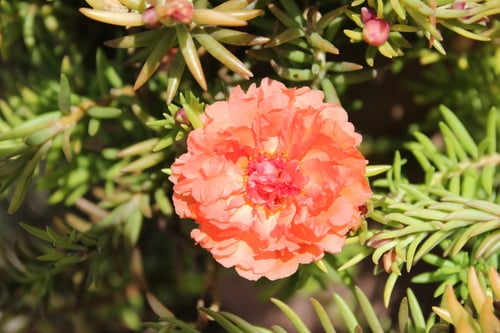
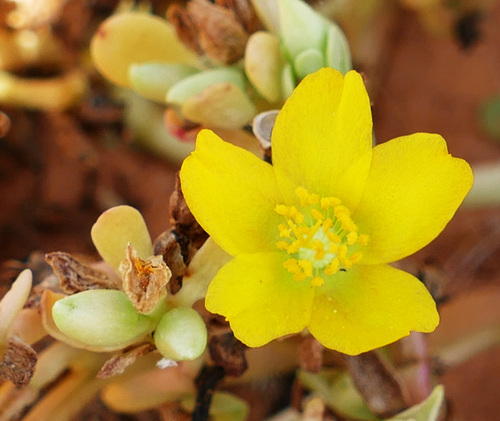
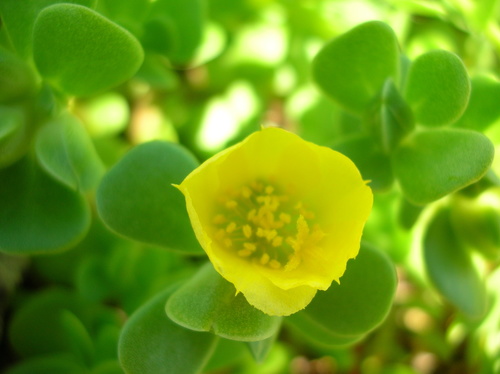
Purslane or Golden purslane
gbif· cc-by
Thomas Gyselinck
gbif· cc-by
Thomas Gyselinck
gbif· cc-by-nc
enkidoo
Summary
Source: WikipediaPortulaca oleracea (common purslane, also known as little hogweed, or pursley) is a succulent plant in the family Portulacaceae. All parts of the plant are edible raw or cooked.
Description
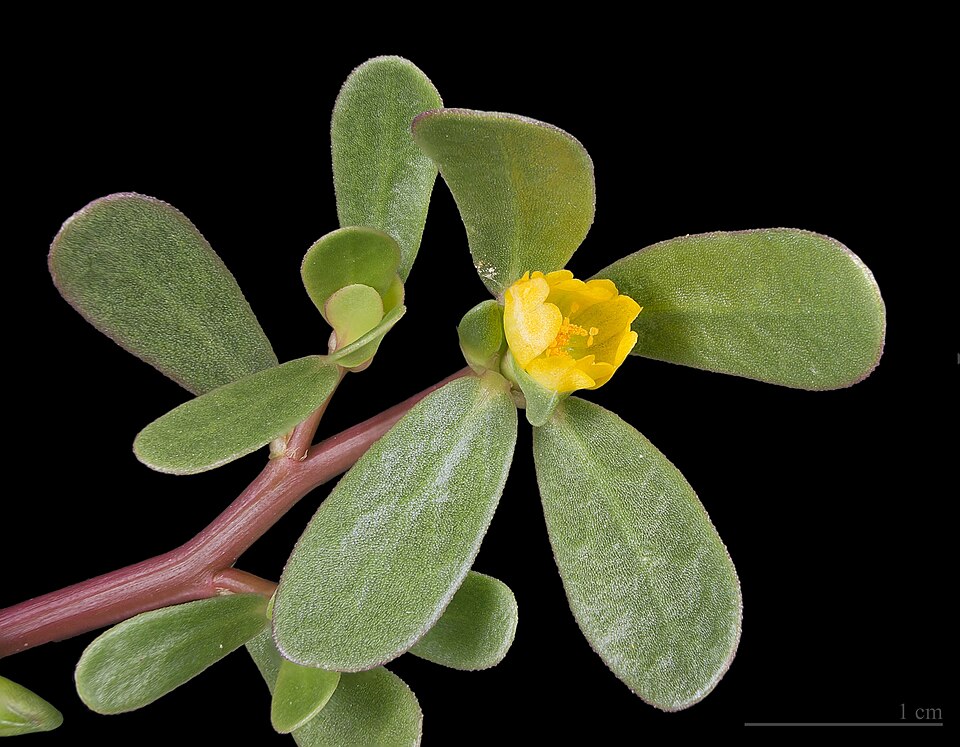
A sprawling annual plant. It grows to 30 cm high. The thick leaves occur in rings or rosettes. They are succulent and bright green. This is the cultivated selection.
Edible Uses
All parts of purslane are edible raw or cooked. The seeds can be eaten raw or used to make flour. The plant may be eaten as a leaf vegetable. William Cobbett noted that it was "eaten by Frenchmen and pigs when they can get nothing else. Both use it in salad, that is to say, raw". It has a slightly sour and salty taste and is eaten throughout much of Europe, North Africa, the Middle East, Asia, and Mexico. The stems, leaves, and flower buds are all edible raw or cooked. Purslane may be used fresh as a salad, stir-fried, or cooked as spinach is, and because of its mucilaginous quality it also is suitable for soups and stews. The sour taste is due to oxalic and malic acid, the latter of which is produced through the CAM pathway that is seen in many xerophytes (plants living in dry conditions) and is at its highest when the plant is harvested in the early morning. Aboriginal Australians use the seeds of purslane to make seedcakes. Greeks, who call it andrákla (αντράκλα) or glistrída (γλιστρίδα), use the leaves and the stems with feta cheese, tomato, onion, garlic, oregano, and olive oil. They add it to salads, boil it, or add it to casseroled chicken. In Turkey, besides being used in salads and baked pastries, it is cooked as a vegetable similar to spinach or is mixed with yogurt to form a tzatziki variant. In Sudan, the vegetable is known as regla (رجلة) it is also cooked as a vegetable stew, similar to how spinach and malva (خبيزة) are cooked, but not fresh in salads. In Kurdistan, people commonly make a kind of soup from it called palpina soup (شۆربای پەڵپینە). In the Alentejo region of Portugal, purslane is used for cooking a traditional soup (sopa de beldroegas) which is topped with soaked bread, poached eggs, and/or goat's cheese. In Mexico and the American Southwest, the plant is consumed as verdolagas.
Traditional Uses
The young leaves are picked and can be cooked like spinach.
This uses section is brief — help expand it
Distribution
It can be grown in tropical and temperate places. It is damaged by frost.
Where It Grows
Australia, Balkans, Macedonia,
Cultivation
Seed are sown where plants are to grow. Plants should be about 15 cm apart.
Other Information
It is cultivated.
Notes
There are about 200 Portulaca species. They are mostly in the tropics and subtropics. It is a cultivated food plant.
Dangerous Lookalikes
This plant can be confused with the following toxic species. Always verify identification carefully before consuming any wild plant.
Spotted Spurge
Euphorbia maculata
Hardyplants at English Wikipedia
Purslane or Golden purslane
Portulaca oleracea var. sativa
Thomas Gyselinck
Spotted Spurge: Milky white latex sap when broken, thinner leaves often with dark spot, prostrate growth, tiny flowers.
Purslane or Golden purslane: Clear sap, thick succulent leaves, reddish smooth stems, yellow flowers.
Nutrition
| Part | Moisture | kJ | kcal | Protein | Vit A | Vit C | Iron | Zinc |
|---|---|---|---|---|---|---|---|---|
| Leaves | 92.5 | 108 | 26 | 1.5 | — | 22 | 3.6 | — |
References (6)
- Flora of Pakistan. www.eFloras.org
- Gouldstone, S., 1983, Growing your own Food-bearing Plants in Australia. Macmillan p 178
- Heywood, V. H. & Zohary, D.,1995, A Catalogue of the Wild Relatives of Cultivated Plants Native to Europe. Flora Mediterranea 5 - 1995, p 381
- Plants for a Future database, The Field, Penpol, Lostwithiel, Cornwall, PL22 0NG, UK. http://www.scs.leeds.ac.uk/pfaf/
- Smith, K & I., 1999, Grow your own bushfoods. New Holland. Australia. p 72
Show all 6 references Hide references
- van Wyk, B., 2005, Food Plants of the World. An illustrated guide. Timber press. p 303