Angelica atropurpurea
L.
Purplestem angelica, American angelica, Great angelica, Masterwort
iNaturalist· cc-by
(c) aarongunnar, some rights reserved (CC BY), uploaded by aarongunnar
iNaturalist· cc-by-nc-sa
(c) Peter Gorman, some rights reserved (CC BY-NC-SA)
iNaturalist· cc-by-nc-sa
(c) Peter Gorman, some rights reserved (CC BY-NC-SA)
Summary
Source: WikipediaAngelica atropurpurea, known commonly as purplestem angelica, great angelica, American angelica, high angelica, and masterwort, is a species of flowering plant that can be found in moist and swampy woodlands, mostly by riverbanks, in eastern North America.
Description
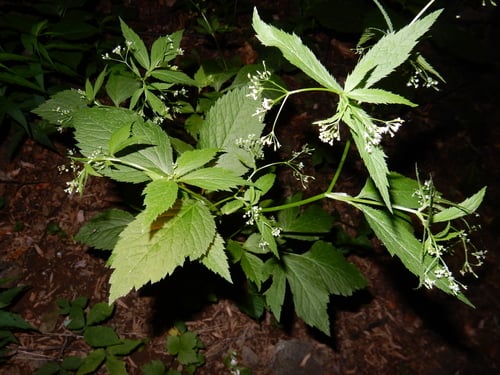
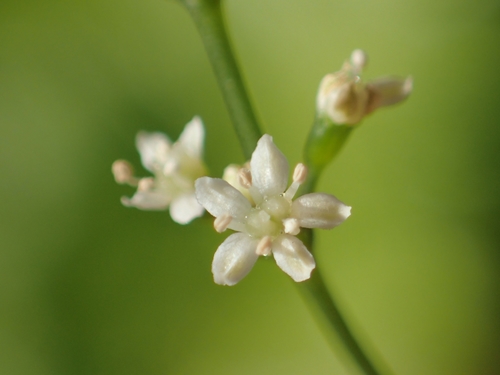
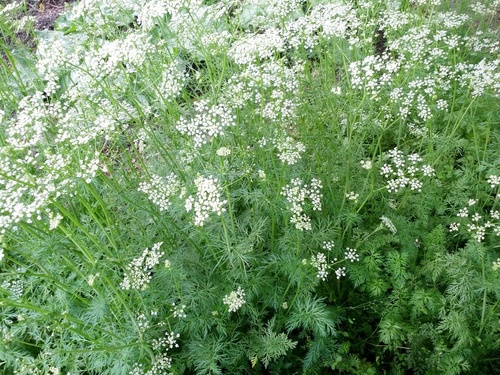
A plant that lives for a few years. It grows 1-2 m high. It has a smell. The leaves are large. They are divided into many leaflets. They are copper coloured when young but turn green with age. The flowers are green and in flat heads.
Edible Uses
Young shoots and leaf stalks can be eaten raw or cooked. When boiled in two changes of water they produce a vegetable that closely resembles celery in character. They can be peeled and eaten raw in salads or blanched and cooked in the same way as asparagus. The stems can also be candied and used as a sweetmeat. The root, leafstalks and stems are all suitable for candying.
Traditional Uses
CAUTION: The roots are possibly poisonous when fresh. The roots are candied. The stems are leaves are eaten. The tender new stems and leafstalks are peeled and eaten in salads. They are also boiled in water and eaten. The young leaves are added to fish dishes, soups and stews.
Medicinal Uses
A tea made from the leaves is carminative and stomachic, and is also used in treating colds and rheumatism. Seeds and roots can be used in the same way and have a stronger effect. The plant has similar properties to A. archangelica but is considered inferior due to its lower aromatic content. The root is carminative, diaphoretic, emmenagogue, sedative, stomachic and tonic. An infusion has been used to treat fevers, colds, flatulent colic and other stomach disorders, obstructed menstruation, and as a general tonic for women. Externally it has been used as a gargle for sore throats and mouths and as a poultice for broken bones and swellings. It has also been used both internally and externally for rheumatism.
Known Hazards
All members of this genus contain furocoumarins, which increase skin sensitivity to sunlight and may cause dermatitis.
Distribution
It is a temperate plant. It can grow in sun or light shade.
Where It Grows
Australia, Canada, North America, USA,
Cultivation
It usually self seeds. Plants can be grown from seed or by division of the root.
Propagation
Seed is best sown in a cold frame as soon as it is ripe, as viability is short. Spring sowing is possible but germination rates will be lower. Light is required for germination. Once seedlings are large enough to handle, prick them out into individual pots and grow on in a cold frame through their first winter before planting out into permanent positions in spring. Seed can also be sown in situ as soon as it is ripe.
Other Uses
None known.
Notes
There are 50 Angelica species. They are temperate plants.
Synonyms
References (14)
- Bircher, A. G. & Bircher, W. H., 2000, Encyclopedia of Fruit Trees and Edible Flowering Plants in Egypt and the Subtropics. AUC Press. p 28
- Esperanca, M. J., 1988. Surviving in the wild. A glance at the wild plants and their uses. Vol. 1. p 391 (As Archangelica atropurpurea)
- Facciola, S., 1998, Cornucopia 2: a Source Book of Edible Plants. Kampong Publications, p 15
- Hedrick, U.P., 1919, (Ed.), Sturtevant's edible plants of the world. p 67
- Hibbert, M., 2002, The Aussie Plant Finder 2002, Florilegium. p 28
Show all 14 references Hide references
- Kiple, K.F. & Ornelas, K.C., (eds), 2000, The Cambridge World History of Food. CUP p 1840
- Lim, T. K., 2015, Edible Medicinal and Non Medicinal Plants. Volume 9, Modified Stems, Roots, Bulbs. Springer p 9
- MacKinnon, A., et al, 2009, Edible & Medicinal Plants of Canada. Lone Pine. p 295
- Morton, 1976,
- Plants for a Future database, The Field, Penpol, Lostwithiel, Cornwall, PL22 0NG, UK. http://www.scs.leeds.ac.uk/pfaf/
- Ryan, S., 2008, Dicksonia. Rare Plants Manual. Hyland House. p 95
- Sp. pl. 1:251. 1753
- Tozer, F., 2007, The Uses of Wild Plants. Green Man Publishing. p 28
- van Wyk, B., 2005, Food Plants of the World. An illustrated guide. Timber press. p 60