Persicaria minor
(Hudson) Opiz
Spotted Ladysthumb, Small water-pepper
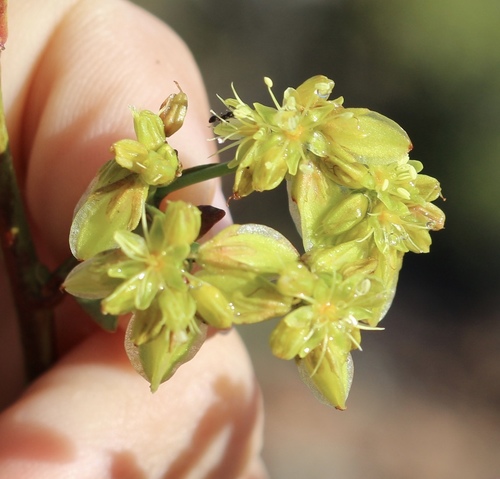
iNaturalist· cc-by-nc
(c) Aleksandr V. Lebedev, some rights reserved (CC BY-NC), uploaded by Aleksandr V. Lebedev
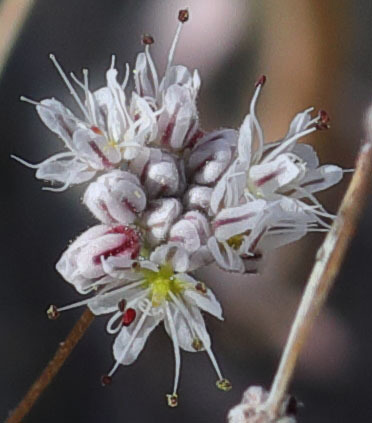
iNaturalist· cc-by-nc
(c) Саранчин Евгений, some rights reserved (CC BY-NC)
Summary
Source: WikipediaPersicaria minor is species of herb in the family Polygonaceae. Common names include pygmy smartweed, small water pepper and swamp willow weed. This herb is native to Asia, but distributed widely in Europe and Australia. It is used in South East Asian cooking.
Description
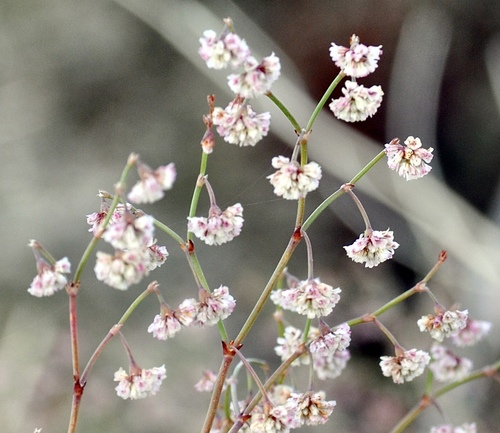
An annual herb. It can also keep growing from year to year. It lies along the ground but can also reach to 1 m high. The stems are slender. They are 1-4 mm thick. The leaf stalks are short. The leaves are sword shaped or almost linear. They are 5-12 cm long. The leaves are hairy underneath. The flowering arrangement is at the top. There are 1 or more lax false spikes. These are 1-6 cm long. There are 3-6 flowers and the bracts are funnel shaped. The fruit are lens shaped with faces which curve outwards. They are 1.5-2 mm long. They are black or brown and shiny.
Edible Uses
The leaves are eaten in curries and the seeds are consumed.
Traditional Uses
The leaves are eaten in curries.
This uses section is brief — help expand it
Medicinal Uses
Persicaria minor is an edible, aromatic herb. In Malaysia and Indonesia it has the common name "kesum", and its shoots and young leaves are eaten raw as part of salad (ulam); used as an aroma spice additive in peppery dishes such as laksa, nasi kerabu, asam pedas and tom yam; used as tea leaves; and used for topical applications in traditional medicine. Its oil has been used for aromatherapy and in treatments for dandruff. In Malaysian traditional medicine, P. minor has been used in post-natal tonics and for treatment of digestion. Pharmacological studies on P. minor have indicated anti-oxidant, LDL oxidation, anti-inflammatory and anti-microbial activities, digestive enhancing and anti-ulcer activities, cognitive enhancing activities, immuno-modulating activities, acetylcholinesterase-inhibiting activity and as a microbial inhibitor to prevent food spoilage. Comparative studies have been carried out to analyse the metabolites not only in the plant's leaves, but also in its stem and roots. Clinical studies have been carried out on this plant, looking at reported abilities to improve cognition, mood and stress, and memory. Compared with other four Malaysian herbs (Cosmos caudatus, Piper sarmentosum, Centella asiatica, Syzygium polyanthum), the Persicaria minor showed the highest concentration of phenols and the highest antioxidant activity. It has been used as a bioactive component for packaging film for edible foods, based on a semi-refined carrageenan and glycerol as plasticizers.
Distribution
A tropical plant. It grows at low altitudes in wet places in Papua New Guinea. It grows in better drained places at higher altitudes. It can grow from sea level to 2500 m altitude. In Argentina it grows below 500 m below sea level.
Where It Grows
Argentina, Asia, Australia, Central Asia, Europe, India, Indochina, Iraq, Ireland, Malaysia, Middle East, Northeastern India, Pacific, Papua New Guinea, PNG, SE Asia, Singapore, Solomon Islands, Spain, Tajikistan, Turkey, Türkiye, Vanuatu, Vietnam,
Notes
There are about 50 Polygonum species. It possibly has anti-cancer properties. It has 2.6 mg per 100 g dry weight and 1.4 mg fresh weight of alpha-tocopherol (Vitamin E).
Synonyms
Also Known As
Lady's-thumb, Persicaria, Kesum, Kesom
References (19)
- Abas, F., et al, 2006, Antioxidant and nitric oxide inhibition of selected Malay traditional vegetables. Food Chemistry 95: 566-573 (As Persicaria tenella)
- Ambasta, S.P. (Ed.), 2000, The Useful Plants of India. CSIR India. p 480 (As Polygonum minus)
- Ching, L. S. & Mohamed, S., 2001, Alpha-Tocopherol Content in 62 Edible Tropical Plants. J. Agric. Food Chem. 2001, 49, 3101−3105 (As Polygonum minus)
- French, B.R., 2010, Food Plants of Solomon Islands. A Compendium. Food Plants International Inc. p 375 (As Polygonum minus)
- Fl. angl. 148. 1762 (As Polygonum minus)
Show all 19 references Hide references
- Henty, E.E., in Womersley, J.S., (ed), 1978, Handbooks of the Flora of Papua New Guinea. Melbourne University Press,Victoria. Vol 1, p 236 (As Polygonum minus)
- Lamp, C & Collet F., 1989, Field Guide to Weeds in Australia. Inkata Press. p 226 (As Polygonum minus)
- Leach, G.J., & Osborne, P.L., 1985, Freshwater Plants of Papua New Guinea. UPNG Press, p 214 (Drawing) (As Polygonum minus)
- Martin, F.W. & Ruberte, R.M., 1979, Edible Leaves of the Tropics. Antillian College Press, Mayaguez, Puerto Rico. p 213 (As Polygonum minus)
- Miean, K. H. & Mohamed, S., 2001, Flavonoid (Myricetin, Quercetin, Kaempferol, Luteolin, and Apigenin) Content of Edible Tropical Plants. Journal of Agricultural and Food Chemistry. 49:3016-3112 (As Polygonum minus)
- Murakami, A. et al, 2014, Screening for the In Vitro Anti-tumor-promoting Activities of Edible Plants from Malaysia. Bioscience, Biotechnology, and Biochemistry, 64:1, 9-16. (As Polygonum minus)
- Pham-Hoang Ho, 1999, An Illustrated Flora of Vietnam. Nha Xuat Ban Tre. p 753 (As Polygonum minus)
- Plants for a Future database, The Field, Penpol, Lostwithiel, Cornwall, PL22 0NG, UK. http://www.scs.leeds.ac.uk/pfaf/ (As Polygonum minus)
- Samy, J., Sugumaran, M., Lee, K. L. W., 2009, Herbs of Malaysia, Marshall Cavendish. p 198 (As Polygonum minus)
- Sarma, H., et al, 2010, Updated Estimates of Wild Edible and Threatened Plants of Assam: A Meta-analysis. International Journal of Botany 6(4): 414-423 (As Polygonum minus)
- Singh, H.B., Arora R.K.,1978, Wild edible Plants of India. Indian Council of Agricultural Research, New Delhi. p 33 (As Polygonum minus)
- Srivastava, R. C., 2010, Traditional knowledge of Nyishi (Daffla) tribe of Arunachal Pradesh. Indian Journal of Traditional Knowledge. 9(1):26-37 (As Polygonum minus)
- Terra, G.J.A., 1973, Tropical Vegetables. Communication 54e Royal Tropical Institute, Amsterdam, p 68 (As Polygonum minus)
- World Checklist of Useful Plant Species 2020. Royal Botanic Gardens, Kew