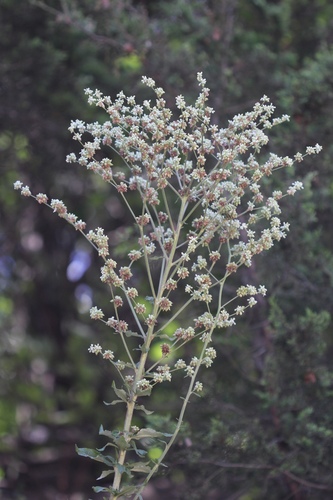
Eriogonum corymbosum
Benth.
Crispleaf buckwheat
iNaturalist· cc-by-nc
(c) shierandrulist, some rights reserved (CC BY-NC), uploaded by shierandrulist
iNaturalist· cc-by-nc
(c) Joey Bom, some rights reserved (CC BY-NC), uploaded by Joey Bom
iNaturalist· cc0
no rights reserved, uploaded by Robbie Hannawacker
Summary
Eriogonum corymbosum is a compact evergreen shrub reaching 0.3 m (1 ft) tall with slow growth. It flowers from July to August and is pollinated by bees, making it attractive to wildlife. The plant thrives in light sandy or medium loamy well-drained soils and tolerates poor fertility. It grows across mildly acidic to mildly alkaline soil types but requires full sun and cannot tolerate shade. It handles strong winds and adapts to both dry and moist soil conditions, though it cannot endure maritime exposure. Hardy to UK zone 3.
Description
An evergreen shrub. It grows 30 cm tall. The stems are spreading and have persistent leaf bases. There is one leaf at each node on the stem.
This description is brief — help expand it
Edible Uses
Leaves and stems are edible when cooked. Leaves can be boiled, mixed with water and cornmeal, and baked into bread. Stems are boiled, pressed into cakes, then dried and eaten with salt.
Traditional Uses
The leaves are boiled and then mixed with water and cornmeal and baked into bread. The stalks are pressed into caked. These are dried and eaten with salt.
Medicinal Uses
A decoction of the leaves, taken three times a day, serves as a remedy for headache. The variety glutinosum was most probably used for this purpose. This same variety was also used to treat TB, or at least to relieve coughs.
Distribution
It is a temperate plant. It suits USDA hardiness zone 3-7.
Where It Grows
North America, USA,
Cultivation
Requires a loose lean gritty well-drained soil in a very sunny position. Succeeds in dry soils. Tolerates exposed positions. Requires some protection from winter wet. A very variable species, it has been divided into a number of distinct varieties. Established plants resent root disturbance, though small plants can be moved successfully. A slow growing plant. A good bee plant.
Propagation
Sow seed as soon as it is ripe in autumn in a sandy compost in a greenhouse. Stored seed can be sown in early spring in a warm greenhouse. Prick seedlings into individual pots once large enough to handle and grow on under glass for at least their first winter. Plant out in late spring or early summer after the last expected frosts. Division in early spring must be done carefully, as the plant resents root disturbance. Work around the edges of the clump without lifting the whole plant, teasing out divisions with as much root as possible, then pot them up and grow in light shade in the greenhouse until well rooted before planting out in summer. Cuttings of greenwood with a heel can be taken in summer, or cuttings of nearly ripe shoots with a heel in July or August in a frame.
Other Uses
No other uses are known for this plant. It is noted for attracting wildlife.
Notes
There are 150 Eriogonum species.
Also Known As
Umbrella plant
References (5)
- Beckstrom-Sternberg, Stephen M., and James A. Duke. "The Foodplant Database." http://probe.nalusda.gov:8300/cgi-bin/browse/foodplantdb.(ACEDB version 4.0 - data version July 1994)
- A. L. P. P. de Candolle, Prodr. 14(1):17. 1856
- Kermath, B. M., et al, 2014, Food Plants in the Americas: A survey of the domesticated, cultivated and wild plants used for Human food in North, Central and South America and the Caribbean. On line draft. p 340
- Moerman, D. F., 2010, Native American Ethnobotany. Timber Press. p 222
- Plants for a Future database, The Field, Penpol, Lostwithiel, Cornwall, PL22 0NG, UK. http://www.scs.leeds.ac.uk/pfaf/