Podocarpus macrophyllus
(Thunb.) Sweet
Japanese Yew, Bigleaf yew tree
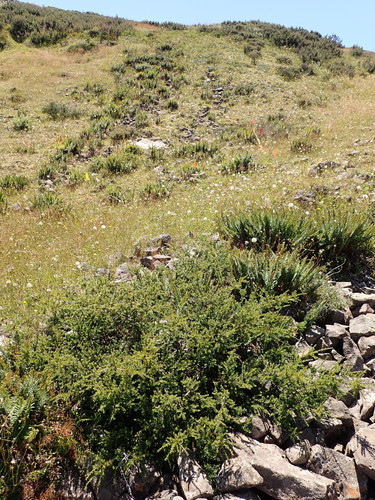
iNaturalist· cc-by-nc
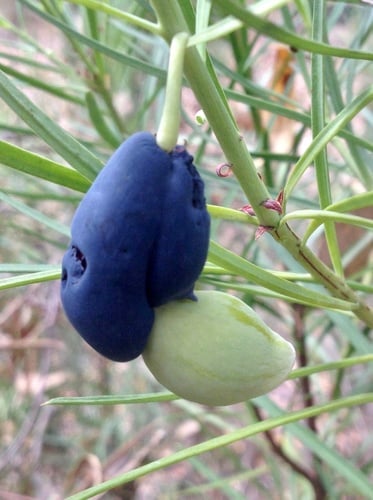
(c) Nicolas Schwab, some rights reserved (CC BY-NC), uploaded by Nicolas Schwab
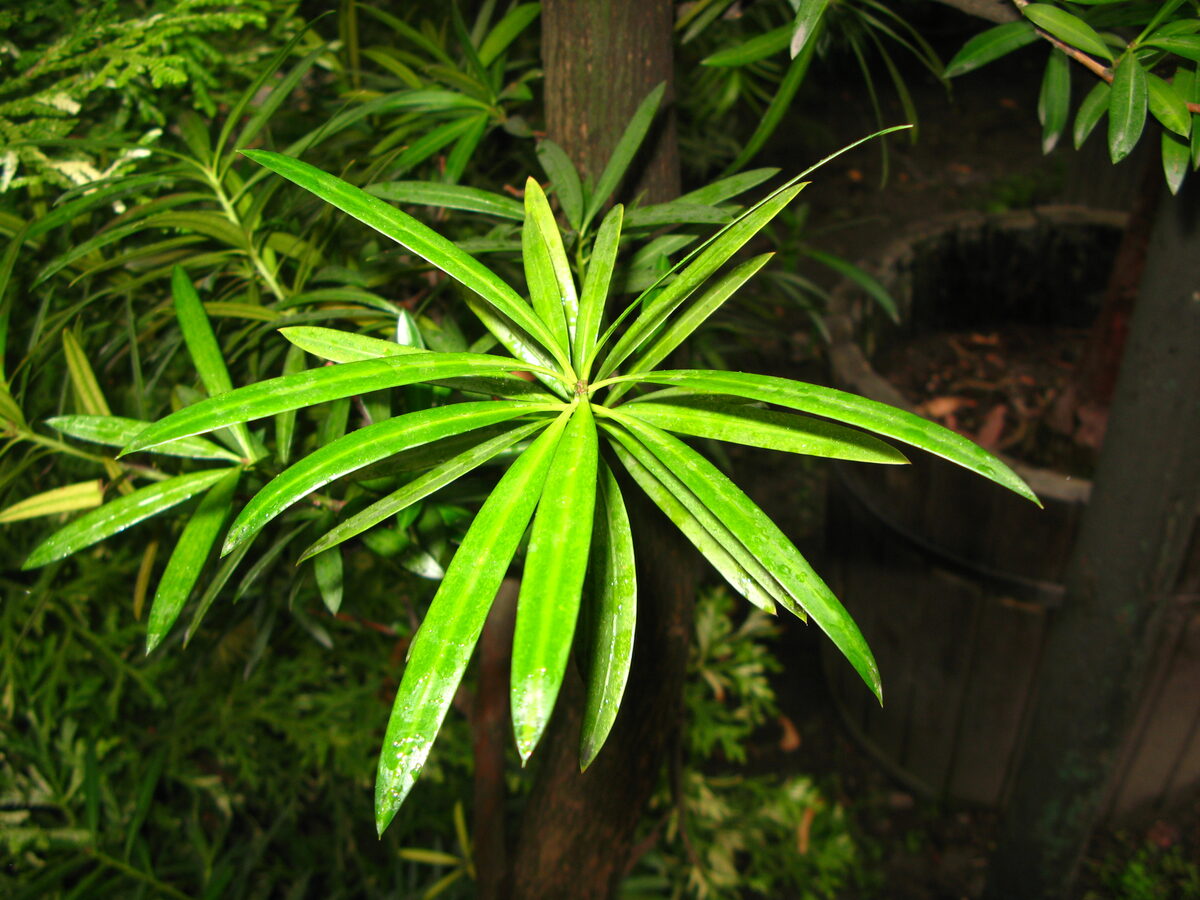
iNaturalist· cc-by-nc
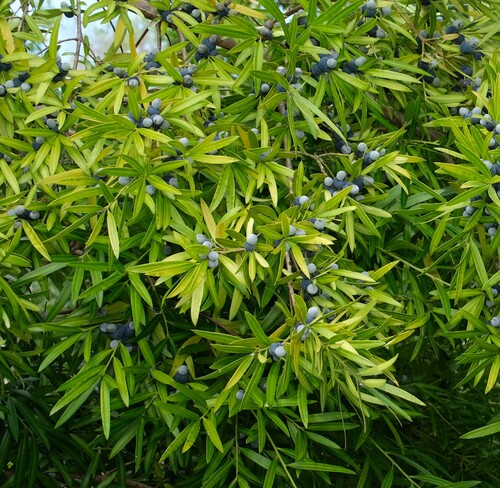
(c) Cheng-Tao Lin, some rights reserved (CC BY-NC)
Summary
Source: WikipediaPodocarpus macrophyllus is a conifer in the genus Podocarpus, family Podocarpaceae. It is the northernmost species of the genus, native to southern Japan and southern and eastern China. Common names in English include yew plum pine, Buddhist pine, fern pine and Japanese yew. Kusamaki (クサマキ) and inumaki (犬槇) are Japanese names for this tree. In China, it is known as luóhàn sōng (羅漢松), which literally means "arhat pine".
Description
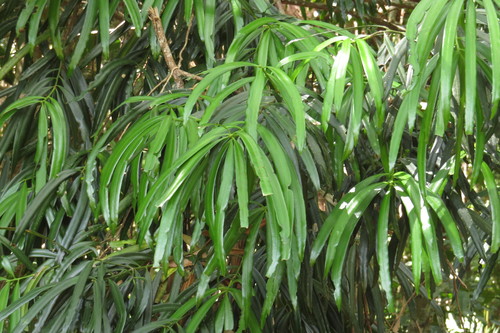
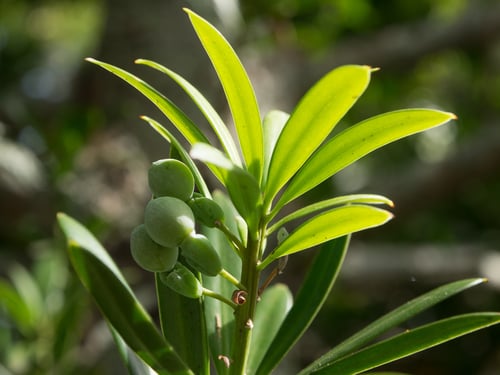
A tree. It grows to 20 m tall. The trunk is 60 cm across. The bark is greyish brown and peels off in large flakes. The branches are erect and spreading. The leaves are arranged in spirals and without leaf stalks. The leaves are dark green on top and pale green underneath. They are 1.7-12 cm long by 2-10 mm wide. The leaves are leathery. The pollen cones are in the axils of leaves and often in groups of 3-5. They are spike like and 3-5 cm long. The seeds are oval and about 1 cm across. The seeds are on a swollen receptacle which becomes red and fleshy.
Edible Uses
The fruit can be eaten raw or cooked — used in pies, cakes, and similar preparations. It measures 12–15mm in length.
Traditional Uses
The fruit are eaten fresh. They can also be used for pies and cakes. Caution: The seeds are not eaten.
This uses section is brief — help expand it
Medicinal Uses
The stem bark is used in the treatment of worms, particularly ringworm, and blood disorders. A decoction made from the fruit is considered tonic for the heart, kidneys, lungs, and stomach.
Distribution
It is a temperate to subtropical plant. It is native to S China and Japan. It grows in forests and open thickets from sea level to 1000 m altitude in S China. It can tolerate sea winds and salt spray. It suits hardiness zones 7-11. Arboretum Tasmania. Hobart Botanical Gardens. Melbourne Botanical Gardens.
Where It Grows
Asia, Australia, China, Hawaii, Indochina, Japan*, Korea, Macao, Myanmar, North America, Pacific, SE Asia, Taiwan, Tasmania, USA,
Cultivation
It can be grown as a hedge plant.
Propagation
Seed can be sown at any time of year in sandy soil in a warm greenhouse, though sowing as soon as it is ripe is ideal. Prick seedlings into individual pots once large enough to handle and grow them on in the greenhouse for at least their first winter. Plant out into permanent positions in late spring or early summer, after the last expected frosts. Cuttings of half-ripe terminal shoots, 5–10cm long, can be taken in July or August and rooted in a frame.
Other Uses
Plants are used for hedging in North America, with the erect cultivar 'Maki' being commonly chosen for this purpose. The wood is used in making furniture, utensils, paper, and farm implements.
Production
Trees can live for hundreds of years. The fruit are left on the tree over winter and they become black and ripe and can be eaten.
Other Information
The fruit are eaten especially by children.
Notes
There are about 100 Podocarpus species. They are mostly in the tropics and subtropics.
Also Known As
Bigleaf podocarp, Buddhist Pine, Inu-maki, Kusa-maki, Kusamaki, Lohan pine, Longleaf podocarp, Luo han song, Maki
References (12)
- Barwick, M., 2004, Tropical and Subtropical Trees. A Worldwide Encyclopedic Guide. Thames and Hudson p 337
- Bodkin, F., 1991, Encyclopedia Botanica. Cornstalk publishing, p 815
- Brickell, C. (Ed.), 1999, The Royal Horticultural Society A-Z Encyclopedia of Garden Plants. Convent Garden Books. p 813
- Cundall, P., (ed.), 2004, Gardening Australia: flora: the gardener's bible. ABC Books. p 1064
- Facciola, S., 1998, Cornucopia 2: a Source Book of Edible Plants. Kampong Publications, p 184
Show all 12 references Hide references
- Fu Liguo, Li Yong, Mill, R.R., Podocarpaceae. Flora of China.
- Hibbert, M., 2002, The Aussie Plant Finder 2002, Florilegium. p 237
- Hort. suburb. Lond. 271. 1818
- Kermath, B. M., et al, 2014, Food Plants in the Americas: A survey of the domesticated, cultivated and wild plants used for Human food in North, Central and South America and the Caribbean. On line draft. p 673
- Levy-Yamamori, R., & Taaffe, G., 2004, Garden Plants of Japan. Timber Press. p 184
- Staples, G.W. and Herbst, D.R., 2005, A tropical Garden Flora. Bishop Museum Press, Honolulu, Hawaii. p 74
- Valder, P., 1999, The Garden Plants of China. Florilegium. p 86