Plantago major
L.
Common plantain, Broadleaf plantain, Greater plantain
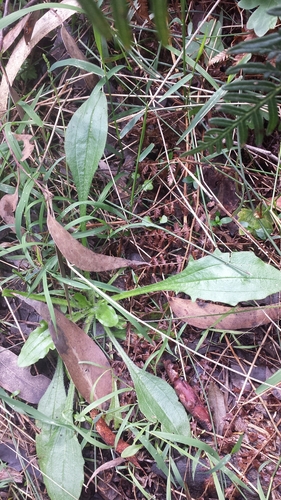
iNaturalist· cc-by-nc
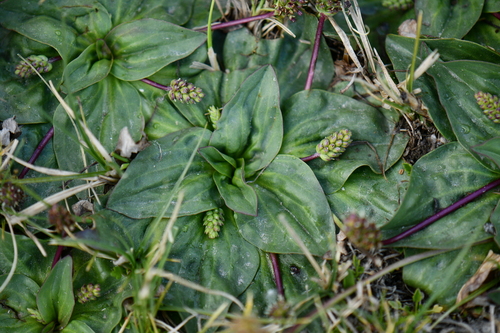
(c) Denys K., some rights reserved (CC BY-NC), uploaded by Denys K.
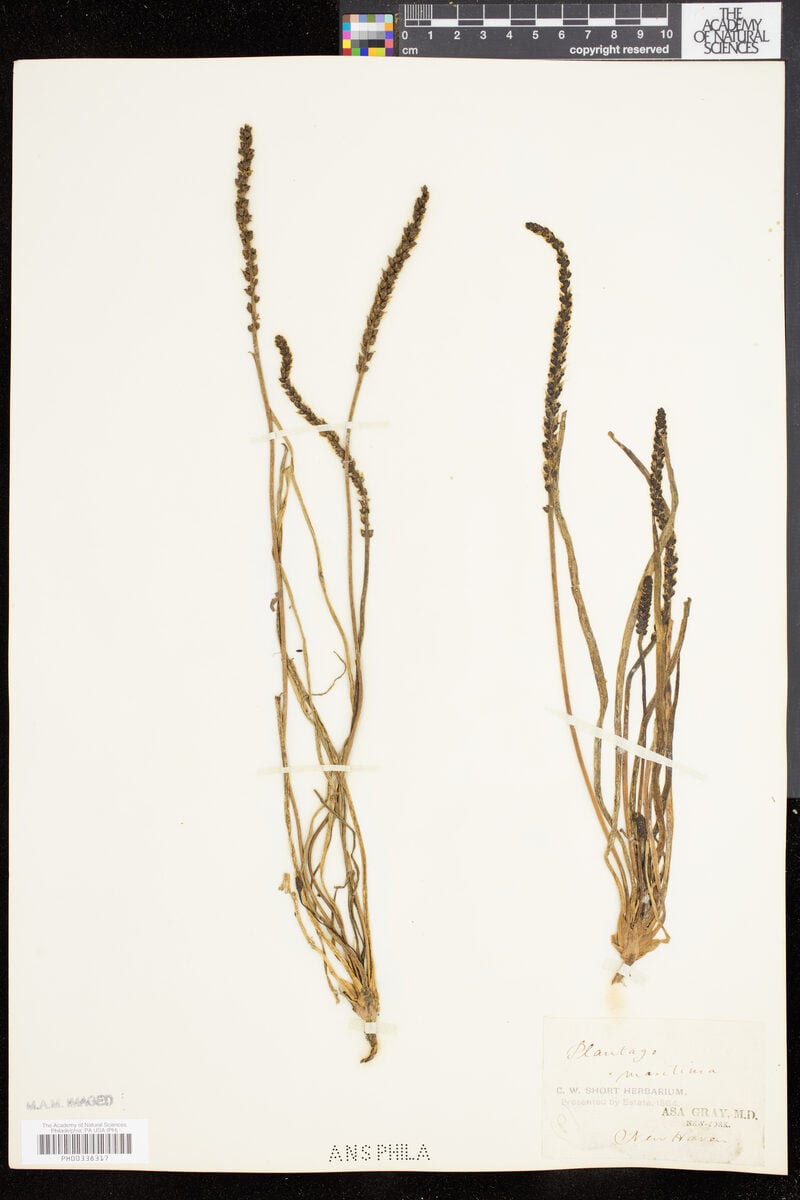
iNaturalist· cc-by-nc-sa
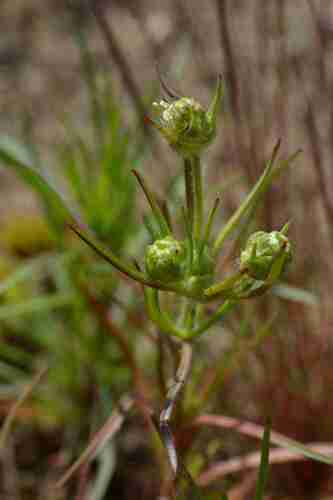
(c) Reiner Richter, some rights reserved (CC BY-NC-SA), uploaded by Reiner Richter
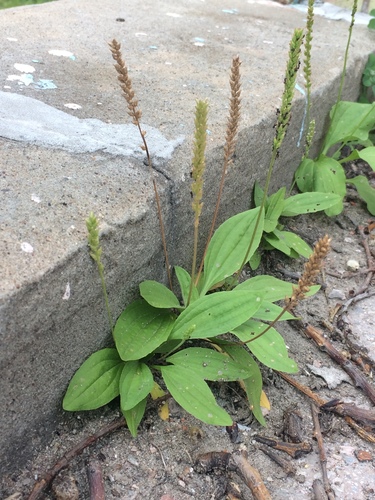
iNaturalist· cc-by
(c) lemonsnapp, some rights reserved (CC BY)
Summary
Source: WikipediaPlantago major, the broadleaf plantain, white man's footprint, waybread, or greater plantain, is a species of flowering plant in the plantain family Plantaginaceae. The plant is native to Eurasia. The young, tender leaves can be eaten raw, and the older, stringier leaves can be boiled in stews and eaten.
Description
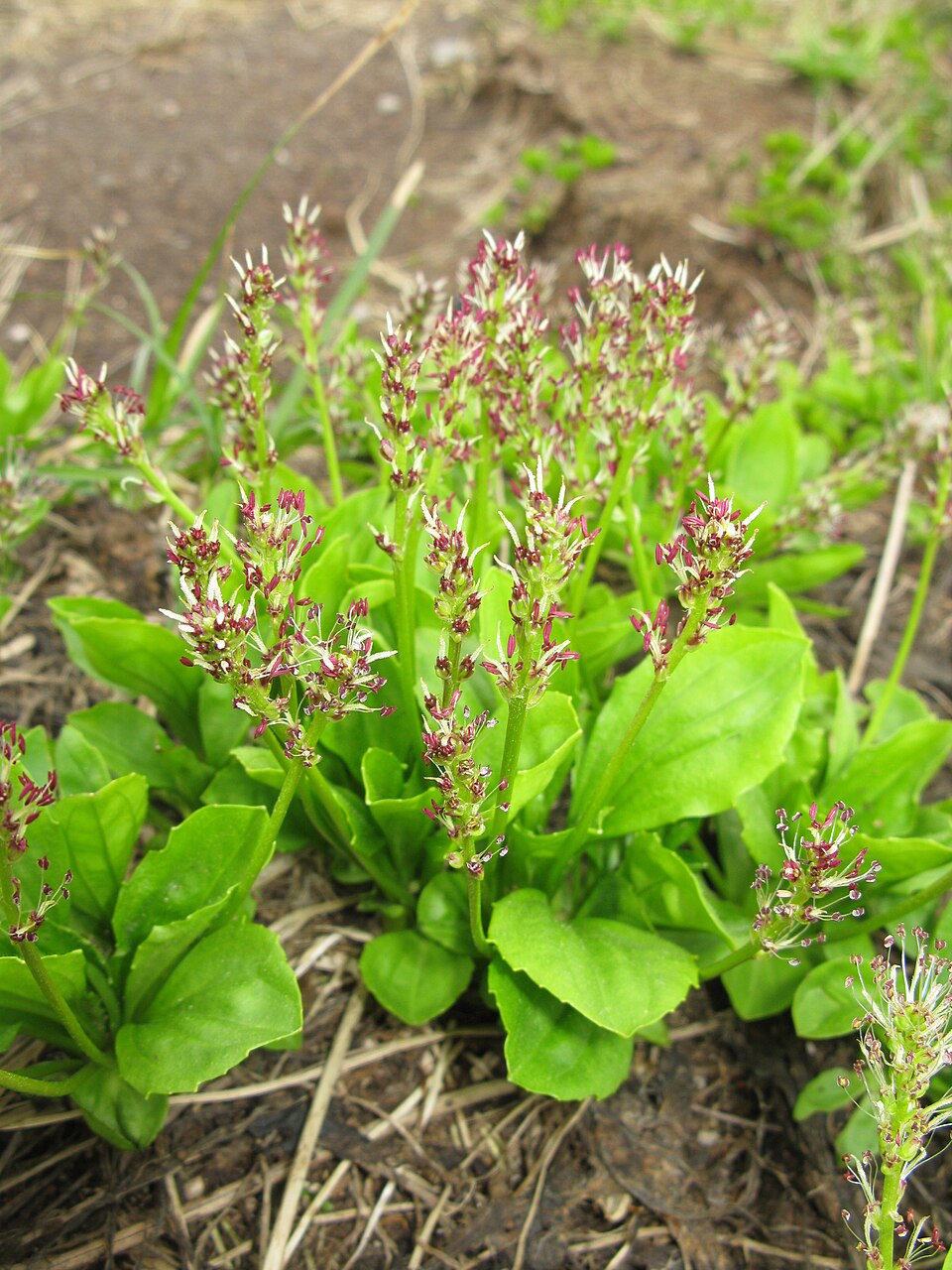
A herb. It keeps growing from year to year. It has a short, stout rootstock. It has a ring of leaves near the ground. The leaves are ribbed. They are soft and oval shaped. The leaves narrow into the stalks. The leaf stalks are fairly long and have wings. The leaves can be 30 cm long by 15 cm wide. The leaves have 5-9 easy to see veins running along them. The flower stem is leafless and as long as or shorter than the leaves. The flowers are in a dense spike. This can be as long as or longer than its stem.
Edible Uses
Young leaves can be eaten raw or cooked, though they are rather bitter and the fibrous strands need to be removed before use. The leaf-stalk is even more fibrous than the leaf and is best avoided. Many people blanch the leaves in boiling water before adding them to salads to improve tenderness. A Chinese form has more palatable leaves, with an approximate composition of 2.7% protein, 0.4% fat, and 2.2% ash. The seed can be ground into a meal and mixed with flour, or the whole seeds boiled and used like sago; they are very rich in vitamin B1, though harvesting is tedious. Dried leaves make an acceptable tea. The root is also edible, though no further details are recorded.
Traditional Uses
Young leaves are lightly cooked. Older leaves become more bitter. The leaves are used in soups. The leaves can be dipped in batter and fried over low heat. They are also used in chutney. The leaves are used for sarma in Turkey. They are rolled around a filling of rice or minced meat. The dried leaves are used for tea. The seeds are used to give a jelly like effect in drinks. They can be ground into a meal for bread. The seeds yield an edible oil. The roots are eaten cooked.
Medicinal Uses
Common plantain is a safe and effective treatment for bleeding, quickly stanching blood flow and supporting tissue repair. The leaves are astringent, demulcent, deobstruent, depurative, diuretic, expectorant, haemostatic, and refrigerant. Internally they are used for diarrhoea, gastritis, peptic ulcers, irritable bowel syndrome, haemorrhage, haemorrhoids, cystitis, bronchitis, catarrh, sinusitis, asthma, and hay fever. Externally they are applied to skin inflammations, malignant ulcers, cuts, and stings. Heated leaves are used as a wet dressing for wounds and swellings. The root, used in equal portions with Marrubium vulgare, is a traditional remedy for rattlesnake bite. The seeds are used to treat parasitic worms. Seeds contain up to 30% mucilage, which swells in the gut and acts as a bulk laxative while soothing irritated membranes; the husks alone are sometimes used without the seeds. A distilled water made from the plant serves as an excellent eye lotion.
Known Hazards
High doses may cause a fall in blood pressure and diarrhoea. Possible allergic contact dermatitis. Avoid in patients with intestinal obstruction or abdominal discomfort.
Distribution
It is a temperate plant. It grows in damp places. It grows in wetlands. It grows mostly in cool places. In Argentina it grows below 500 m above sea level. Tasmania Herbarium. In Yunnan. In Sichuan.
Where It Grows
Africa, Alaska, Albania, American Samoa, Andorra, Angola, Argentina, Armenia, Asia, Australia, Austria, Balkans, Belarus, Bosnia, Brazil, Britain, British Indian Ocean Terr., BIOT, Canada, Caucasus, Central America, Central Asia, Chile, China, Colombia, Croatia, Cuba, Denmark, Dominican Republic, East Africa, Easter Island, East Timor, Ecuador, Estonia, Eswatini, Europe*, Falklands, Finland, France, Georgia, Greece, Guatemala, Guiana, Guianas, Guyana, Haiti, Himalayas, Hungary, India, Indochina, Indonesia, Italy, Haiti, Kazakhstan, Korea, Kyrgyzstan, Laos, Latvia, Lesotho, Libya, Lithuania, Luxembourg, Macedonia, Madagascar, Mediterranean, Middle East, Mongolia, Myanmar, Nepal, Netherlands, New Zealand, Niue, Norfolk Island, North Africa, North America, Northeastern India, NW India, Norway, Pacific, Pakistan, Papua New Guinea, PNG, Peru, Poland, Puerto Rico, Russia, Sao Tome and Principe, Scandinavia, SE Asia, Sicily, Slovakia, Slovenia, South Africa, Southern Africa, South America, Spain, St Helena, St Lucia, Suriname, Swaziland, Sweden, Switzerland, Taiwan, Tajikistan, Tasmania, Tibet, Timor-Leste, Tonga, Turkey, Türkiye, Ukraine, Uruguay, USA, Uzbekistan, Venezuela, Vietnam, Virgin Islands, West Indies, Yemen, Zambia, Zimbabwe,
Cultivation
Succeeds in any moderately fertile soil in a sunny position. Although this species is a common garden weed, some named forms have been selected for their ornamental value. Plantago major is self-fertile. The leaves can be harvested throughout the growing season, but the best time is from spring to early summer. Plantago major typically flowers from late spring to summer, around May to July (Northern Hemisphere). Common plantain is a fast-growing plant that often establishes itself quickly in disturbed areas and thrives in various soil conditions.
Propagation
Sow seed in spring in a cold frame. Once seedlings are large enough to handle, prick them out into individual pots and plant out in early summer. If seed is plentiful, a direct outdoor sowing can be made in situ from mid to late spring.
Other Uses
Plantago major works well as a ground cover, helping to prevent soil erosion and suppress weeds, while also providing habitat and food for beneficial insects. Some named forms have been selected for ornamental value. It is an important food plant for the caterpillars of many butterfly species, and its seeds can serve as food for birds. The flowers can attract some pollinators, though they are not a primary nectar source. Leaf litter and foliage provide habitat for invertebrates. The leaves have a distinct aroma that may help deter some pests. It is a dynamic accumulator and is suitable for food forest and wildlife garden settings. The plant is also suitable for dried flower arrangements.
Other Information
It is sold in local markets. It is cultivated.
Notes
Leaves reported to contain a small amount of Vitamin C. The plantains or Plantaginaceae are mostly in temperate regions. There are about 165 Plantago species.
Nutrition
| Part | Moisture | kJ | kcal | Protein | Vit A | Vit C | Iron | Zinc |
|---|---|---|---|---|---|---|---|---|
| Leaves | 81.4 | 255 | 61 | 3.8 | 11000 | 19 | 1.2 | — |
| Leaves | 85 | 159 | 39 | 2.1 | — | — | — | — |
Synonyms
Also Known As
Ah-gwaw-paung-ta-htaung, Akyaw-baung-tha-thaung, Babka, Baga, Bag yapragi, Balazagva, Bar preme, Belgheviz, Bolila ba lipoli, Brede weegbree, Broad-leafed plantain, Bud-gull, Centunervi, Che qian, Cheuli, Damarliot, Damar otu, Daun sejumbok, Daun sendok, Ekur anjing, Ezan lezu, Ghuzbe, Groblad, Gul, Isabgol, Isafghol, Karet, Kel-ba-an, Kesikotu, Ki arut, Kirksinirotu, Kolocier, Kolosija, Kopakopa, Kutu kiyanchi remedyu tape, Lengue pechere, Lessan-imthaur, Llanten, Llanten mayor, Luhuriya, Ma de, Mravaldzargva, Nido marto, Ominwas, Orecchie d'asino, Padaroznik, Pampina larga, Pel hewes, Pelonbas, Plantatge ample, Plantain, Planten, Podorozhnik, Pulung nyang, Rat's-tail plantain, Sangka-buwah, Sangkubah, Se-gyaw-paung-ta-htaung, Se-kyaw-gyi, Sepodi, Sinirliot, Sinirotu, Teeleht, Tharam, Tirafilo, Torraja cimarrona, Torreja cimarrona, Veliki trpotec, Wa gui, Warmi llanten, Yara otu, Yawar llanten, Yempat, Zenska bokvica
References (134)
- Alimenticias - FloraSBS
- Al-Fatimi, M. A., Wild Edible Plants Traditionally Collected and Used in Southern Yemen. Research Square. University of Aden. p 22
- Ambasta, S.P. (Ed.), 2000, The Useful Plants of India. CSIR India. p 467
- Arora, R. K., 2014, Diversity in Underutilized Plant Species - An Asia-Pacific Perspective. Bioversity International. p 44
- Beckstrom-Sternberg, Stephen M., and James A. Duke. "The Foodplant Database." http://probe.nalusda.gov:8300/cgi-bin/browse/foodplantdb.(ACEDB version 4.0 - data version July 1994)
Show all 134 references Hide references
- Bennett, B. C., 1990, Useful Plants of Amazonian Ecuador. US Agency for International Development. Fifth Progress Report. New York Botanical Gardens. p 39
- Biscotti, N. et al, 2018, The traditional food use of wild vegetables in Apulia (Italy) in the light of Italian ethnobotanical literature. Italian Botanist 5:1-24
- Blamey, M and Grey-Wilson, C., 2005, Wild flowers of the Mediterranean. A & C Black London. p 421
- Bodkin, F., 1991, Encyclopedia Botanica. Cornstalk publishing, p 809
- Bonet, M. A. & Valles, J., 2002, Use of non-crop food vascular plants in Montseny biosphere reserve (Catalonia, Iberian Peninsula). International Journal of Food Sciences and Nutrition (2002) 53, 225–248
- Bremness, L., 1994, Herbs. Collins Eyewitness Handbooks. Harper Collins. p 203
- Bowser, M., 2017, Handout on Edible Plants of the Kenai Peninsula. USFWS Kenai National Wildlife Refuge p 16
- Burkill, I.H., 1966, A Dictionary of the Economic Products of the Malay Peninsula. Ministry of Agriculture and Cooperatives, Kuala Lumpur, Malaysia. Vol 2 (I-Z) p 1797
- Bussman, R. W., et al, 2021, Unity in diversity—food plants and fungi of Sakartvelo (Republic of Georgia), Caucasus. Journal of Ethnobiology and Ethnomedicine (2021) 17:72 p 12
- Cerne, M., 1992, Wild Plants from Slovenia used as Vegetables. Acta Horticulturae 318
- Cheng, Z., et al, 2022, Ethnobotanical study on wild edible plants used by Dulong people in northwestern Yunnan, China. Journal of Ethnobiology and Ethnomedicine (2022) 18:3
- "Chinese Nutrition Journal", 2002, Vol 23(8) p 298
- Cordero, S. E., Abello, L. A., & Galvez, F. L., 2017, Plantas silvestres comestibles y medicinales de Chile y otras partes del mundo. CORMA p 220
- Cormack, R. G. H., 1967, Wild Flowers of Alberta. Commercial Printers Edmonton, Canada. p 319
- Crate, S. A., 2008, "Eating Hay": The Ecology, Economy and Culture of Viliui Sakha Smallholders of Northeastern Siberia. Human Ecology 36:161-174
- Crawford, M., 2012, How to grow Perennial Vegetables. Green Books. p 150
- Curtis, W.M., 1993, The Student's Flora of Tasmania. Part 3 St David's Park Publishing, Tasmania, p 559
- Dashorst, G.R.M., and Jessop, J.P., 1998, Plants of the Adelaide Plains & Hills. Botanic Gardens of Adelaide and State Herbarium. p 134
- Demir, I. & Ayaz, N., 2022, Wild edible plants contributing to the traditional foods of Mardin (Turkey) Province. Indian Journal of Traditional Knowledge Vol 21(3), July 2022, pp 569-582
- Denes, A., et al, 2012, Wild plants used for food by Hungarian ethnic groups living in the Carpathian Basin. Acta Societatis Botanicorum Poloniae 81 (4): 381-396
- de Polle, E., Plantas Silvestres Comestible de Guatemala. 1(1) Universidad de San Carlos de Guatemala.
- Dobriyal, M. J. R. & Dobriyal, R., 2014, Non Wood Forest Produce an Option for Ethnic Food and Nutritional Security in India. Int. J. of Usuf. Mngt. 15(1):17-37
- Dogan, Y., et al, 2015, Of the importance of a leaf: the ethnobotany of sarma in Turkey and the Balkans. Journal of Ethnobiology and Ethnomedicine, 11:56
- Dolina, K. & Luczaj, L., 2014, Wild food plants used on the Dubrovnik coast (south-eastern Croatia) Acta Soc Bot Pol 83(3):175–181
- Duke, J.A., 1992, Handbook of Edible Weeds. CRC Press. p 150
- Elias, T.S. & Dykeman P.A., 1990, Edible Wild Plants. A North American Field guide. Sterling, New York p 79
- Ertug, F, Yenen Bitkiler. Resimli Türkiye Florası -I- Flora of Turkey - Ethnobotany supplement
- Esperanca, M. J., 1988. Surviving in the wild. A glance at the wild plants and their uses. Vol. 2. p 156
- Facciola, S., 1998, Cornucopia 2: a Source Book of Edible Plants. Kampong Publications, p 173
- Flora of Pakistan. www.eFloras.org
- Fox, F. W. & Young, M. E. N., 1982, Food from the Veld. Delta Books. p 293
- Geraci, A., et al, 2018, The wild taxa utilized as vegetables in Sicily (Italy): a traditional component of the Mediterranean diet. Journal of Ethnobiology and Ethnomedicine (2018) 14:14
- Girard, N. J., 2020, Sustainable Foraging of Wild Edible Plants in Norway. A Biocultural Approach. M. Sc. thesis Norwegian University. p 133
- Grivetti, L. E., 1980, Agricultural development: present and potential role of edible wild plants. Part 2: Sub-Saharan Africa, Report to the Department of State Agency for International Development. p 65
- Guil-Guerrero, J. L., et al, 2001, Edible Wild Plants. in Recent Progress in Medicinal Plants Vol. 8 Sci. Tech publishing, Texas
- Hadjichambis, A. C., et al, 2007, Wild and semi-domesticated food plant consumption in seven circum-Mediterranean areas. International Journal of Food Sciences and Nutrition. 2007, 1-32.
- Hani Medicine of Xishuangbanna, 1999, p 267
- Hedrick, U.P., 1919, (Ed.), Sturtevant's edible plants of the world. p 507
- Henty, E.E., & Pritchard, G.S., 1973, Weeds of New Guinea and their control. Botany Bulletin No 7, Division of Botany, Lae, PNG. p 136
- Hibbert, M., 2002, The Aussie Plant Finder 2002, Florilegium. p 236
- http://nordicfood lab/org/blog/2102/9/wild-edible-plants-an-overview
- http://www.botanic-gardens-ljubljana.com/en/plants
- Hussey, B.M.J., Keighery, G.J., Cousens, R.D., Dodd, J., Lloyd, S.G., 1997, Western Weeds. A guide to the weeds of Western Australia. Plant Protection Society of Western Australia. p 196
- Huxley, A. (Ed.), 1977, The Encyclopedia of the Plant Kingdom. Chartweil Books. p 227
- Hu, Shiu-ying, 2005, Food Plants of China. The Chinese University Press. p 677
- Hyde-Wyatt, B.H. & Morris D.I., 1975, Tasmanian Weed Handbook. Dept of Ag Tasmania. p 88
- Irving, M., 2009, The Forager Handbook, A Guide to the Edible Plants of Britain. Ebury Press p 250
- Jardin, C., 1970, List of Foods Used In Africa, FAO Nutrition Information Document Series No 2.p 95
- Kaliszewska, I & Kolodziejska-Degorska, I, 2015, The social context of wild leafy vegetables uses in Shiri, Daghestan. Journal of Ethnobiology and Ethnomedicine, 11:63
- Kalle, R. & Soukand, R., 2012, Historical ethnobotanical review of wild edible plants of Estonia (1770s-1960s) Acta Societatis Botanicorum Poloniae 81(4):271-281
- Kar, A., 2004, Common wild vegetables of Aka tribe of Arunachal Pradesh. Indian Journal of Traditional Knowledge 3(3) pp 305-313
- Kar, A., et al, 2013, Wild Edible Plant Resources used by the Mizos of Mizoram, India. Kathmandu University Journal of Science, Engineering and Technology. Vol. 9, No. 1, July, 2013, 106-126
- Kermath, B. M., et al, 2014, Food Plants in the Americas: A survey of the domesticated, cultivated and wild plants used for Human food in North, Central and South America and the Caribbean. On line draft. p 670
- Khan, M. & Hussain, S., 2014, Diversity of wild edible plants and flowering phenology of district Poonch (J & K) in the northwest Himalaya. Indian Journal of Sci, Res. 9(1): 032-038
- Kizilarslan, C. & Ozhatay, N., 2012, An ethnobotanical study of the useful and edible plants of İzmit. Marmara Pharmaceutical Journal 16: 134-140, 2012.
- Kolosova, V., et al, 2020, Foraging in Boreal Forest: Wild Food Plants of the Republic of Karelia, NW Russia. Foods 2020, 9, 1015; p 19
- Lamp, C & Collet F., 1989, Field Guide to Weeds in Australia. Inkata Press. p 220
- Lautenschläger, T., et al, 2018, First large-scale ethnobotanical survey in the province of Uíge, northern Angola. Journal of Ethnobiology and Ethnomedicine (2018) 14:51
- Lazarides, M. & Hince, B., 1993, Handbook of Economic Plants of Australia, CSIRO. p 192
- Lim, T. K., 2015, Edible Medicinal and Non Medicinal Plants. Volume 9, Modified Stems, Roots, Bulbs. Springer p 66
- Long, C., 2005, Swaziland's Flora - siSwati names and Uses http://www.sntc.org.sz/flora/
- Low, T., 1991, Wild Herbs of Australia and New Zealand. Angus & Robertson. p 48 (Drawing)
- Luczaj, L., 2012, Ethnobotanical review of wild edible plants of Slovakia. Acta Societatis Botanicorum Poloniae 81(4):245-255
- Luczaj, L. et al, 2017, Comfrey and Buttercup Eaters: Wild Vegetables of the Imereti Region in Western Georgia, Caucasus. Economic Botany, 71(2), 2017, pp. 188–193
- Mabey, R., 1973, Food for Free. A Guide to the edible wild plants of Britain, Collins. p 105
- MacKinnon, A., et al, 2009, Edible & Medicinal Plants of Canada. Lone Pine. p 256
- Mahklouf, M. H., 2019, Ethnobotanical Study of Edible Wild Plants in Libya. European Journal of Ecology. 5(2): 30-40
- Malezas Comestibles del Cono Sur, INTA, 2009, Buernos Aires
- Martin, F.W. & Ruberte, R.M., 1979, Edible Leaves of the Tropics. Antillian College Press, Mayaguez, Puerto Rico. p 80
- Mattalia, G., et al, 2012, Traditional uses of wild food and medicinal plants among Brigasc, Kye ́, and Provenc ̧al communities on the Western Italian Alps. Genet Resour Crop Evol. Springer
- Mir, M. Y., 2014, Documentation and ethnobotanical survey of wild edible plants used by the tribals of Kupwara, J & K, India. International Journal of Herbal Medicine. 2(4): 11-18
- Moerman, D. F., 2010, Native American Ethnobotany. Timber Press. p 416
- Morley, B.D., & Toelken, H.R., (Eds), 1983, Flowering Plants in Australia. Rigby. p 285
- Nanagulyan, S., et al, 2020, Wild plants and fungi sold in the markets of Yerevan (Armenia). Journal of Ethnobiology and Ethnomedicine 16:26
- Ogle, B. M., et al, 2003, Food, Feed or Medicine: The Multiple Functions of Edible Wild Plants in Vietnam. Economic Botany 57(1): 103-117 (Also as Plantago asiatica)
- Ozbucak, T. B. et al, 2006, The Contribution of Wild Edible Plants to Human Nutrition in the Black Sea Region of Turkey. Ethnobotanical Leaflets 10: 98-103
- Paczkowska, G . & Chapman, A.R., 2000, The Western Australian Flora. A Descriptive Calatogue. Western Australian Herbarium. p 457
- Paoletti, M.G., Dreon, A.L., and Lorenzoni, G.G., 1995, Pistic, Traditional Food from Western Friuli, NE Italy. Economic Botany 49(1) pp 26-30
- Pasta, S., et al, 2020, An Updated Checklist of the Sicilian Native Edible Plants: Preserving the Traditional Ecological Knowledge of Century-Old Agro-Pastoral Landscapes. Frontiers in Plant Science. Volume 11|Article 388
- Pieroni, A., 1999, Gathered wild food plants in the Upper Valley of the Serchio River (Garfagnana), Central Italy. Economic Botany 53(3) pp 327-341
- Pieroni, A. & Soukand, R., 2018, Forest as Stronghold of Local Ecological Practice: Currently Used Wild Food Plants in Polesia, Northern Ukraine. Economic Botany, XX(X) pp. 1-21
- Pieroni, A. & Soukand, R., 2017, The disappearing wild food and medicinal plant knowledge in a few mountain villages of North-Eastern Albania. Journal of Applied Botany and Food Quality 90, 58 - 67
- Pieroni, A., et al, 2020, Wild food plants traditionally gathered in central Armenia: archaic ingredients or future sustainable foods? Environment, Development and Sustainability. Springer p 11
- Plants for a Future database, The Field, Penpol, Lostwithiel, Cornwall, PL22 0NG, UK. http://www.scs.leeds.ac.uk/pfaf/
- Plants of Haiti Smithsonian Institute http://botany.si.edu/antilles/West Indies
- Polat, R., et al, 2015, Survey of wild food plants for human consumption in Elazig (Turkey). Indian Journal of Traditional Knowledge. Vol. 1(1): 69-75
- Polat, R., et al, 2017, Survey of wild food plants for human consumption in Bingol, (Turkey). Indian Journal of Traditional Knowledge. Vol. 16(3) July 2017, pp. 378-384
- Prakofjewa, J., et al, 2023, Boundaries Are Blurred: Wild Food Plant Knowledge Circulation across the Polish-Lithuanian-Belarusian Borderland. Biology 2023, 12, 571.
- Pruse, B., et al, 2021, Active Wild Food Practices among Culturally Diverse Groups in the 21st Century across Latgale, Latvia. Biology 2021, 10, 551.
- READ,
- Recher, P, 2001, Fruit Spirit Botanical Gardens Plant Index. www.nrg.com.au/~recher/ seedlist.html p 3
- Redzic, S. J., 2006, Wild Edible Plants and their Traditional Use in the Human Nutrition in Bosnia-Herzegovina. Ecology of Food and Nutrition, 45:189-232
- Redzic, S., 2010, Use of Wild and Semi-Wild Edible Plants in Nutrition and Survival of People in 1430 Days of Siege of Sarajevo during the War in Bosnia and Herzegovina (1992–1995). Coll. Antropol 34 (2010) 2:551-570
- Roa, J. A. G. & Boada, D. S. G., 2018, Fundación para el Fortalecimiento de la Fruticultura y Plantas Alimenticias no Convencionales en Colombia.
- Ruiters-Welcome, A. K., 2019, Food plants of southern Africa. Ph.D. thesis. Univ. of Johannesburg p 87
- Sang, D. T., & Mizoue, K. O. N., 2012, Use of Edible Forest Plants among Indigenous Ethnic Minorities in Cat Tien Biosphere Reserve, Vietnam. Asian Journal of Biodiversity Vol. 3 (1), p 23-49
- Schunko, C., et al, 2010, Organic farmers use of wild food plants and fungi in a hilly area in Styria (Austria). Journal of Ethnobiology and Ethnomedicine 6:17
- Shikov, A. N. et al, 2017, Traditional and Current Food Use of Wild Plants Listed in the Russian Pharmacopoeia. Frontiers in Pharmacology. Vol. 8 Article 841
- Shin, T., et al, 2018, Traditional knowledge of wild edible plants with special emphasis on medicinal uses in Southern Shan State, Myanmar. Journal of Ethnobiology and Ethnomedicine (2018) 14:48
- Singh, S.R. and Singh, N.I., 1985, A Preliminary Ethnobotanical studies on wild edible plants in the markets of Manipur - 1. J. Econ. Tax. Bot. Vol. 6 No. 3 pp 699-703
- Skinner, G. & Brown, 1981, C., Simply Living. A gatherer's guide to New Zealand's fields, forests and shores. Reed. p 17
- Smith, N., Mori, S.A., et al, 2004, Flowering Plants of the Neotropics. Princeton. p 298 (Drawing)
- Soukand, R., et al, 2017, Multi-functionality of the few: current and past uses of wild plants for food and healing in Liubań region, Belarus. Journal of Ethnobiology and Ethnomedicine (2017) 13:10
- Sp. pl. 1:112. 1753
- Srivastava, R. C., 2010, Traditional knowledge of Nyishi (Daffla) tribe of Arunachal Pradesh. Indian Journal of Traditional Knowledge. 9(1):26-37
- Swaziland's Flora Database http://www.sntc.org.sz/flora
- Tasmanian Herbarium Vascular Plants list p 44
- Tardio, J., et al, Ethnobotanical review of wild edible plants in Spain. Botanical J. Linnean Soc. 152 (2006), 27-71
- Terra, G.J.A., 1973, Tropical Vegetables. Communication 54e Royal Tropical Institute, Amsterdam, p 67
- Thothathri, K., & Pal, G.D., 1987, Further Contribution to the Ethnobotany of Subansiri District, Aranchal Pradesh. J. Econ. Tax. Bot. Vol. 10 No. 1 pp 149-157
- Topp, J. M. W., 1988, An Annotated Check List of the Flora of Diego Garcia, British Ocean Territory. Atoll Research Bulletin No. 313 (Rare)
- Torre, de la, L., et al, 2008, Enciclopedia de las Plantas Útiles del Ecuador. Herbario QCA. Pontificia Universidad Católica del Ecuador. p 505
- Toupal, R. S. & Hollenback, K., 2009, An Ethnobotany of Indiana Dunes National Lakeshore: Plant Uses of the Ojibwa People. Bureau of Applied Research in Anthropology. University of Arizona
- Tsering, J., et al, 2017, Ethnobotanical appraisal on wild edible plants used by the Monpa community of Arunchal Pradesh. Indian Journal of Traditional Knowledge. Vol 16(4), October 2017, pp 626-637
- Upson, R., & Lewis R., 2014, Updated Vascular Plant Checklist and Atlas for the Falkland Islands. Falklands Conservation and Kew.
- Urgamal, M., Oyuntsetseg, B., Nyambayar, D. & Dulamsuren, Ch. 2014. Conspectus of the vascular plants of Mongolia. (Editors: Sanchir, Ch. & Jamsran, Ts.). Ulaanbaatar, Mongolia. “Admon“ Press. 334pp. (p. 79-90).
- Vorstenbosch, T., et al, 2017, Famine food of vegetal origin consumed in the Netherlands during World War II. Journal of Ethnobiology and Ethnomedicine (2017) 13:63
- Wang, J. et al, 2013, A Study on the Utilization of Wild Plants for Food in Liangshan Yi Autonomous Prefecture. Plant Diversity and Resources. 35(4): 416-471
- Wang, J., et al, 2020, An ethnobotanical survey of wild edible plants used by the Yi people of Liangshan Prefecture, Sichuan Province, China. Journal of Ethnobiology and Ethnomedicine 16:10 p 8
- Welcome, A. K. & Van Wyk, B.-E., 2019, An inventory and analysis of the food plants of southern Africa. South African Journal of Botany 122 (2019) 136–179
- Westerway, J., et al, 2018, Preliminary checklist of the naturalised and pest plants of Timor-Leste. Blumea 63:157-163
- Wijayakusuma, H.M.H., et al, 1996, Tanaman Berkhasiat Obat Di Indonesia. Pustaka Kartini. p 48
- World Checklist of Useful Plant Species 2020. Royal Botanic Gardens, Kew
- Wujisguleng, W., & Khasbagen. K., 2010, An integrated assessment of wild vegetable resources in Inner Mongolian Autonomous Region, China. Journal of Ethnobiology and Ethnomedicine 6:34
- www.ediblewildfood.com
- Yuncker, T.G., 1959, Plants of Tonga, Bernice P. Bishop Museum, Hawaii, Bulletin 220. p 244
- Zennie, T.M. and Ogzewalla, C.D., 1974, Ascorbic Acid and Vitamin A content of Edible Wild Plants of Ohio and Kentucky.
- Zhang, Y., et al, 2014, Diversity of wetland plants used traditionally in China: a literature review. Journal of Ethnobiology and Ethnomedicine. 10:72
- Zizka, G., 1991, Flowering Plants of Easter Island. Palmarum Hortus Francofurtensis