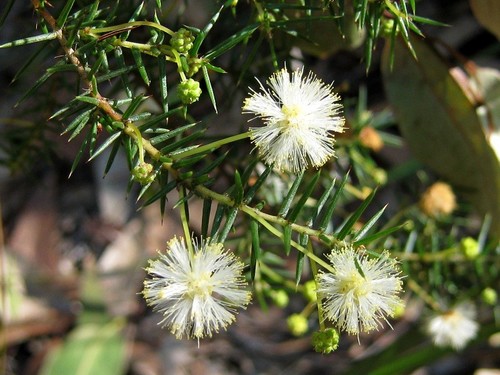
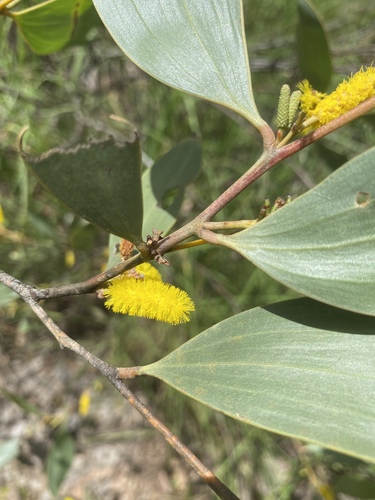
Vachellia jacquemontii
(Benth.) Ali
Babul, Bamul
iNaturalist· cc-by-nc
(c) Dhaivat Hathi, some rights reserved (CC BY-NC), uploaded by Dhaivat Hathi
iNaturalist· cc-by-nc-sa
(c) Shivam Bhatt, some rights reserved (CC BY-NC-SA)
iNaturalist· cc-by-nc-sa
(c) Shivam Bhatt, some rights reserved (CC BY-NC-SA)
Summary
Source: WikipediaVachellia jacquemontii is a species of plant native to the Thar Desert of India and Pakistan. The species name refers to French botanist Victor Jacquemont. It grows as an erect shrub or small tree, usually 6 feet (1.8 m) to 10 feet (3.0 m) high, with multiple shoots coming from below ground. This plant has a number of traditional medicinal uses, including treatment of snakebite, induction of abortion, and for chronic renal disease. This shrub also plays an important role in stabilizing the sand dunes of its native desert habitat. The wood is valuable as firewood because it produces a large amount of heat. The branches are used in construction of huts and fences and the sturdy roots are used as rope.
Description
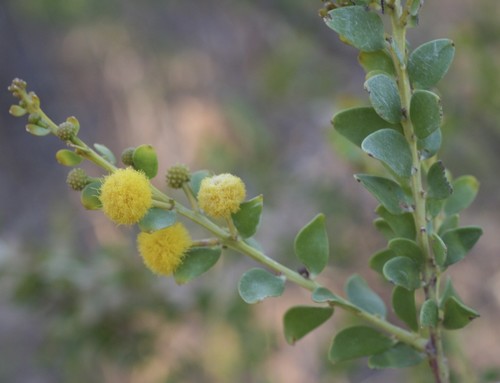
A shrub. It grow up to 2.5 m high. The twigs zigzag. It has several shoots. The bark is greyish brown. The spines are straight. The leaf stalk can be 5 cm long. There are 1-4 pairs of pinnae. These are 5-15 cm long. These contain 5-10 pairs of leaflets. These are 3-4 mm long. The fruit is a pod 5-7 cm long and about 1 cm wide. It has 5-6 seeds.
Edible Uses
The gum is eaten, though it is poor quality and traditionally consumed only in times of scarcity.
Traditional Uses
The gum is poor quality but is eaten in times of scarcity.
This uses section is brief — help expand it
Medicinal Uses
The gum serves as a famine food.
Known Hazards
Especially in times of drought, many Acacia species can concentrate high levels of the toxin Hydrogen cyanide in their foliage, making them dangerous for herbivores to eat.
Distribution
It is a subtropical plant. It is used in Rajasthan, India in Jaisalmer district. It can tolerate drought. It grows in dry sandy soils.
Where It Grows
Asia, India, Iran, Middle East, Pakistan,
Cultivation
This species has a symbiotic relationship with certain soil bacteria, these bacteria form nodules on the roots and fix atmospheric nitrogen. Some of this nitrogen is utilized by the growing plant but some can also be used by other plants growing nearby.
Propagation
The seed of most, if not all, members of this genus has a hard seedcoat and may benefit from scarification before sowing to speed up germination. This can usually be done by pouring a small amount of nearly boiling water on the seeds (being careful not to cook them!) and then soaking them for 12 - 24 hours in warm water. By this time they should have imbibed moisture and swollen - if they have not, then carefully make a nick in the seedcoat (being careful not to damage the embryo) and soak for a further 12 hours before sowing. Acacia seeds that have matured fully on the bush and have been properly dried have a hard seed coat and can be stored in closed containers without deterioration for 5 - 10 years or more in dry conditions at ambient temperatures. It is best to remove the aril, which attracts weevils and can lead to moulds forming. The arils are easilyremoved by placing the seeds in water and rubbing them between the hands, then drying the seeds and winnowing them.
Other Uses
The plant yields a gum of fair quality but inferior to gum arabic (Vachellia nilotica). It is used in calico printing and paper making. The bark is a source of tannins. Bark harvested for its tannins should only be taken from mature stems, and only when the sap is rising at the beginning of the growing season - which is when the tannin content is highest and the bark is most easily removed from the wood. The white or yellowish-white wood is hard. It is generally too small to be of much use other than for items such as tool handles. The plant has a spreading root system and, with its ability to fix atmospheric nitrogen, is a good sand binder. It is often grown to stabilize sandy soils. Sometimes grown as a hedge.
Other Information
It has a small amount of gum as a famine food.
Notes
There are about 1,350 Acacia species. Over 1,000 occur in Australia. Also as Mimosaceae.
Synonyms
Also Known As
Boan, Boo-banwali, Bouli, Gulli bouli, Kikar, Ratabauli
References (7)
- Ambasta S.P. (Ed.), 2000, The Useful Plants of India. CSIR India. p 5 (As Acacia jacquemontii)
- Bhandari, (As Acacia jacquemontii)
- Flora of Pakistan. www.eFloras.org (As Acacia jacquemontii)
- ILDIS Legumes of the World http:www;ildis.org/Legume/Web (As Acacia jacquemontii)
- Kew Plants of the World Online
Show all 7 references Hide references
- Shekhawat, G.S. & Anand, S., 1984, An Ethnobotanical Profile of Indian Desert. J. Econ. Tax. Bot. Vol.5 No.3 pp 591-598 (As Acacia jacquemontii)
- World Checklist of Useful Plant Species 2020. Royal Botanic Gardens, Kew