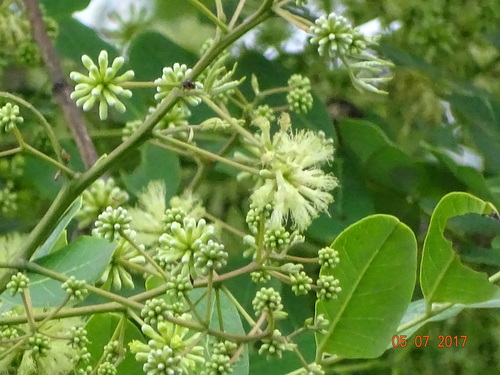
Cassia sieberiana
DC.
African Laburnum
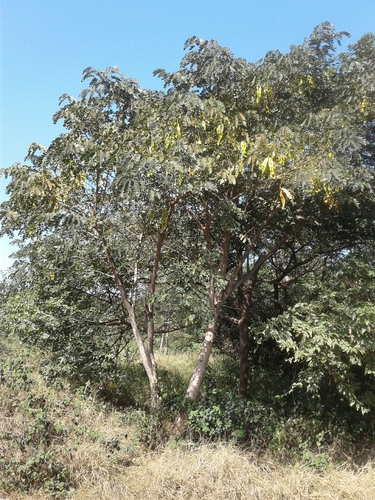
iNaturalist· cc-by-nc
(c) Sylvain Piry, some rights reserved (CC BY-NC), uploaded by Sylvain Piry
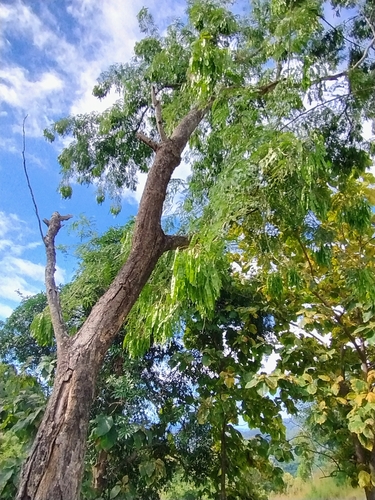
iNaturalist· cc-by-nc
(c) Sylvain Piry, some rights reserved (CC BY-NC), uploaded by Sylvain Piry
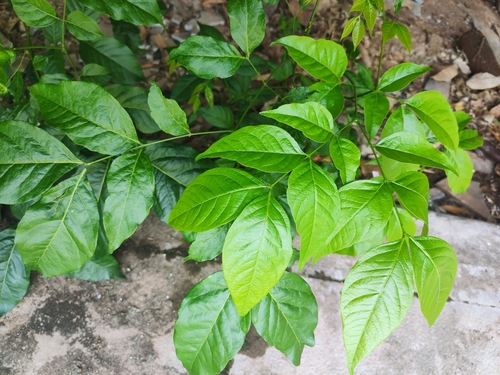
iNaturalist· cc-by-nc
(c) Sylvain Piry, some rights reserved (CC BY-NC), uploaded by Sylvain Piry
Summary
Source: WikipediaCassia sieberiana, the drumstick tree, is a tree in the family Fabaceae native to Africa. It ranges from 10 to 20 metres in height and has very bright yellow flowers. It is used for multiple medical purposes in Africa and is found in the secondary jungle of a forest.
Description
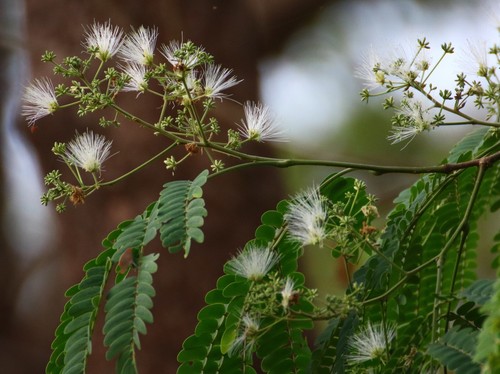
A tree that loses its leaves during the dry season. It grows 10-20 m high. The bark is dark grey and wrinkled. The leaflet stalks are 20-30 cm long with 7-10 pairs of leaflets. They are 5-10 cm long by 3-5 cm wide. The flowers are bright yellow and attractive. They are in groups that can be upright or hanging. These groups are 30-50 cm long. The fruit is a long pods. It is dark brown and 40-80 cm long. It has division between the seeds.
Edible Uses
A sweet extract from the stems is eaten. Chew sticks can also be made from the root-wood of the plant.
Traditional Uses
The sweet extract from the stems is eaten.
This uses section is brief — help expand it
Medicinal Uses
The leaves, roots and pods are widely used in traditional medicine. Research has identified several active compounds including calcium oxalate, flavones, an anthraquinone and tannins. The purgative action is attributed to the anthraquinones; the flavones cause diuresis and have antibacterial and anti-inflammatory activity. Extracts have shown significant activity against Herpes simplex virus type 1. Leaf extracts are active against Staphylococcus lutea, Mycobacterium phlei, Bacillus subtilis and Proteus sp., but not against Staphylococcus albus, Pseudomonas aeruginosa or Escherichia coli. The entire plant is purgative and diuretic. An infusion is given against all children's diseases. Powdered plant parts are applied to the teeth to cure toothache; mixed with butter, the powder treats skin diseases. An infusion of leaves sweetened with honey is taken for stomach-ache, ulcers and diarrhoea. A steam bath of leafy twigs boiled in water is prescribed against malaria and fever, and the liquid should also be drunk. Boiled and squeezed fresh leaves are applied as a poultice for pleurisy or burns. Leaf powder taken with food is used to treat gonorrhoea in women. The twigs are used to treat sleeping sickness. The roots boiled in water treat haemorrhoids, bilharzia, leprosy, dropsy and bloody dysentery. In large doses they are used against intestinal worms including tapeworms, though this is considered risky. A pinch of powdered dried decorticated roots taken after each meal is said to prevent malaria. The liquid from roots soaked in water is used as a bath against tiredness and for body massage. Crushed roots rubbed on the temples treat headache. An infusion of the root bark is used against venereal diseases, sterility and dysmenorrhoea. Capsules of root bark are prescribed against AIDS. The yellow pulp around the seeds and an infusion of the pods are taken as a laxative.
Known Hazards
The roots and seeds are used as fish poison in Cote d'Ivoire and Nigeria.
Distribution
A tropical plant. It is best in well-drained humid soils. It needs at least 500 mm of rain each year. It grows in savannah woodland and palm groves. It is often along river banks. It grows in the Sahel.
Where It Grows
Africa, Benin, Burkina Faso, East Africa, Guinea, Guinée, Guinea-Bissau, Nigeria, Sahel, Senegal, Sierra Leone, Sudan, Uganda, West Africa,
Cultivation
A tropical plant. A plant of drier areas of the tropics, thriving best in savannah areas with an annual rainfall of 800mm or less. Prefers a deep, well-drained, moderately fertile sandy loam and a position in full sun. Plants grow best in an acid, sandy soil. The plant responds well to coppicing. The tree is one of the constituents of the vegetation of fallow fields in the Sahel, but unlike some species, such as the African locust bean (Parkia biglobosa), and shea butter tree (Vitellaria paradoxa), it is eradicated during clearing. Although it is a legume, the roots of this species lack nodulating ability and do not fix atmospheric nitrogen.
Propagation
Fresh seed sown immediately achieves close to 100% germination. Older seed should be soaked in warm water for 12–24 hours or treated with sulphuric acid stratification before sowing. Passage of seeds through cattle intestines also hastens germination. Vegetative multiplication by marcotting and side-grafting is feasible.
Other Uses
The root wood is used as chewsticks. The heartwood is white or yellowish-pink, darkening to dark red on exposure. It is finely textured, heavy, very hard, resistant to termites and difficult to work; it is suitable for furniture, cabinet work, tools, construction and railway sleepers. The wood is used for fuel, though it is considered inferior due to the large amount of smoke it produces. The tree is sometimes planted in shelterbelts and is ornamental with brightly coloured flowers.
Notes
There are 100 Cassia species. This group has been revised to a smaller more consistent group. Also as Caesalpinaceae.
Synonyms
Also Known As
Bentape, Betame, Bissindje, Bussindja, Canafistra, Canafistula, Caquecequece, Kiskatigrai, Marga, N'tame, P'fonante, Sama-sidjam, Samba-cintrao, Samba-sinhangho, Samba-sinjandje, Sambassinhague, Sambassinhame, Sambisinhanha, Sandjone, Sanfone, Sanjoue, Sindjam-o, Tinan, Untame
References (8)
- Achigan-Dako, E, et al (Eds), 2009, Catalogue of Traditional Vegetables in Benin. International Foundation for Science.
- Bonou, A., et al, 2013, Valeur economique des Produits Forestiers Non Ligneux (PFNL) au Benin. Editions Universitaires Europeennes p 89
- FAO, 1988, Traditional Food Plants, FAO Food and Nutrition Paper 42. FAO Rome p 159
- Jardin, C., 1970, List of Foods Used In Africa, FAO Nutrition Information Document Series No 2.p 64
- Maydell, H. von, 1990 Trees and shrubs of the Sahel: their characteristics and uses. Margraf. p 225
Show all 8 references Hide references
- MORTIMORE,
- Prodr. 2:489. 1825
- World Checklist of Useful Plant Species 2020. Royal Botanic Gardens, Kew