Piper guineense
Schumach & Thonn.
Guinea pepper, West African pepper
iNaturalist· cc-by-nc
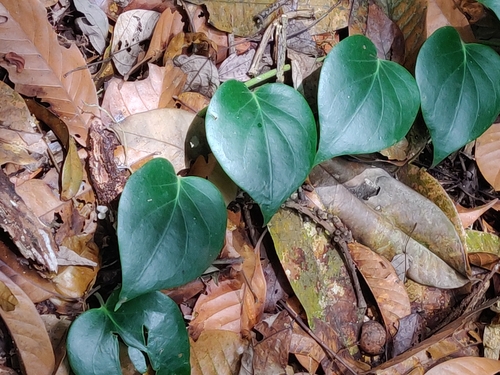
(c) kizkizito, some rights reserved (CC BY-NC)
iNaturalist· cc-by-nc
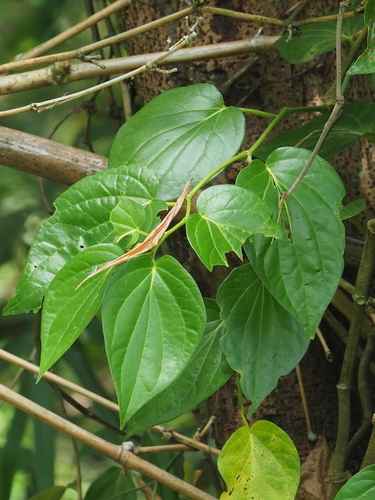
(c) Peter Zika, some rights reserved (CC BY-NC), uploaded by Peter Zika
iNaturalist· cc-by-nc
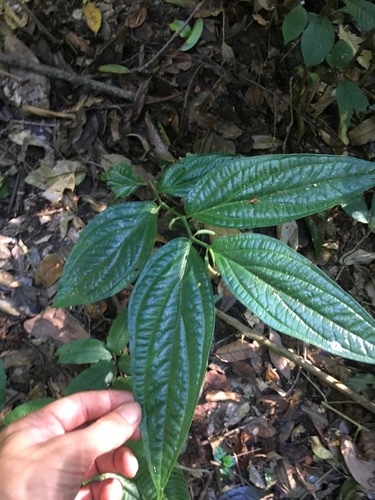
(c) Peter Zika, some rights reserved (CC BY-NC), uploaded by Peter Zika
Summary
Source: WikipediaPiper guineense is a West African species of Piper; the spice derived from its dried fruit is known as Ashanti pepper, Benin pepper, Edo pepper, false cubeb, Guinea cubeb, and called locally kale, kukauabe, masoro, etiñkeni, sasema, soro wisa, eyendo, eshasha by the Urhobo people, iyere or ata-iyere by the Yoruba and oziza and uziza by the Igbo people of Nigeria. It is a close relative of cubeb pepper and a relative of black pepper and long pepper. Unlike cubeb, which is large and spherical in shape, Ashanti pepper grains are prolate spheroids, smaller and smoother than cubeb pepper in appearance and generally bear a reddish tinge. The stalks of Ashanti pepper berries are also distinctly curved whilst those of cubeb pepper are completely straight. The terms West African pepper and Guinea pepper have also been used, but are ambiguous and may refer to grains of Selim or grains of paradise. The plants that provide Ashanti pepper are vines that can grow up to 20 m in length, climbing up boles of trees by means of adventitious roots. These are native to topical regions of Central and Western Africa and are semi-cultivated in countries such as Nigeria where the leaves, known as uziza, are used as a flavouring for stews. Like other members of the pepper family, Ashanti pepper contains 5–8% of the chemical piperine which gives them their piquant taste. They contain large amounts of beta-caryophyllene, which is being investigated as an anti-inflammatory agent. It also contains significant proportions (up to around 10%) of myristicin, elemicin, safrole, and dillapiol, as well as some apiole (around 1.4%). In terms of flavour, Ashanti pepper is very similar to cubeb pepper but is less bitter and has a fresher, more herbaceous flavour and aroma than cubeb's more pine-like scent. Though known in Europe during the Middle Ages (it was a common spice in Rouen and Dieppe in 14th-century France), these days, its use is largely marginalized to West and Central Africa.
Description
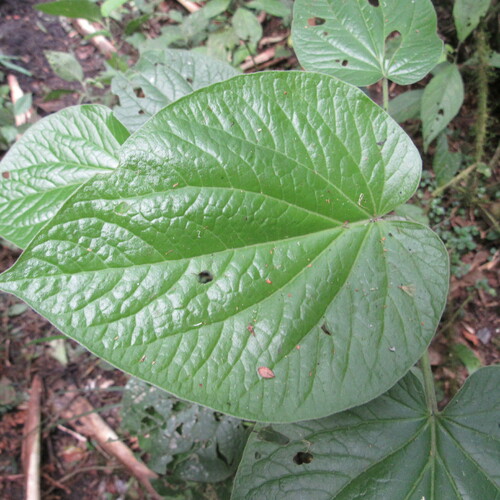
A slightly woody creeper. It attaches to the trunks of trees. It grows 10 m long. The fruit occur in clusters. They are 5 mm across. They are orange-red in colour.
Edible Uses
It is used in West African cuisine where it imparts spiciness and a pungent aroma to stews. Even in West Africa, Ashanti pepper is an expensive spice and is used sparingly. Often, a few grains are ground in a pestle and mortar before being added (along with black pepper) to soups or to boiled rice. The spice can also be substituted in any recipe calling for cubeb pepper, where Ashanti imparts a less bitter flavour. The pepper is also sometimes one of the ingredients in the Berbere spice mix used in the cuisines of Ethiopia and of Eritrea. However, West African Pepper is a highly esteemed spice in its region of origin and may be hard to get abroad; thus, long pepper is more often used in Berbere.
Traditional Uses
The fresh or dried fruit is used to flavour soups, rice and other foods. It is like mild pepper. The leaves are added to soups. The leaves are also cooked and used as a substitute for tea. Leaves are chewed with betel nut as a substitute for Piper betle. Ash from the plants is used as a substitute for salt.
Medicinal Uses
The fruits and leaves are used fresh and dried as components of medicinal preparations. The roots are chewed and the juice swallowed as an aphrodisiac.
Distribution
It is a tropical plant. It grows in forests, woodland and along rivers.
Where It Grows
Africa, Angola, Benin, Cameroon, Central Africa, Central African Republic, CAR, Congo DR, Congo R, Côte d'Ivoire, East Africa, Equatorial-Guinea, Gabon, Gambia, Ghana, Guinea, Guinée, Guinea-Bissau, Ivory Coast, Liberia, Nigeria, Sao Tome and Principe, Senegal, Sierra Leone, Tanzania, Togo, Uganda, West Africa,
Cultivation
Plants can be grown by seeds or cuttings. Seeds germinate in about 22 days. Plants can be grown from stem cuttings.
Other Uses
The roots are used as chew sticks for cleaning the teeth.
Production
Fruit are harvested then dried in the sun. In Tanzania fruit are collected from October to December. In Central African Republic flowers have been observed in May and fruit from December to February.
Other Information
It is sold in local markets and internationally.
Notes
There are between 1000-2000 Piper species. They are mostly in the tropics.
Nutrition
| Part | Moisture | kJ | kcal | Protein | Vit A | Vit C | Iron | Zinc |
|---|---|---|---|---|---|---|---|---|
| Leaves | 78.6 | — | — | 18.5 | — | — | 6.1 | 2.1 |
Synonyms
Also Known As
Abeka, Acachat, Adua, Ashanti pepper, Ashoesie, Beka, Benin pepper, Boloko, Bololoko, Fufop, Iketu, Iyeyeh, Kakwale, Kampidi, Kandase, Kanlin man, Kapidi, Kechu, Keshu, Ketsu, Ketu, Kumpidi, Lenlenkoun, Masoro, Mbeka, Mbikondi, Mtambuu mwitu, Ndong, Nhamaco, Nkefu, Ohaya, Oleleko, Olokoloko, Poivre, Rukokota, Sop, Tambuu, Taquale, Tokesu, Toketchu, Toketu, Uda, Uziza, Zenbeleh, Zenbeleh-leh
References (57)
- Abbiw, D.K., 1990, Useful Plants of Ghana. West African uses of wild and cultivated plants. Intermediate Technology Publications and the Royal Botanic Gardens, Kew. p 40
- Atato, A., et al, 2012 Especes lianescentes a fruits comestibles du Togo. Fruits. 67(5): 353-368
- Billong Fils, P. E., et al, 2020, Ethnobotanical survey of wild edible plants used by Baka people in southeastern Cameroon. Journal or Ethnobiology and Ethnomedicine. 16:64 p 9
- Bongers, F. et al (Eds), Forest Climbing Plants of West Africa: Diversity, Ecology and Management. CABI
- Bouba, A. A., et al, 2012, Proximate Composition, Mineral and Vitamin Content of Some Wild Plants Used as Spices in Cameroon. Food and Nutrition Sciences 3:423-432
Show all 57 references Hide references
- Burkill, I.H., 1966, A Dictionary of the Economic Products of the Malay Peninsula. Ministry of Agriculture and Cooperatives, Kuala Lumpur, Malaysia. Vol 2 (I-Z) p 1766 (As Piper clusii)
- Burkill, H. M., 1985, The useful plants of west tropical Africa, Vol. 4. Kew.
- Busson, 1965,
- Chapman, J. D. & Chapman, H. M., 2001, The Forest Flora of Taraba and Andamawa States, Nigeria. WWF & University of Canterbury. p 194
- Dalziel, J. M., 1937, The Useful plants of west tropical Africa. Crown Agents for the Colonies London.
- Danforth, R.M., & Boren, P.D., 1997, Congo Native fruits. Twenty-five of the best. Privately published. p 70
- Davis, S.D., Heywood, V.H., & Hamilton, A.C. (eds), 1994, Centres of plant Diversity. WWF. Vol 1. p 165, 172
- Dibong, S. D., et al, 2011, Inventory and Biodiversity of species edible wild fruits sold in the markets of Douala, Cameroon. International Journal of Applied Biology and Pharmaceutical Technology. 2(3).
- Diop, A. l., et al, 2021, Cultural importance of wild edible plants in three sympatric communities: Agni, Akyé and Gwa in the Department of Alépé (Southeast of Côte d’Ivoire). Ethnobotany Research and Applications 22:35. p 7
- Eilu, G. & Bukenya-Ziraba, R., 2004, Local Use of Climbing Plants of Budongo Forest Reserve, Western Uganda. Journal of Ethnobiology 24(2): 307-327
- Facciola, S., 1998, Cornucopia 2: a Source Book of Edible Plants. Kampong Publications, p 171
- Fongnzossie Fedoung, E., et al, 2020, Wild edible plants and mushrooms of the Bamenda Highlands in Cameroon: ethnobotanical assessment and potentials for enhancing food security. Journal of Ethnobiology and Ethnomedicine 16:12
- Gallois, S., et al, 2020, Methodological priorities in assessing wild edible plant knowledge and use – a case study among the Baka in Cameroon.
- Grivetti, L. E., 1980, Agricultural development: present and potential role of edible wild plants. Part 2: Sub-Saharan Africa, Report to the Department of State Agency for International Development. p 33
- Hawthorne, W.& Marshall, C., 2013, Nimba Western Area Iron Ore Concentrator Mining Project Environmental and Social Impact Assessment. AcelorMittel Liberia. p 501
- Hedrick, U.P., 1919, (Ed.), Sturtevant's edible plants of the world. p 499 (As Piper clusii)
- Hoare A. L., 2007, The Use of Non-timber Forest Products in the Congo Basin. Constraints and Opportunities. Rainforest Foundation. p 13
- Idohou, I., et al, 2013, National inventory and prioritization of crop wild relatives: case study for Benin. Genet Resour Crop Evol (2013) 60:1337–1352
- Ingram, V. & Schure, J. 2010, Review of Non Timber Forest Products (NTFPs) in Central Africa, Cameroon. Center for International Forestry Research (CIFR). p 34
- Kafoutchoni, K. M., et al, 2018, Species richness, cultural importance, and prioritization of wild spices for conservation in the Sudano-Guinean zone of Benin (West Africa). Journal of Ethnobiology and Ethnomedicine. 14:67
- Kunkel,
- Latham, P & Mbuta, A., 2017, Useful Plants of Central Province, Democratic Republic of Congo. Volume 2. Salvation Army p 108
- Lautenschläger, T., et al, 2018, First large-scale ethnobotanical survey in the province of Uíge, northern Angola. Journal of Ethnobiology and Ethnomedicine (2018) 14:51
- Liengola, I. B., 2001, A contribution to the study of native edible plants by the Turumbu and Lokele of the Tshopo District, Province Orientale, D. R. Congo. Syst. Geogr. Pl. 71:687-698
- Macmillan, H.F. (Revised Barlow, H.S., et al), 1991, Tropical Planting and Gardening. Sixth edition. Malayan Nature Society. Kuala Lumpur. p 384 (As Piper clusii)
- Mawunu, M., et al, 2020, First Survey of the Edible Non-Wood Forest Products Sold in Uige Province, Northern Angola. European Journal of Agriculture and Food Sciences. Vol. 2, No. 6
- Mawunu, M., et al, 2022, Ethnobotanical uses of wild edible plants of Mucuba municipality, Angola. Natural Resources for Human Health. 2022, 0:1-10
- Mercy, N. A., et al, 2016, Survey of Wild Vegetables in the Lebialem Highlands of South Western Cameroon. Journal of Plant Sciences 4(6): 172-184
- Meregini, O. A., 2005, Some endangered plants producing edible fruits and seeds in Southeastern Nigeria. Fruits, Vol. 60 pp 211-220
- Morton,
- Mosango, M., Szafranski, F., 1985, Plantes sauvages à fruits comestibles dans les environs de Kisangani (Zaïre). In: Journal d'agriculture traditionnelle et de botanique appliquée, 32e année, pp. 177-190
- Moutsambote, J., 1996, Vegetation forestiere et plantes alimentaires de la region de la Sangha. Chp. 11 of Bien Manger et Bien Vivre. ORSTOM p 119
- Nkeoua, G. & Boundzanga, G. C., 1999, Donnees sur les produits forestieres non ligneux en Republique du Congo. FAO. p 34
- Okafor, J. C., Conservation and use of traditional vegetables from woody forest species in southeastern Nigeria. FAO
- Okigbo, B.N., Vegetables in Tropical Africa, in Opena, R.T. & Kyomo, M.L., 1990, Vegetable Research and development in SADCC countries. Asian Vegetable Research and development Centre. Taiwan. p 44
- Onuminya, T. O., et al, 2017, Comparative proximate and Phytochemical Analysis of leafy vegetables in Lagos State. Nig. J. Pure and Applied Sci. Vol. 30 Issue 3: p 3097f
- Peters, C. R., O'Brien, E. M., and Drummond, R.B., 1992, Edible Wild plants of Sub-saharan Africa. Kew. p 161
- Purseglove, J.W., 1968, Tropical Crops Dicotyledons, Longmans. p 436 (Also as Piper clusii)
- Ruffo, C. K., Birnie, A. & Tengnas, B., 2002, Edible Wild Plants of Tanzania. RELMA p 524
- C. F. Schumacher, Beskr. Guin. pl. 19. 1827
- Sunderland, T. C. H., et al, 2002, Distribution, Utilisation and Sustainability of the Non-timber forest products of the Takamanda Forest Reserve, Cameroon. PROFA
- Terashima, H., et al, 1991, Ethnobotany of the Lega in the tropical rainforest of eastern Zaire: part 1, Zone de Mwenga. African Study Monographs. Suppl. 15:1-61
- Terashima, H., & Ichikawa, M., 2003, A comparative ethnobotany of the Mbuti and Efe hunter-gatherers in the Ituri Forest, Democratic Republic of Congo. African Study Monographs, 24 (1, 2): 1-168, March 2003
- Termote, C., et al, 2011, Eating from the wild: Turumbu, Mbole and Bali traditional knowledge of non-cultivated edible plants, District Tshopo, DRCongo, Gen Resourc Crop Evol. 58:585-618
- Uphof,
- Zeven, A.C., 1979, Black Pepper, in Simmonds, N.W., (ed), Crop Plant Evolution. Longmans. London. p 234
- Vivien, J., & Faure, J.J., 1996, Fruitiers Sauvages d'Afrique. Especes du Cameroun. CTA p 262
- von Katja Rembold, 2011, Conservation status of the vascular plants in East African rain forests. Dissertation Universitat Koblenz-Landau p 177
- Vouleng, I. K., et al, 2012, Antibacterial and antibiotic-potentiation activities of the methanol extract of some Cameroonian spices against Gram-negative multi-drug resistant phenotypes. BMC Research Notes, 5:299
- World Checklist of Useful Plant Species 2020. Royal Botanic Gardens, Kew
- Yaradua, S. S. & El-Ghani, M. A., 2015, Ethnobotanical Survey of Edible Plants Sold in Katsina Metropolis Markets.International Journal of Science and Research (IJSR). 4(12)
- Zapfack, L., et al, 2001, Ethnobotanical Survey of the Takamanda Forest Reserve. Consultancy Report PROFA, Cameroon. p 23, 28