Piper sarmentosum
Roxb. ex Hunter
Lolot pepper, Vegetable pepper
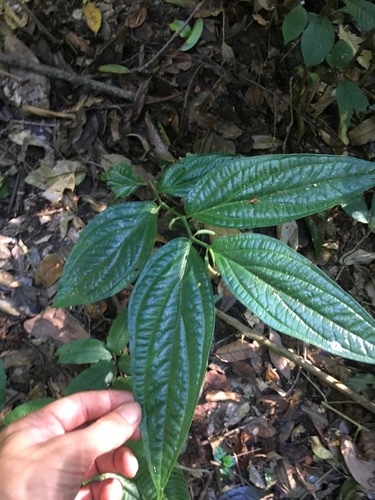
iNaturalist· cc-by-nc
(c) John Howes, some rights reserved (CC BY-NC), uploaded by John Howes
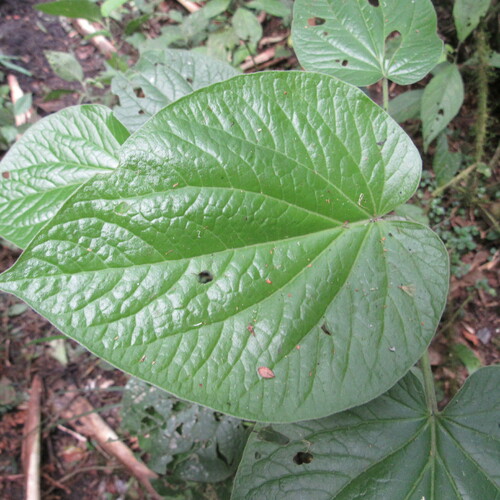
iNaturalist· cc-by-nc-sa
(c) 106611639464075912591, some rights reserved (CC BY-NC-SA), uploaded by 106611639464075912591
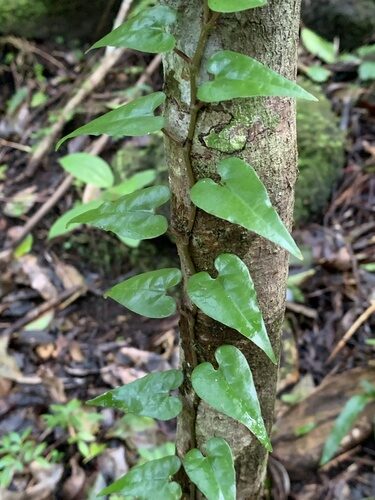
iNaturalist· cc-by
(c) Carrie Seltzer, some rights reserved (CC BY), uploaded by Carrie Seltzer
Summary
Source: WikipediaPiper sarmentosum (lolot pepper, lolot, wild betel) is a plant in the family Piperaceae used in many Southeast Asian cuisines. The leaves are often confused with betel, but they lack the intense taste of the betel leaves and are significantly smaller. Piper lolot (lolot) is now known to be the same species. Under this name it is cultivated for its leaf which is used in Lao and Vietnamese cuisine as a flavoring wrap for grilling meats, namely the thịt bò nướng lá lốt in Vietnam.
Description
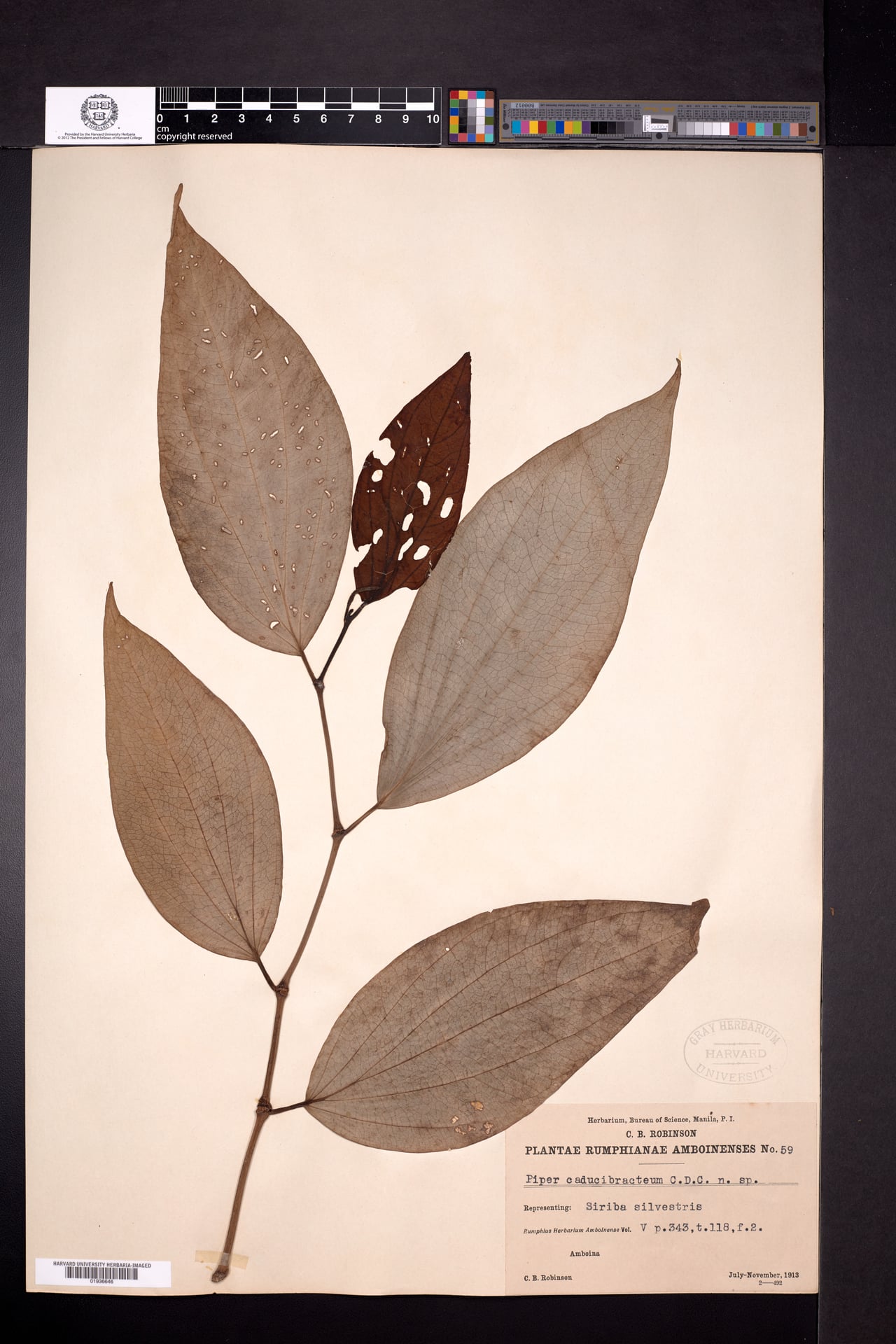
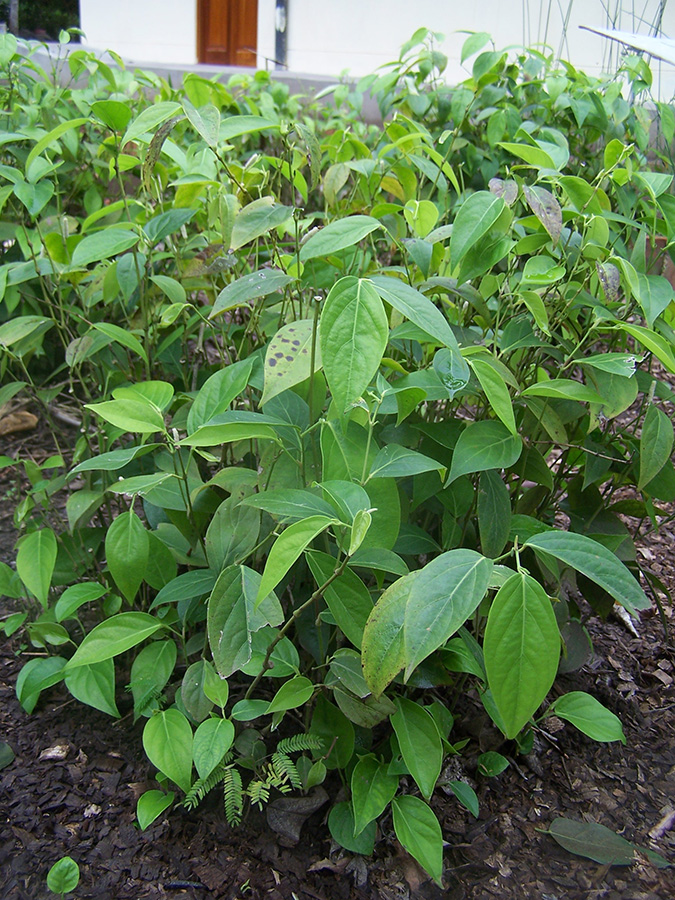
A creeper with an erect stem. It is 50 cm high. The creeper or vine can be 10 m long. There are very fine powdery hairs when young. The leaves are finer and more tender than Piper betel. They are brighter green with distinct veins. The leaf stalk is 2-5 cm long. The leaf blades are larger near the base. They are 7-14 cm long by 6-13 cm wide. The leaf base is rounded or heart shaped and tapers to a short tip. The fertile stem stick upwards. The spikes are opposite the leaves. The spikes hang downwards. The male spikes are white and 1.5-2.5 cm long by 2-3 mm wide. The female spikes are 2-5 cm long by 8 mm wide in fruit. The fruit is 4 angled and 2.5-3 mm across. The fruit is a single seeded berry.
Edible Uses
The leaves can be eaten raw or cooked and have a pleasant peppery flavour that works well chopped into salads. They can also be added to curries or blanched and used as a potherb. Larger leaves, which can reach up to 10cm across, can be lightly steamed and used as wraps for vegetables and other fillings. In Thailand, such leaf wraps are a favourite snack known as 'mieng kum', filled with peanuts, shrimps, shallots, lime, and raw ginger. Soaking the leaves in cold water with a little sugar for two hours before use subtly alters their flavour. The dried infructescence is occasionally used as a spice. The leaves can also be made into a tea.
Traditional Uses
The leaf is slightly pungent and is eaten raw. They are also added to curries or blanched and eaten as a potherb. The leaves are used to wrap an Asian snack dish. They are also used in soups. The dried fruit is used as a spice. The leaves are chewed with betle nut. The leaves are used as a flavouring for meat dishes.
Medicinal Uses
The whole plant is anodyne, anti-inflammatory, and expectorant. It is used to treat skin diseases, rheumatism, ostealgia, lumbago, oedema, headache, dyspepsia, colic, nausea, diarrhoea, and toothache. It is also used in combination with other plants to treat mushroom poisoning and snakebite. For medicinal use, the whole plant is preferably harvested when in flower, then dried and stored. The leaf specifically is carminative.
Distribution
A tropical plant. It grows in forests in wet places near villages and from near sea level to 1000 m altitude in S China. It does best is shady places. It grows in humid locations in forests. In Hawaii it is grown under shade cloth. Dry winds turn the leaves brown spoiling their appearance. In Yunnan.
Where It Grows
Andamans, Asia, Australia, Cambodia, China, East Timor, India, Indochina, Indonesia*, Laos, Malaysia, Marquesas, Pacific, Philippines, SE Asia, Singapore, Thailand, Timor-Leste, Vietnam,
Cultivation
It prefers rich, well-drained soil with partial shade but can tolerate full shade. It likes moist soil but does not tolerate waterlogging. Frost will damage the leaves but not kill the plant once it is well established. The plant can be invasive, so it needs to be given space to roam - it does well as an understorey plant in a woodland. It makes a good ground cover under trees in subtropical and tropical areas. It thrives in the right position and can be difficult to remove because of its suckering habit. It can be grown successfully in colder regions in a hanging basket or large pot and moved to a warm, sheltered position in winter. The stems can be up to 10 metres long, though they tend to creep along the ground with off-shoots to 0.5m. A dioecious plant, both male and female forms need to be grown if seed is required. It grows in forests in wet places near villages and from sea level to 1000 m altitude in S China. In Hawaii, it is grown under shade cloth. Dry winds turn the leaves brown, spoiling their appearance.
Propagation
Propagate by seed or from cuttings, which root easily.
Other Uses
The plant grows well as an understorey shrub in woodland settings and can be used as a hanging basket or large pot plant, as groundcover, or as an annual.
Other Information
It is popular in Thailand. It is cultivated.
Notes
There are between 1000-2000 Piper species. They are mostly in the tropics. It is used in medicine. It possibly has anti-cancer properties. It has 10.1 mg per 100 g dry weight and 6.0 mg fresh weight of alpha-tocopherol (Vitamin E).
Nutrition
| Part | Moisture | kJ | kcal | Protein | Vit A | Vit C | Iron | Zinc |
|---|---|---|---|---|---|---|---|---|
| Leaves | 81.1 | 321 | — | 4 | — | — | — | — |
Synonyms
Also Known As
Aimanas ai leten, 'i: le:d, Bo la lot, Cabean, Cha phlu, Cha plu, Chabai, Chaphlu, Chhiplou, Chi phlu, Chiaobiouluo, Daun kadok, Jia ju, Julo, Kadok batu, Karuk, l(oos)t tat ph(aws)t, La lot, Lot, Morech ansai, Nom wa, Pa dan, Pa die, Pake, Pak ereart, Patai-butu, Phak i leut, Phak iloed, Phlu ling, Pipali sag, Poivre lolot, Sirih tanah, Tat bat, Ti(ee)u
References (44)
- Anderson, E. F., 1993, Plants and people of the Golden Triangle. Dioscorides Press. p 218
- Annuaire Conserv. Jard. Bot. Geneve 2:272. 1898 (As Piper lolot)
- Arora, R. K., 2014, Diversity in Underutilized Plant Species - An Asia-Pacific Perspective. Bioversity International. p 107 (As Piper saigonense)
- Bremness, L., 1994, Herbs. Collins Eyewitness Handbooks. Harper Collins. p 283
- Burkill, I.H., 1966, A Dictionary of the Economic Products of the Malay Peninsula. Ministry of Agriculture and Cooperatives, Kuala Lumpur, Malaysia. Vol 2 (I-Z) p 1782 and 1766 (As Piper lolot) and as (As Piper saigonense)
Show all 44 references Hide references
- Cao, Y., et al, 2020, Ethnobotanical study on wild edible plants used by three trans-boundary ethnic groups in Jiangcheng County, Pu’er, Southwest China. Journal of Ethnobiology and Ethnomedicine (2020) 16:66
- Chin, H. F., 1999, Malaysian Vegetables in Colour. Tropical Press. p 95
- Ching, L. S. & Mohamed, S., 2001, Alpha-Tocopherol Content in 62 Edible Tropical Plants. J. Agric. Food Chem. 2001, 49, 3101−3105
- Facciola, S., 1998, Cornucopia 2: a Source Book of Edible Plants. Kampong Publications, p 172
- Fl. ind. 1:162. 1820
- Food Composition Tables for use in East Asia FAO http://www.fao.org/infoods/directory No. 660
- Ghorbani, A., et al, 2012, A comparison of the wild food plant use knowledge of ethnic minorities in Naban River Watershed Nature Reserve, Yunnan, SW China. Journal of Ethnobiology and Ethnomedicine; 8:17
- Hedrick, U.P., 1919, (Ed.), Sturtevant's edible plants of the world. p 500
- Hutton, W., 1997, Tropical Herbs and Spices of Indonesia. Periplus. p 46
- IUCN (2013). Ecological Survey of the Mekong River between Louangphabang and Vientiane Cities, Lao PDR, 2011-2012. Vientiane, Lao PDR: IUCN. 241 pp.
- Jacquat, C., 1990, Plants from the Markets of Thailand. D.K. Book House p 63
- Luczaj, L., et al, 2021, Wild food plants and fungi sold in the markets of Luang Prabang, Lao PDR. Journal of Ethnobiology and Ethnomedicine (2021) 17:6
- Miean, K. H. & Mohamed, S., 2001, Flavonoid (Myricetin, Quercetin, Kaempferol, Luteolin, and Apigenin) Content of Edible Tropical Plants. Journal of Agricultural and Food Chemistry. 49:3016-3112
- MARDI Malaysia
- Mot So Rau Dai an Duoc O Vietnam. Wild edible Vegetables. Ha Noi 1994, p 238 (As Piper lolot)
- Nakahara, K. et al, 2002, Antimutagenicity of Some Edible Thai Plants, and a Bioactive Carbazole Alkaloid, Mahanine, Isolated from Micromelum minutum. Journal of Agricultural and Food Chemistry. 50: 4796-4892
- Norrington, L., & Campbell, C., 2001, Tropical Food Gardens. Bloomings Books. p 81
- Ogle, B. M., et al, 2003, Food, Feed or Medicine: The Multiple Functions of Edible Wild Plants in Vietnam. Economic Botany 57(1): 103-117
- Pham-Hoang Ho, 1999, An Illustrated Flora of Vietnam. Nha Xuat Ban Tre. 301, p 297 (Also as Piper lolot)
- Phatlamphu, N., et al, 2021, Ethnobotany of edible plants in Muang District, Kalasin Province, Thailand, Biodiversitas Vol. 22, No. 12 pp 5432-5444
- Phon, P., 2000, Plants used in Cambodia. © Pauline Dy Phon, Phnom Penh, Cambodia. p 501 (As Piper lolot)
- PROSEA handbook Volume 13 Spices. p 261 (Also as Piper lolot)
- Purseglove, J.W., 1968, Tropical Crops Dicotyledons, Longmans. p 437 (As Piper saigonense)
- Samy, J., Sugumaran, M., Lee, K. L. W., 2009, Herbs of Malaysia, Marshall Cavendish. p 188
- Sang, D. T., & Mizoue, K. O. N., 2012, Use of Edible Forest Plants among Indigenous Ethnic Minorities in Cat Tien Biosphere Reserve, Vietnam. Asian Journal of Biodiversity Vol. 3 (1), p 23-49 (As Piper lolot)
- Solomon, C., 2001, Encyclopedia of Asian Food. New Holland. p 38, 71
- Srichaiwong, P., et al, 2014, A Study of the Biodiversity of Natural Food Production to Support Community Upstream of Chi Basin, Thailand. Asian Social Science 10 (2):
- Staples, G.W. and Herbst, D.R., 2005, A tropical Garden Flora. Bishop Museum Press, Honolulu, Hawaii. p 456 (As Piper lolot)
- Sukarya, D. G., (Ed.) 2013, 3,500 Plant Species of the Botanic Gardens of Indonesia. LIPI p 1130
- Tanaka, Y. & Van Ke, N., 2007, Edible Wild Plants of Vietnam. Orchid Press. p 111 (As Piper lolot)
- Tseng Yung-chien, Xia Nianhe, Gilbert, M.G., Piperaceae. Flora of China.
- Turreira Garcia, N., et al, 2017, Ethnobotanical knowledgeof the Kuy and Khmer people in Prey Lang, Cambodia. Cambodian Journal of Natural History 2017 (1): 76-101
- Van Sam, H. et al, 2008, Uses and Conservation of Plant Species in a National Park. A case study of Ben En, Vietnam. Economic Botany 62:574-593 (As Piper lolot)
- Wiersema, J. H. & Leon, B., 2013, World Economic Plants. A Standard Reference CRC Press. 2nd Ed. p 535
- Woodward, P., 2000, Asian Herbs and Vegetables. Hyland House. p 113
- World Checklist of Useful Plant Species 2020. Royal Botanic Gardens, Kew
- Xu, You-Kai, et al, 2004, Wild Vegetable Resources and Market Survey in Xishuangbanna, Southwest China. Economic Botany. 58(4): 647-667.
- Yeoh, H. and Wong, P. F., 1993, Food value of lesser utilised tropical plants. Food Chemistry 46:239-241
- Zeven, A. C. & de West, J. M. J., 1982, Dictionary of cultivated plants and their regions of diversity. Wageningen. p 62 (As Piper saigonense)