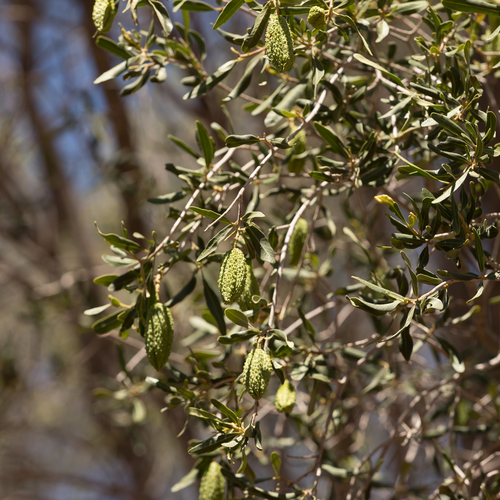
Phellodendron amurense
Ruprecht
Amur cork tree
iNaturalist· cc-by-nc
(c) Misha Zitser, some rights reserved (CC BY-NC), uploaded by Misha Zitser
iNaturalist· cc-by-nc
(c) Andrii Churilov, some rights reserved (CC BY-NC), uploaded by Andrii Churilov
iNaturalist· cc0
no rights reserved, uploaded by Daniel Atha
Summary
Source: WikipediaPhellodendron amurense is a species of tree in the family Rutaceae, commonly called the Amur cork tree. It is a major source of huáng bò (Chinese: 黄柏 or 黄檗), one of the 50 fundamental herbs used in traditional Chinese medicine. The Ainu people used its fruit, called "shikerebe-ni" (in Ainu, sikerpe), as a painkiller. It is known as hwangbyeok in Korean and (キハダ) kihada in Japanese. It is native to eastern Asia: northern China, northeast China, Korea, Ussuri, Amur, and Japan, the Amur cork tree is considered invasive in many parts of North America. The State of Massachusetts lists it as a noxious weed.
Description
A small tree. It loses its leaves during the year. The bark is yellowish-grey. It becomes furrowed and develops corky ridges with age. The leaves occur in opposite pairs. They are made up of 5-13 leaflets. These are on a central stalk 10-15 cm long. Each leaflet is 6-10 cm long. They are narrow and oval. They taper to the tip. The edges are smooth. They are shiny green on the upper surface. They have a smell. The leaf scars are U shaped. The flowers are small and yellowish-green. They occur in clusters at the ends of branches. The male and female flowers are on separate trees. The fruit are small berries. These are 10 mm across. They are dark blue and have a scent and have 5 hard seeds.
Edible Uses
The fruit is edible and is approximately 1cm in diameter with a strong scent of turpentine. An oil is also obtained from the seed.
Traditional Uses
The bark is used in brewing.
This uses section is brief — help expand it
Medicinal Uses
Known in China as Huang Bai, Amur cork tree is considered one of the 50 fundamental herbs in Chinese herbalism, though it is regarded as one that should be used with care. It is a strongly bitter remedy that acts strongly on the kidneys and is used as a detoxicant for hot damp conditions. Recent research has shown it to be useful in treating meningitis and conjunctivitis. It should only be used under professional supervision and must not be taken during pregnancy. The bark is alterative, antibacterial, antirheumatic, aphrodisiac, bitter stomachic, cholagogue, diuretic, expectorant, febrifuge, hypoglycaemic, ophthalmic, vasodilatory, and tonic. Internally it is used to treat acute diarrhoea, dysentery, jaundice, vaginal infections including Trichomonas, acute urinary tract infections, enteritis, boils, abscesses, night sweats, and skin diseases. It is commonly combined with Scutellaria baicalensis and Coptis chinensis in a preparation called 'injection of three yellow herbs', given intramuscularly for upper respiratory tract infections. Bark is harvested from trees at least 10 years old in winter or spring and dried for later use. The fruit is expectorant.
Known Hazards
High doses can cause nausea & vomiting. Avoid with spleen and stomach disorders. Avoid during pregnancy as high berberine content
Distribution
It is a temperate plant. It is native to NE Asia. It grows near streams in the mountains. It is hardy. It grows well on limestone soils but will grow on most soils. It suits hardiness zones 3-9. Arboretum Tasmania.
Where It Grows
Asia, Australia, Canada, Central Asia, China, Japan, Korea, Manchuria, North America, Russia, Slovenia, Tajikistan, Tasmania,
Cultivation
Prefers a moisture retentive well-drained deep rich loam in full sun. Prefers a neutral to alkaline soil. Succeeds in shallow chalky soils. Grows best in areas with long hot summers. Plants are gross feeders and require a rich soil if they are to perform well. Dormant plants are fully hardy in Britain, but the young growth is liable to damage from late spring frosts. The leaves are aromatic. This species is occasionally cultivated for timber in S.E. Europe. Dioecious. Male and female plants must be grown if seed is required.
Propagation
Seed is best sown in autumn in a cold frame. Stored seed requires 2 months of cold stratification; sow in late winter in a cold frame. Germination is usually good. Prick seedlings into individual pots when large enough to handle and grow on in the cold frame through their first winter, then plant out in late spring or early summer after the last expected frosts. Cuttings of half-ripe wood, 7–10cm with a heel, can be taken in July or August and rooted in a frame, potted up in autumn, and overwintered in a cold frame — fair to good success rate. For root cuttings, obtain material in December and store in leafmold in a warm place for 3 weeks, then cut into 4cm lengths, plant horizontally in pots, and grow on in a warm greenhouse — good success rate.
Other Uses
A yellow dye is obtained from the inner bark. An oil from the seed has insecticidal properties similar to pyrethrum. The bark can be used as a cork substitute. The wood is heavy, hard, strong, and close-grained, and is used for furniture.
Notes
There are about 10 Phellodendron species.
Nutrition
| Part | Moisture | kJ | kcal | Protein | Vit A | Vit C | Iron | Zinc |
|---|---|---|---|---|---|---|---|---|
| Fruit | 8.8 | 1 | 389 | 12.1 | — | — | 6.2 | 0.4 |
Also Known As
Amurski plutnik, Hwangbyeoknamu, Sikerpe
References (13)
- Bull. Cl. Phys.-Math. Acad. Imp. Sci. Saint-Petersbourg 15:353. 1857
- Chen, B. & Qiu, Z., Consumer's Attitudes towards Edible Wild Plants, Ishikawa Prefecture, Japan. p 24 www.hindawi.com/journals/ijfr/aip/872413.pdf
- Coombes, A.J., 2000, Trees. Dorling Kindersley Handbooks. p 283
- Cundall, P., (ed.), 2004, Gardening Australia: flora: the gardener's bible. ABC Books. p 1023
- Etherington, K., & Imwold, D., (Eds), 2001, Botanica's Trees & Shrubs. The illustrated A-Z of over 8500 trees and shrubs. Random House, Australia. p 517
Show all 13 references Hide references
- Farrar, J.L., 1995, Trees of the Northern United States and Canada. Iowa State University press/Ames p 171
- Hibbert, M., 2002, The Aussie Plant Finder 2002, Florilegium. p 230
- http://www.botanic-gardens-ljubljana.com/en/plants
- Kuhnlein, H. V., et al, 2009, Indigenous Peoples' food systems. FAO Rome p 148
- Plants for a Future database, The Field, Penpol, Lostwithiel, Cornwall, PL22 0NG, UK. http://www.scs.leeds.ac.uk/pfaf/
- Ryan, S., 2008, Dicksonia. Rare Plants Manual. Hyland House. p 46
- Schuler, S., (Ed.), 1977, Simon & Schuster's Guide to Trees. Simon & Schuster. No. 140
- Song, M., et al, 2013, Traditional knowledge of wild edible plants in Jeju Island, Korea. Indian Journal of Traditional Knowledge. 12(2) pp 177-194