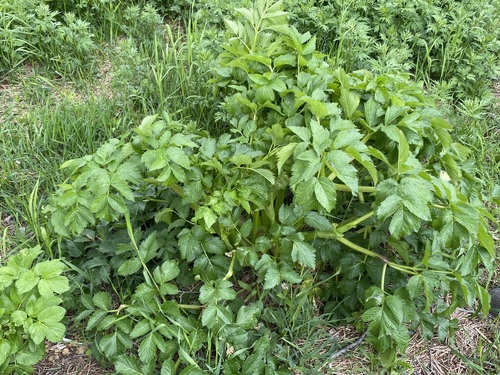
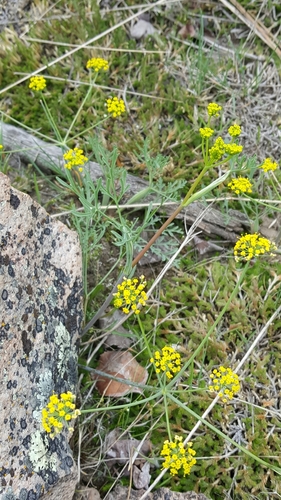
Petroselinum crispum
(Miller) Nyman
Parsley
iNaturalist· cc-by-nc
(c) elizabethompson, some rights reserved (CC BY-NC)
gbif· cc-by-nc
thecamberwellcarrot
iNaturalist· cc-by-nc
(c) Lukáš Blecha, some rights reserved (CC BY-NC), uploaded by Lukáš Blecha
iNaturalist· cc-by-nc
(c) Юрий, some rights reserved (CC BY-NC), uploaded by Юрий
iNaturalist· cc-by
(c) Vítor Jorge, some rights reserved (CC BY), uploaded by Vítor Jorge
iNaturalist· cc-by-nc
(c) Pat Enright, some rights reserved (CC BY-NC), uploaded by Pat Enright
Summary
Source: WikipediaA biennial herb reaching 0.6 m tall and 0.3 m wide at medium growth rate. Hardy to UK zone 5, flowering June to August with seeds ripening July to September. Hermaphroditic and self-fertile, attracting beneficial insects. Grows in light, medium, or heavy well-drained soils across mildly acidic to basic pH ranges, tolerating semi-shade or full sun and preferring moist soil.
Description
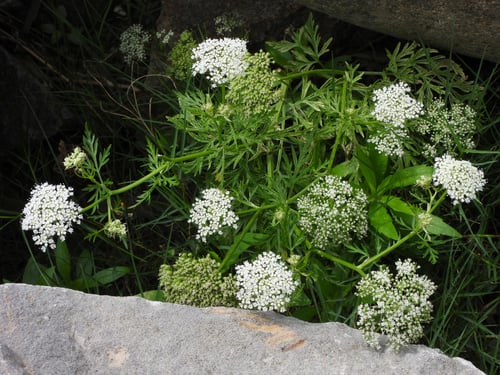
A short lived perennial plant. Often it grows and flowers over two years. It forms clumps and is a hairless plant. It has stems up to 50 cm long which are upright and with grooves. They branch. Several stems come from the top of the fattened taproot. It spreads to 50 cm across. The leaflets are finely divided. They are feather like and dark green. They are triangular and divided 3 times. They are divided into toothed segments about 3 cm long. They have a strong smell. The flowers are greenish white and star shaped. They occur at the ends of branches. The flowers are flat topped and up to 4 cm across. There are about 30 variations of curled parsley. Some are more tightly curled than others. Wild parsley also occurs in some temperate places. It can be cooked and eaten.
Edible Uses
Parsley leaves can be used raw or cooked, most commonly as a garnish or flavouring in salads and cooked dishes. The flavour is strong enough that most people use it sparingly rather than eating it in quantity. It is a key component of the classic herb blend bouquet garni. Leaves should be harvested regularly to encourage fresh growth and maximise yields. They are difficult to dry but freeze well; if drying, use a well-ventilated, sunny room and ensure leaves are fully crisp before storing. Parsley is very rich in iron, iodine and magnesium, and is also a good source of other minerals and vitamins A, B and C. The dried, ground stems can be used as a food colouring. A tea made from fresh or dried leaves is rich in vitamin C. An essential oil extracted mainly from the leaves is used as a commercial food flavouring; the leaves yield around 1% essential oil, while the seeds yield around 6%. Some caution is advised in using this plant, particularly the essential oil.
Traditional Uses
The leaves are used for flavouring. They are used in salads, sauces, stews, stuffings, and in other cooked dishes. The leaves can be dried or used fresh for tea. Parsley oil from the leaves or seeds is used in foods.
Medicinal Uses
Parsley is a well-known culinary herb with a long history of domestic medicinal use. The fresh leaves are highly nutritious and function as a natural vitamin and mineral supplement. Its primary medicinal use is as a diuretic, effective in treating kidney stones, jaundice, dropsy and cystitis. It is also a good detoxifier, helping the body eliminate toxins through the urine and supporting treatment of conditions such as rheumatism. The seeds are considered safe at normal doses but can be toxic in excess. All parts of the plant have medicinal value, though the root is most commonly used and the seeds have the strongest action. Parsley is antidandruff, antispasmodic, aperient, carminative, digestive, diuretic, emmenagogue, expectorant, galactofuge, stomachic and tonic. An infusion of the roots and seeds is taken after childbirth to promote lactation and help contract the uterus. It also acts as a mild laxative and is useful for treating anaemia and aiding convalescence. Externally, a poultice of the leaves soothes bites and stings and is said to be of value in treating cancerous tumours. It has been used to treat eye infections, and juice-soaked cotton wool can relieve toothache or earache. It is also reputed to prevent hair loss and reduce freckles. Leaves held close to the breasts of a nursing mother for several days are said to suppress milk flow. Excessive internal use, especially of the essential oil, can cause liver and kidney damage, nerve inflammation and gastrointestinal haemorrhage. Parsley should not be used by pregnant women, as it stimulates menstrual flow and may provoke miscarriage, nor should it be used by people with kidney disease. The German Commission E Monographs approve Petroselinum crispum for urinary tract infections and kidney and bladder stones.
Known Hazards
Avoid during pregnancy as it stimulates menstrual flow and may cause miscarriage. Do not use with kidney disease. Excessive doses cause liver and kidney damage, nerve inflammation, and gastro-intestinal hemorrhage.
Distribution
A temperate plant. It can be grown from sea level up to 2400 m altitude in the tropics. It grows best in moderately cool, shady and humid conditions. It can grow well in full sunlight but also in slight shade. Young plants can be damaged by frost. It is best with a pH of 5.0-6.0. It suits hardiness zones 7-9.
Where It Grows
Africa, Algeria, Amazon, Andorra, Argentina, Asia, Australia, Austria, Balkans, Belarus, Belgium, Brazil, Britain, Bulgaria, Cambodia, Canada, Canary Is., Cape Verde, Caucasus, Central America, Central Asia, Chile, China, Cook Islands, Costa Rica, Crete, Cuba, Czech Republic, Denmark, Dominican Republic, East Africa, Ecuador, Egypt, El Salvador, Europe, Fiji, Finland, France, Georgia, Germany, Greece, Guatemala, Guyana, Haiti, Hawaii, Hungary, India, Indochina, Indonesia, Iran, Ireland, Italy, Japan, Kazakhstan, Kenya, Kiribati, Kyrgyzstan, Laos, Lebanon, Libya, Lithuania, Macedonia, Malaysia, Mauritius, Mediterranean, Mexico, Middle East, Mongolia, Mozambique, Myanmar, Nauru, Netherlands, New Zealand, Niger, North Africa, North America, Norway, Pacific, Pakistan, Papua New Guinea, PNG, Peru, Philippines, Poland, Portugal, Puerto Rico, Reunion, Romania, Rotuma, Russia, Sahel, Sao Tome and Principe, Sardinia*, Saudi Arabia, Scandinavia, SE Asia, Serbia, Sinai, Slovenia, Solomon Islands, Somalia, South Africa, Southern Africa, South America, Spain, St Helena, Sweden, Switzerland, Tajikistan, Tasmania, Thailand, Timor-Leste, Trinidad-Tobago, Tunisia, Turkey, Türkiye, Ukraine, USA, Uzbekistan, Vanuatu, Vietnam, West Africa, West Indies, Zimbabwe,
Cultivation
It is grown from seed and transplanted. Seeds are slow to germinate. They can be sown directly where they are to grow. Seed are collected by cutting flowers before they ripen then shaking the seeds out onto a cloth. Seed germinate in about 3-4 weeks. It is best to soak the seed in water for one day. Seedlings are transplanted and spaced at 45 cm.
Propagation
Three successive sowings can provide a year-round supply of fresh leaves. The first sowing is made under glass in late winter; prick seedlings into individual pots once large enough and plant out in mid to late spring. The second sowing is made directly outdoors in mid-spring, and the third is sown outdoors in mid to late summer, both in their final positions. Germination typically occurs in about 7 days at 25°C, though it can take 4–6 weeks. Pre-soaking seed for 12 hours in hot water that is allowed to cool quickly can speed germination — take care not to overheat and damage the seed. Stored under normal conditions, seed remains viable for 2–3 years.
Other Uses
Parsley is a good companion plant, repelling insects from nearby plants. The juice is an effective mosquito repellent when rubbed on the skin, and also relieves the pain of bites and stings. An essential oil from the plant is used in men's perfumery. An infusion of the leaves makes an excellent rinse for dark hair and helps treat dandruff. Parsley is also noted as a dynamic accumulator and is valued for attracting wildlife.
Production
Leaves are picked throughout the first growing season. The plant becomes bitter after flowering. The outer and larger leaves are harvested first.
Other Information
It is a commercially cultivated vegetable. It is one of the most popular herbs.
Notes
It is rich in iron, Vitamin A and Vitamin C.
Dangerous Lookalikes
This plant can be confused with the following toxic species. Always verify identification carefully before consuming any wild plant.
Fool's Parsley
Aethusa cynapium
H. Zell
Parsley
Petroselinum crispum
(c) elizabethompson, some rights reserved (CC BY-NC)
Fool's Parsley: Long downward-pointing bracts beneath flower clusters, bitter taste, slightly shinier leaves.
Parsley: Pleasant parsley flavour, no downward-pointing bracts under flowers.
Nutrition
| Part | Moisture | kJ | kcal | Protein | Vit A | Vit C | Iron | Zinc |
|---|---|---|---|---|---|---|---|---|
| Leaves - dried | 9 | 1156 | 277 | 22.4 | 2334 | 122 | 97.9 | 4.8 |
| Leaves - raw | 78.7 | 88 | 21 | 5.2 | 58 | 150 | 8 | 0.9 |
| Root | — | — | — | — | — | — | — | — |
Synonyms
Also Known As
Achu mooda, Faan uen sai, Fan yan sui, Julivert, Maydanoz, Okhrakhushi, Patraseli, Peregil, Perejil, Persil, Persille, Petersilie, Pletik apu, Potrasoli, Pravi peteršilj, Prezzemolo, Salsa, Salsinha
References (75)
- Ambasta, S.P. (Ed.), 2000, The Useful Plants of India. CSIR India. p 442
- Anderson, E. F., 1993, Plants and people of the Golden Triangle. Dioscorides Press. p 217
- Arellanes, Y., et al, 2013, Influence of traditional markets on plant management in the Tehuacan Valley. Journal of Ethnobiology and Ethnomedicine 9:38 (As Petroselinum sativum)
- Bernholt, H. et al, 2009, Plant species richness and diversity in urban and peri-urban gardens of Niamey, Niger. Agroforestry Systems 77:159-179
- Bianchini, F., Corbetta, F., and Pistoia, M., 1975, Fruits of the Earth. Cassell. p 98
Show all 75 references Hide references
- Bodkin, F., 1991, Encyclopedia Botanica. Cornstalk publishing, p 778
- Bonet, M. A. & Valles, J., 2002, Use of non-crop food vascular plants in Montseny biosphere reserve (Catalonia, Iberian Peninsula). International Journal of Food Sciences and Nutrition (2002) 53, 225–248
- Bremness, L., 1994, Herbs. Collins Eyewitness Handbooks. Harper Collins. p 264
- Brickell, C. (Ed.), 1999, The Royal Horticultural Society A-Z Encyclopedia of Garden Plants. Convent Garden Books. p 776
- Burkill, I.H., 1966, A Dictionary of the Economic Products of the Malay Peninsula. Ministry of Agriculture and Cooperatives, Kuala Lumpur, Malaysia. Vol 2 (I-Z) p 1729
- Bussman, R. W., et al, 2016, A comparative ethnobotany of Khevsureti, Samtskhe-Javakheti, Tusheti, Svaneti, and Racha-Lechkhumi, Republic of Georgia (Sakartvelo), Caucasus. Journal of Ethnobiology and Ethnomedicine (2016) 12:4
- Bussman, R. W. et al, 2017, Ethnobotany of Samtskhe-Javakheti, Sakartvelo (Republic of Georgia), Caucasus. Indian Journal of Traditional Knowledge Vol. 16(1) pp 7-24
- Bussman, R. W., et al, 2021, Unity in diversity—food plants and fungi of Sakartvelo (Republic of Georgia), Caucasus. Journal of Ethnobiology and Ethnomedicine (2021) 17:72 p 5
- Caballero-Serrano, V., et al, 2019, Traditional ecological knowledge and medicinal plant diversity in Ecuadorian Amazon home gardens. Global Ecology and Conservation 17 (2019) e00524 p 7
- Cheifetz, A., (ed), 1999, 500 popular vegetables, herbs, fruits and nuts for Australian Gardeners. Random House p 147
- Cundall, P., (ed.), 2004, Gardening Australia: flora: the gardener's bible. ABC Books. p 1016
- Curtis, W.M., 1963, The Students Flora of Tasmania Vol 2 p 256
- Duarte, M. C., et al, 2022, Diversity of Useful Plants in Cabo Verde Islands: A Biogeographic and Conservation Perspective. Plants 2022, 11, 1313 p 8
- Esperanca, M. J., 1988. Surviving in the wild. A glance at the wild plants and their uses. Vol. 2. p 132
- Facciola, S., 1998, Cornucopia 2: a Source Book of Edible Plants. Kampong Publications, p 21
- FAO, 1988, Traditional Food Plants, FAO Food and Nutrition Paper 42. FAO Rome p 399
- Flora of Pakistan. www.eFloras.org
- Foo, J.T.S.(ed), 1996, A Guide to Common Vegetables. Singapore Science Foundation. p 147
- French, B.R., 2010, Food Plants of Solomon Islands. A Compendium. Food Plants International Inc. p 362
- Girard, N. J., 2020, Sustainable Foraging of Wild Edible Plants in Norway. A Biocultural Approach. M. Sc. thesis Norwegian University. p 127
- Hadfield, J., 2001, The A-Z of Vegetable Gardening in South Africa. Struik p 135
- Hand-list of Herbaceous plants ed. 3, 122. 1925
- Hedrick, U.P., 1919, (Ed.), Sturtevant's edible plants of the world. p 166
- Hemphill, I, 2002, Spice Notes. Macmillan. p 285
- Heywood, V.H., Brummitt, R.K., Culham, A., and Seberg, O. 2007, Flowering Plant Families of the World. Royal Botanical Gardens, Kew. p 35
- Hibbert, M., 2002, The Aussie Plant Finder 2002, Florilegium. p 229
- http://www.botanic-gardens-ljubljana.com/en/plants
- Hussey, B.M.J., Keighery, G.J., Cousens, R.D., Dodd, J., Lloyd, S.G., 1997, Western Weeds. A guide to the weeds of Western Australia. Plant Protection Society of Western Australia. p 84
- Hu, Shiu-ying, 2005, Food Plants of China. The Chinese University Press. p 603
- Jardin, C., 1970, List of Foods Used In Africa, FAO Nutrition Information Document Series No 2.p 94
- Kapelle, M., et al, 2000, Useful plants within a Campesino Community in a Costa Rican Montane Cloud Forest. Mountain Research and Development, 20(2): 162-171.
- Katz, E., et al, 2012, No greens in the forest? Note on the limited consumption of greens in the Amazon. Acta Soc Bot Pol 81(4):283–293
- Kayabasi, N. P., et al, 2018, Wild edible plants and their traditional use in the human nutrition in Manyas (Turkey). Indian Journal of Traditional Knowledge. Vol. 17(2), April 2018, pp 299-306
- Kays, S. J., and Dias, J. C. S., 1995, Common Names of Commercially Cultivated Vegetables of the World in 15 languages. Economic Botany, Vol. 49, No. 2, pp. 115-152
- Kew Plants of the World Online
- Kiple, K.F. & Ornelas, K.C., (eds), 2000, The Cambridge World History of Food. CUP p 433, 1829
- Kybal, J., 1980, Herbs and Spices, A Hamlyn Colour Guide, Hamlyn Sydney p 148
- Ladio, A., Lozada, M. & M. Weigandt, 2007, Comparison of traditional wild plant knowledge between aboriginal communities inhabiting arid and forest environments in Patagonia, Argentina. Journal of Arid Environments 69 (2007) 695–715 (As Petroselinum sativum)
- Lazarides, M. & Hince, B., 1993, Handbook of Economic Plants of Australia, CSIRO. p 186
- Lentini, F. and Venza, F., 2007, Wild food plants of popular use in Sicily. J Ethnobiol Ethnomedicine. 3: 15 (As Petroselinum sativum)
- Low, T., 1991, Wild Herbs of Australia and New Zealand. Angus & Robertson. p 67
- Low, T., 1992, Bush Tucker. Australia’s Wild Food Harvest. Angus & Robertson. p 180
- Mabey, R., 1973, Food for Free. A Guide to the edible wild plants of Britain, Collins. p 139
- Martin, F.W. & Ruberte, R.M., 1979, Edible Leaves of the Tropics. Antillian College Press, Mayaguez, Puerto Rico. p 101, 222
- Miguel, E., et al, 1989, A checklist of the cultivated plants of Cuba. Kulturpflanze 37. 1989, 211-357
- Mulherin, J., 1994, Spices and natural flavourings. Tiger Books, London. p 98
- Norrington, L., & Campbell, C., 2001, Tropical Food Gardens. Bloomings Books. p 70
- Ochse, J. J. et al, 1931, Vegetables of the Dutch East Indies. Asher reprint. p 719 (As Petroselinum vulgare)
- Omawale, 1973, Guyana's edible plants. Guyana University, Georgetown p 99
- Oomen, H.A.P.C., & Grubben, G.J.H., 1978, Tropical Leaf Vegetables in Human Nutrition, Communication 69, Department of Agricultural research, RTI Amsterdam, p 95
- Owen, S., 1993, Indonesian Food and Cookery, INDIRA reprints. p 83
- Paczkowska, G. & Chapman, A.R., 2000, The Western Australian Flora. A Descriptive Catalogue. Western Australian Herbarium. p 148
- Plants for a Future database, The Field, Penpol, Lostwithiel, Cornwall, PL22 0NG, UK. http://www.scs.leeds.ac.uk/pfaf/
- Plants of Haiti Smithsonian Institute http://botany.si.edu
- PROSEA
- Purseglove, J.W., 1968, Tropical Crops Dicotyledons, Longmans. p 652
- Ruiters-Welcome, A. K., 2019, Food plants of southern Africa. Ph.D. thesis. Univ. of Johannesburg p 20
- Sharma, B.B., 2005, Growing fruits and vegetables. Publications Division. Ministry of Information and broadcasting. India. p 217
- Smith, P.M., 1979, Parsley, in Simmonds, N.W., (ed), Crop Plant Evolution. Longmans. London. p 322
- Terra, G.J.A., 1973, Tropical Vegetables. Communication 54e Royal Tropical Institute, Amsterdam, p 65
- Tindall, H.D., 1983, Vegetables in the Tropics, Macmillan p 411
- Torre, de la L., et al, 2008, Enciclopedia de las Plantas Útiles del Ecuador. Herbario QCA. Pontificia Universidad Católica del Ecuador. p 171
- Tyagi, R. K., et al, 2004, Conservation of Spices Germplasm in India. Indian J. Plant Genet. Resour. 17(3): 163-174
- van Wyk, B., 2005, Food Plants of the World. An illustrated guide. Timber press. p 287
- Vickery, M.L. and Vickery, B., 1979, Plant Products of Tropical Africa, Macmillan. p 83
- Walter, A. & Lebot, V., 2007, Gardens of Oceania. ACIAR Monograph No. 122. p 279
- Welcome, A. K. & Van Wyk, B.-E., 2019, An inventory and analysis of the food plants of southern Africa. South African Journal of Botany 122 (2019) 136–179
- Wiersema, J. H. & Leon, B., 2013, World Economic Plants. A Standard Reference CRC Press. 2nd Ed. p 512
- World Checklist of Useful Plant Species 2020. Royal Botanic Gardens, Kew
- Zeven, A. C. & de West, J. M. J., 1982, Dictionary of cultivated plants and their regions of diversity. Wageningen. p 119