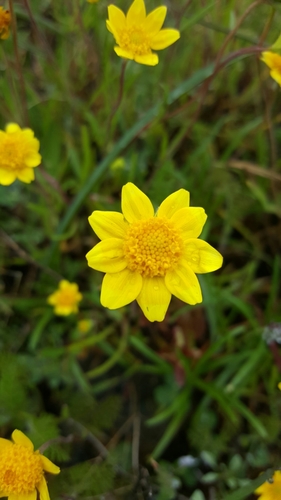
Petasites frigidus
(L.) Fries.
Arctic Sweet Coltsfoot, Sweet coltsfoot
iNaturalist· cc-by-nc
(c) christinelind, some rights reserved (CC BY-NC)
iNaturalist· cc-by-nc
(c) August, some rights reserved (CC BY-NC), uploaded by August
iNaturalist· cc-by
(c) Mary Krieger, some rights reserved (CC BY), uploaded by Mary Krieger
Summary
Source: WikipediaPetasites frigidus, the Arctic sweet coltsfoot or Arctic butterbur, is a species of flowering plant in the family Asteraceae. It is native to Arctic to cool temperate regions of the Northern Hemisphere in northern Europe, northern Asia and northern North America. It is a herbaceous perennial plant producing flowering stems in early spring, and large leaves through the summer. The upright flowering stems are 10–20 cm (4–8 in) tall, and bear only 5–12 inflorescences, yellowish-white to pink in colour. The leaves are rounded, 15–20 cm (6–8 in) broad, with a deeply cleft base and shallowly lobed margin, and rise directly from the underground rootstock. The underside of the leaves is covered with matted, woolly fuzz. It grows in moist shaded ground, preferring stream banks and seeping ground of cut-banks. While there is some disagreement, some sources identify five varieties of P. frigidus: Petasites frigidus var. frigidus Petasites frigidus var. nivalis, sometimes referred to as P. nivalis or P. hyperboreus. This variety is common at subalpine and alpine elevations. Petasites frigidus var. palmatus, sometimes referred to as P. palmatus, palmate coltsfoot, or western coltsfoot; mâl-ē-mē’ (Konkow language); or tä-tä-tē’; pē’-wē is the root. Petasites frigidus var. sagittatus, arrowleaf sweet coltsfoot. Petasites frigidus var. vitifolius
Description
A herb in the daisy family which keeps growing from year to year. It has creeping underground stems. The leaves are heart shaped. They have teeth around the edge and slight lobes. The leaves have white soft hairs underneath. There is a single leaf on each stem coming from the rhizome. The flowers are yellowish-white or red and in open spikes. The flowers appear before the leaves expand. There are 5-7 flowering heads at the top of the stem.
Edible Uses
Young leaves can be eaten raw or cooked, mixed with other greens as a potherb, or made into a sauerkraut. Young stalks and flower heads are used cooked, and the roots are also eaten cooked. The burnt ash of the leaves serves as a salt substitute: the stems and leaves, while still green, are rolled into balls, dried, then burned on top of a very small fire on a rock. The resulting ash makes a very acceptable condiment for piñole.
Traditional Uses
The young leaves are mixed with other greens and used as a potherb. The young stalks and flower heads are cooked and eaten. The roots are roasted and eaten. The leaves are dried, burned and crushed to produce a salt like flavouring. Caution: It contains alkaloids and should not be eaten by pregnant women.
Medicinal Uses
The plant is antispasmodic and used as a poultice. An infusion of the dried leaves has been used to treat colds and head and chest congestion.
Known Hazards
The leaf stalks and flower stems (with flowers) are edible, and can be used as a vegetable dish. A salt-substitute can also be made by drying and then burning the leaves. This black, powdery substance will provide a salty taste. However, given the high likelihood of the presence of toxic unsaturated, diester pyrrolizidine alkaloids in this species, consumption should be very limited.
Distribution
It is a temperate plant. It grows in wet or moist thickets. It can be in peaty tundra. It suits hardiness zones 5-10.
Where It Grows
Alaska, Arctic, Australia, Canada, Europe, North America, Mongolia, Russia, Scandinavia, Siberia, USA,
Propagation
Sow seed in a cold frame as soon as it is ripe or in early spring, covering only lightly and keeping the compost moist. Prick seedlings into individual pots when large enough to handle and plant out in summer. Division succeeds at almost any time of year. Larger divisions can go directly into permanent positions; smaller ones are better potted up and grown on in light shade in a cold frame until well established, then planted out in late spring or early summer.
Other Uses
Makes a good ground cover for wilder areas of the garden. The cotton-like seed heads have been used as stuffing material for mattresses. The leaves have been folded into conical containers for collecting fruit and have also been used to make temporary funnels.
Notes
There are about 14 Petasites species.
Synonyms
Also Known As
Kamgyak, Llamquq
References (15)
- Ainana, L. & Zagrebin, I., 2014, Edible Plants Used by the Siberian Yupik Eskimos of Southeastern Chukotka Peninsula, Russia, (English translation). p 28
- Bremness, L., 1994, Herbs. Collins Eyewitness Handbooks. Harper Collins. p 201
- Cundall, P., (ed.), 2004, Gardening Australia: flora: the gardener's bible. ABC Books. p 1014
- Facciola, S., 1998, Cornucopia 2: a Source Book of Edible Plants. Kampong Publications, p 41
- Holloway, P. S. & Alexander, G., 1990, Ethnobotany of the Fort Yukon Region, Alaska. Economic Botany, Vol. 44, No. 2 pp. 214-225
Show all 15 references Hide references
- Jernigan, K. A., et al, 2017, Naukan ethnobotany in post-Soviet times: lost edibles and new medicinals. Journal of Ethnobiology and Ethnomedicine (2017) 13:61
- Kermath, B. M., et al, 2014, Food Plants in the Americas: A survey of the domesticated, cultivated and wild plants used for Human food in North, Central and South America and the Caribbean. On line draft. p 635
- Lim, T. K., 2015, Edible Medicinal and Non Medicinal Plants. Volume 9, Modified Stems, Roots, Bulbs. Springer p 64
- Lim, T. K., Edible Medicinal and Non-Medicinal Plants Volume 7 Flowers
- MacKinnon, A., et al, 2009, Edible & Medicinal Plants of Canada. Lone Pine. p 362
- Moerman, D. F., 2010, Native American Ethnobotany. Timber Press. p 388
- Plants for a Future database, The Field, Penpol, Lostwithiel, Cornwall, PL22 0NG, UK. http://www.scs.leeds.ac.uk/pfaf/
- Porsild, A.E., 1953, Edible Plants of the Arctic, Arctic 6:15-34, page 26
- Summa veg. Scand. 1:182. 1845
- Urgamal, M., Oyuntsetseg, B., Nyambayar, D. & Dulamsuren, Ch. 2014. Conspectus of the vascular plants of Mongolia. (Editors: Sanchir, Ch. & Jamsran, Ts.). Ulaanbaatar, Mongolia. “Admon“ Press. 334pp. (p. 199-230).