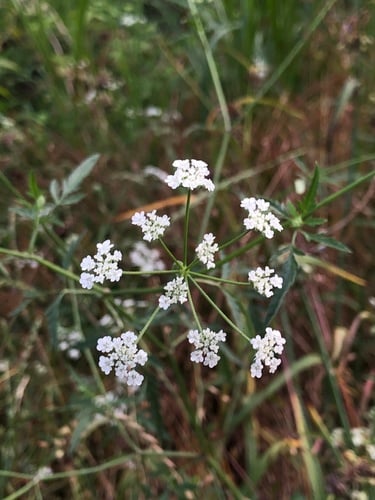
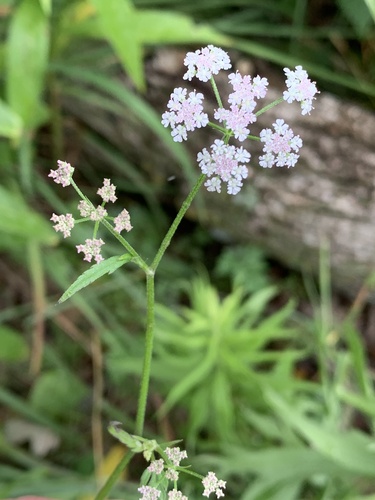
Perideridia oregana
(S. Watson) Mathias
Squaw potato, Eppaw
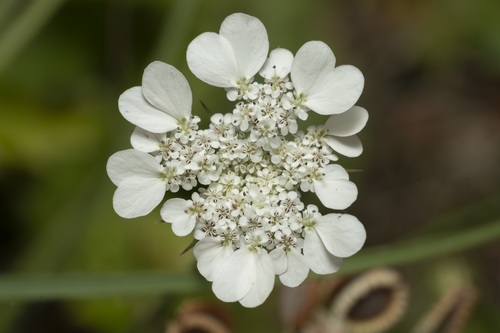
iNaturalist· cc-by
(c) Ed Alverson, some rights reserved (CC BY), uploaded by Ed Alverson
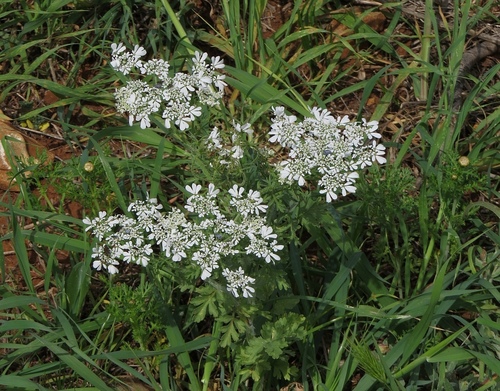
iNaturalist· cc-by-nc
(c) leanadickerson, some rights reserved (CC BY-NC), uploaded by leanadickerson
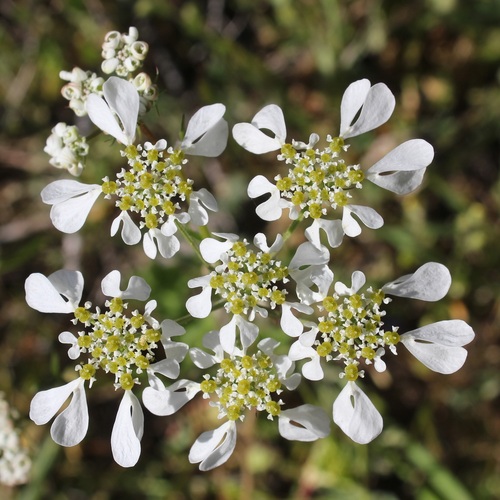
iNaturalist· cc-by-nc-sa
(c) 2006 Keir Morse, some rights reserved (CC BY-NC-SA)
Summary
Source: WikipediaPerideridia oregana is a species of flowering plant in the family Apiaceae known by the common names Oregon yampah and eppaw. It is native to Oregon and California in the western United States, where it grows in woodland and other habitat. This plant is quite variable in appearance. In general, it is a perennial herb 10 to 90 centimeters tall, its green to waxy-grayish erect stem growing from a cluster of small tubers. Leaves near the base of the plant have blades 3 to 30 centimeters long divided into a variable number of leaflets, which may be subdivided into smaller segments. The inflorescence is a compound umbel of many spherical clusters of small white flowers. These yield ribbed, oblong-shaped fruits 3 to 6 millimeters long.
Description
A herb. It grows 10-90 cm tall. The stem is green or waxy grey. There is a cluster of small tubers. The leaves near the base are 3-30 cm long with several leaflets. These can be divided again. The flower is a compound umbel. The flowers are small and white.
Edible Uses
The root can be eaten raw or cooked and has a pleasant nutty flavour. It can also be dried and stored for later use.
Traditional Uses
The roots are sun dried then eaten raw or boiled.
This uses section is brief — help expand it
Medicinal Uses
None known
Distribution
It is a temperate plant.
Where It Grows
North America, USA,
Propagation
No specific information is available for this species, but sowing the seed in a cold frame as soon as it is ripe is recommended. Alternatively, sow in early spring in a cold frame. Prick out seedlings into individual pots when large enough to handle and grow on in a greenhouse through their first winter, planting out in late spring of the following year. Division may also be possible in spring or autumn.
Other Uses
None known
Nutrition
| Part | Moisture | kJ | kcal | Protein | Vit A | Vit C | Iron | Zinc |
|---|---|---|---|---|---|---|---|---|
| Root - raw | 60 | 628 | 150 | 4.6 | 0 | 13 | 1.2 | 1.2 |
Synonyms
Also Known As
Pamahayapa
References (7)
- Beckstrom-Sternberg, Stephen M., and James A. Duke. "The Foodplant Database." http://probe.nalusda.gov:8300/cgi-bin/browse/foodplantdb.(ACEDB version 4.0 - data version July 1994) (As Carum oreganum)
- Brittonia 2:243. 1936
- Couture, M. D., 1978, Recent and Contemporary Foraging Practices of the Harney Valley Paiute. Thesis, Portland State University
- Moerman, D. F., 2010, Native American Ethnobotany. Timber Press. p 387
- Plants for a Future database, The Field, Penpol, Lostwithiel, Cornwall, PL22 0NG, UK. http://www.scs.leeds.ac.uk/pfaf/
Show all 7 references Hide references
- Proc. Amer. Acad. Arts 20:368. 1885 (As Carum oreganum)
- Saunders, C.F., 1948, Edible and Useful Wild Plants. Dover. New York. p 14 (As Carum oreganum)