Perideridia gairdneri
(Hook. & Arn.) Mathias
Gairdner's yampah
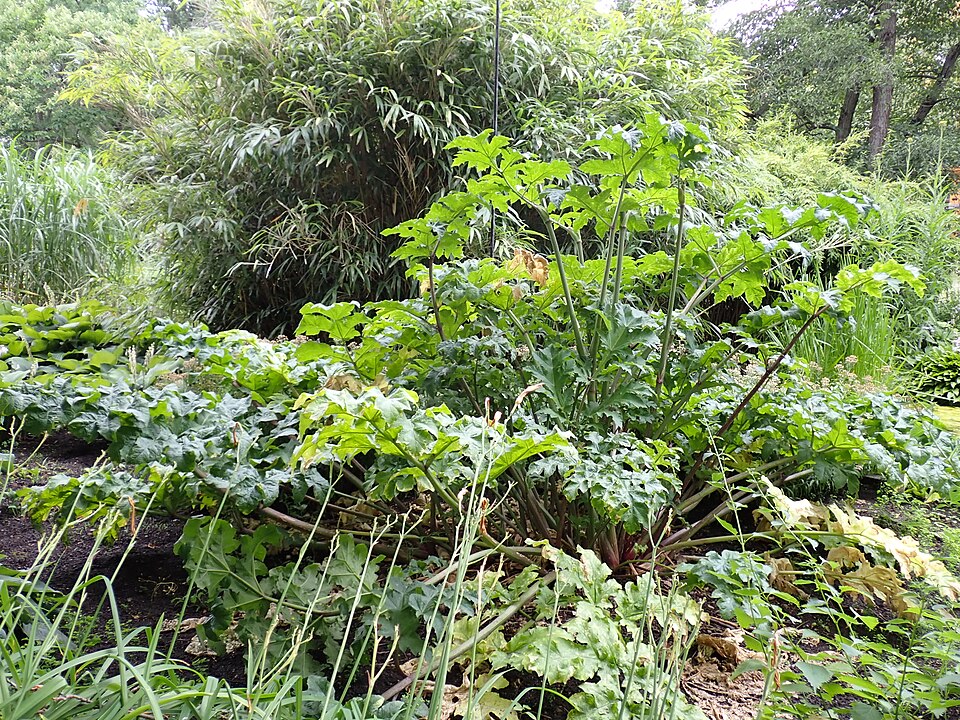
iNaturalist· cc-by-nc
(c) Kristin Currin, some rights reserved (CC BY-NC), uploaded by Kristin Currin
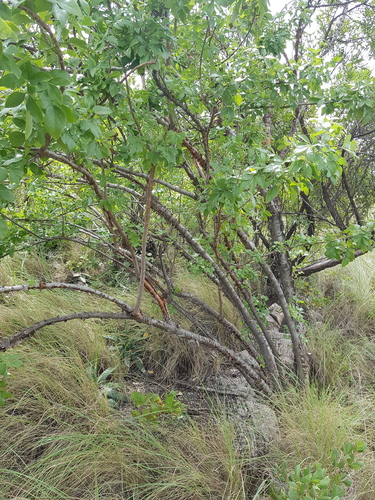
iNaturalist· cc-by-nc
(c) Brian Starzomski, some rights reserved (CC BY-NC), uploaded by Brian Starzomski
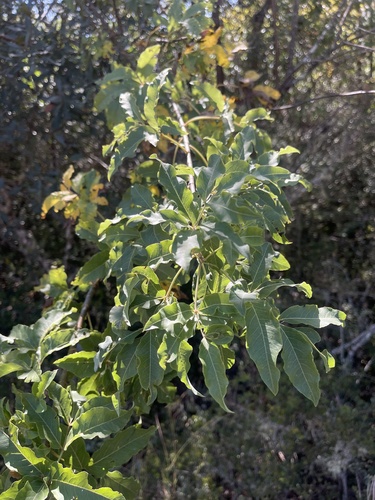
iNaturalist· cc-by-nc
(c) Lynette Schimming, some rights reserved (CC BY-NC)
Summary
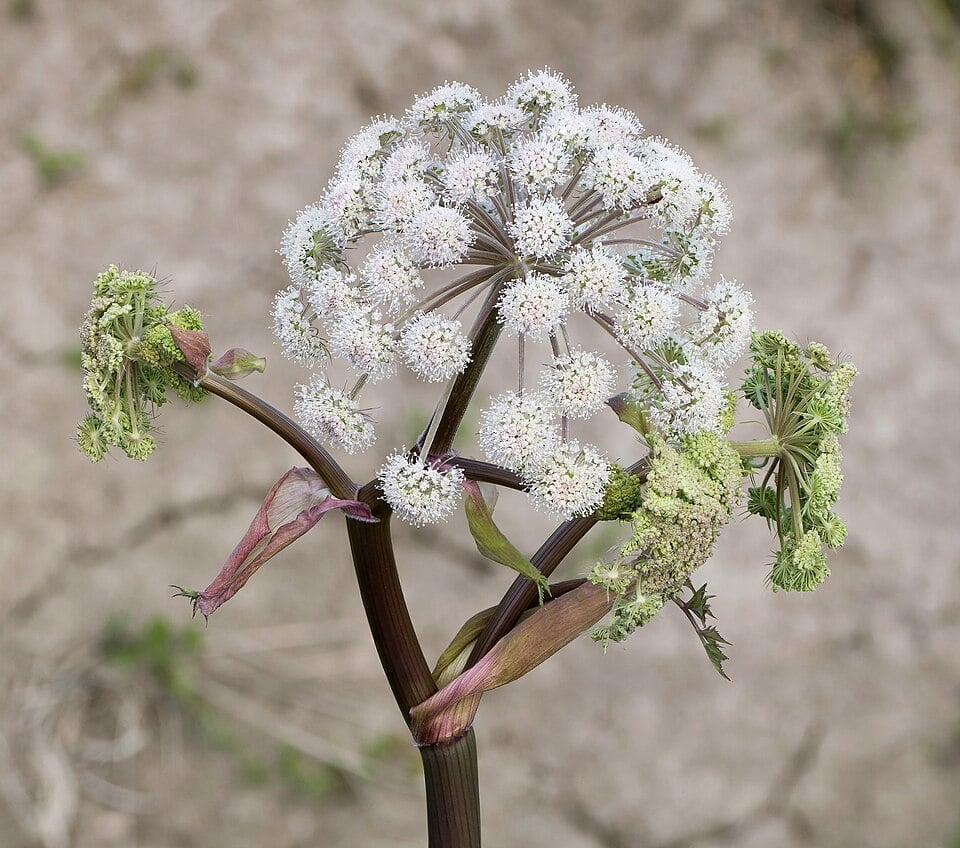
Source: WikipediaPerideridia gairdneri is a species of flowering plant in the family Apiaceae known by the common names common yampah, Gardner's yampah and Squaw root. It is native to western North America from southwestern Canada to California to New Mexico, where it grows in many types of habitat. It is a perennial herb which grows to around .6–1 metre (2.0–3.3 ft). Its slender, erect stem grows from cylindrical tubers measuring up to 8 centimeters long. Leaves near the base of the plant have blades up to 35 centimeters long which are divided into many narrow, subdivided lobes. Leaves higher on the plant are smaller and less divided. The inflorescence is a compound umbel of many spherical clusters of small white flowers. These yield ribbed, rounded fruits each a few millimeters long. The entire plant is edible, but caution should be maintained as it has a similar appearance to the carrot family's deadly water hemlock and poison hemlock. It was an important food plant, even a staple food, for many Native American groups, including the Blackfoot, Northern Paiute, Cheyenne and Comanche. It would seem certain that the term yampa would be a version on the Comanche name for the tuber, variously yap, and yampa. One of the main divisions of the Comanche, the Yapainuu, were named the yap eaters, whose chief was the famous Ten Bears. More commonly referred to as the Yamparikas, this division roamed in the Northern Oklahoma area in historic times. The tuberous roots could be eaten like potatoes, roasted, steamed, eaten fresh or dried, made into mush or pinole, used as flour and flavoring, and were also used medicinally. Meriwether Lewis encountered the plant in 1805 and 1806, referring to it as a species of fennel. This food root is called cawíitx in Nez Perce, sawítk in Sahaptin and yap in Comanche. Blackfoot Indians knew the root by the name nits-ik-opa ("double root") and by those tribes of the Pacific Northwest as either yampa, ipo, or sa'-hweet.
Description
A slender herb that does not have hairs. It keeps growing from year to year. It grows 40-100 cm tall. The root is spindle shaped. The leaves are compound and divided twice.
Edible Uses
The root can be eaten raw or cooked and has a pleasant sweet, nutty flavour suitable for use as a staple food. It is best harvested when the plant is dormant. The root can be dried for later use or ground into a powder and combined with cereals for porridges, cakes, and similar preparations. The seed can be used as a caraway-like seasoning, parched and eaten in porridge, or used as piñole. Young leaves are also edible raw or cooked.
Traditional Uses
The fleshy roots are eaten raw or boiled. They are also dried for later use. They can be used in soups.
This uses section is brief — help expand it
Medicinal Uses
The root is carminative, diuretic, mildly laxative, and ophthalmic. An infusion of the roots has been taken to counter the cathartic and emetic effects of other infusions. The same infusion can be applied as a wash to sores and wounds, and used as a nasal wash to clear catarrh. A poultice of the roots has been applied to draw inflammation from swellings. Slowly chewing the root and swallowing the juice is considered beneficial for sore throats and coughs.
Distribution
It is a temperate plant. In Canada it grows in moist open woods at low and middle elevations. It suits hardiness zone 5.
Where It Grows
Canada, Mexico, North America, USA,
Propagation
No specific information is available for this species, but sowing the seed in a cold frame as soon as it is ripe is recommended. Alternatively, sow in early spring in a cold frame. Prick out seedlings into individual pots when large enough to handle and grow on in a greenhouse through their first winter, planting out in late spring of the following year. Division may also be possible in spring or autumn.
Other Uses
Attracts wildlife.
Other Information
The roots are often eaten by children.
Nutrition
| Part | Moisture | kJ | kcal | Protein | Vit A | Vit C | Iron | Zinc |
|---|---|---|---|---|---|---|---|---|
| Root | 37.1 | — | — | 6.4 | — | 11.2 | 3.2 | — |
Synonyms
Also Known As
Edible-rooted caraway, Ipo, Pamahayampa, Squawroot, Yamp, Yampa
References (20)
- Anderson, M. K., 2012, Edible Seeds and Grains of California Tribes and the Klamath Tribe of Oregon in the Phoebe Apperson Hearst Museum of Anthropology Collections, University of California, Berkeley. USDA p 21
- Beckstrom-Sternberg, Stephen M., and James A. Duke. "The Foodplant Database." http://probe.nalusda.gov:8300/cgi-bin/browse/foodplantdb.(ACEDB version 4.0 - data version July 1994) (As Carum gairdneri)
- Brittonia 2:244. 1936
- Coutre, M. D., et al, 1986, Foraging Behaviour of a Contemporary Northern Great Basin Population. Journal of California and Great Bason Anthropology Vol. 8(2) pp 150-160
- Facciola, S., 1998, Cornucopia 2: a Source Book of Edible Plants. Kampong Publications, p 21
Show all 20 references Hide references
- Hedrick, U.P., 1919, (Ed.), Sturtevant's edible plants of the world. p 166 (As Carum gairdneri)
- Jackes, D. A., Edible Forest Gardens
- Kaldy, M.S., Johnston, A and Wilson, D.B., 1980, Nutritive value of Indian Bread-root, Squaw-root and Jerusalem artichoke. Economic Botany 34(4) pp 352-357
- Kermath, B. M., et al, 2014, Food Plants in the Americas: A survey of the domesticated, cultivated and wild plants used for Human food in North, Central and South America and the Caribbean. On line draft. p 631
- Kiple, K.F. & Ornelas, K.C., (eds), 2000, The Cambridge World History of Food. CUP p 1789 (As Carum gairdneri)
- Lim, T. K., 2015, Edible Medicinal and Non Medicinal Plants. Volume 9, Modified Stems, Roots, Bulbs. Springer p 64
- MacKinnon, A., et al, 2009, Edible & Medicinal Plants of Canada. Lone Pine. p 298
- Moerman, D. F., 2010, Native American Ethnobotany. Timber Press. p 386
- Plants for a Future database, The Field, Penpol, Lostwithiel, Cornwall, PL22 0NG, UK. http://www.scs.leeds.ac.uk/pfaf/
- Saunders, C.F., 1948, Edible and Useful Wild Plants. Dover. New York. p 13 (As Carum gairdneri)
- Stromberg, M. R. et al, California Grasslands: Ecology and Management. p 63
- Stubbs, R. D., 1966, An investigation of the Edible and Medicinal Plants used by the Flathead Indians. MA thesis University of Montana. p 72
- Turner, N., 1995, Food Plants of Coastal First Peoples. Royal BC Museum Handbook p 59
- Turner, N., 1997, Food Plants of Interior First Peoples. Royal BC Museum Handbook p 88
- Turner, N., et al, 2011, "Up on the Mountain": Ethnobotanical Important of Montane Sites in Pacific Coastal North America. Journal of Ethnobiology 31(1): 4-43