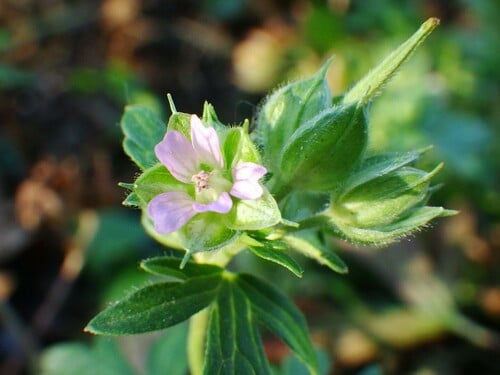
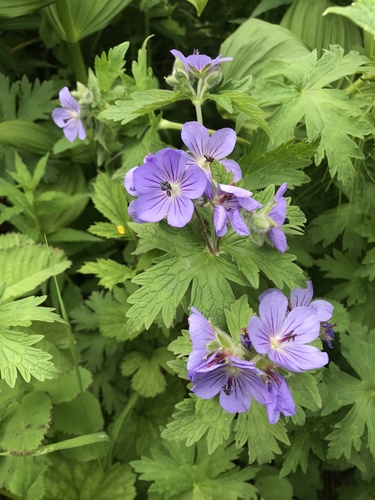
Pelargonium peltatum
(L.) L'Hér.
Ivy-leaved geranium, Hanging Pelargonium
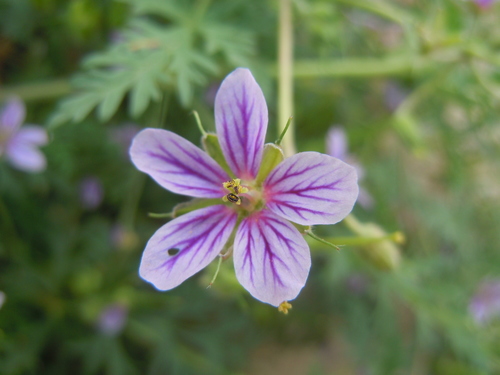
iNaturalist· cc-by-nc-sa
(c) Marco Schmidt, some rights reserved (CC BY-NC-SA), uploaded by Marco Schmidt
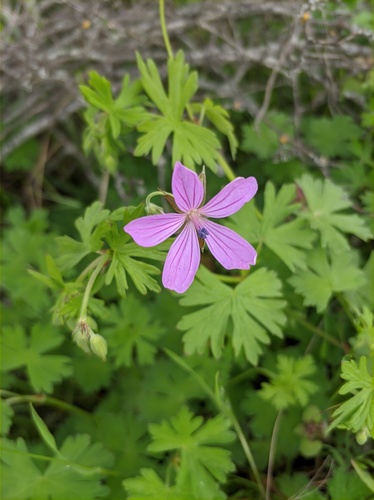
iNaturalist· cc-by-sa
(c) Nicola van Berkel, some rights reserved (CC BY-SA), uploaded by Nicola van Berkel
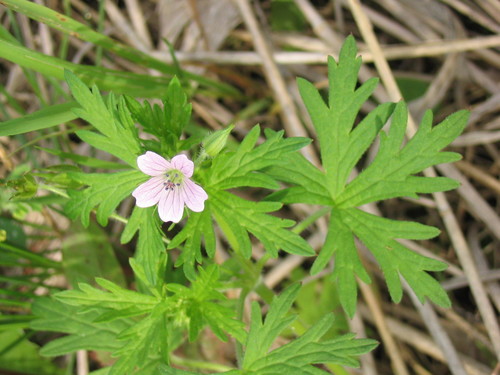
iNaturalist· cc-by-nc
(c) Nicole Dealtry (nee wienand), some rights reserved (CC BY-NC), uploaded by Nicole Dealtry (nee wienand)
Summary
Source: WikipediaPelargonium peltatum is a scrambling purple perennial plant with five shallow or deeply lobed, circular- to heart-shaped, somewhat fleshy leaves, sometimes with a differently coloured semicircular band, that has been assigned to the cranesbill family. It carries umbel-like inflorescences with 2–10, white to mauve, bilateral symmetrical flowers, each with a "spur" that is merged with the flower stalk. It is known by several common names including ivy-leaved pelargonium and cascading geranium. It is native to the Cape Provinces of South Africa. In its home range, it flowers year round but most vigorously from August to October.
Description
A shrubby herb. It is evergreen and keeps growing from year to year. It is creeping. It grows 30 cm high and spreads 60-120 cm wide. It has long trailing stems. The leaves are ivy like and glossy green. They are almost round but with lobes. The flowers occur in clusters. They can be single or double. They are 2.5 cm wide and the petals do not overlap. They are white, pink or lavender.
Edible Uses
Leaves and buds can be eaten raw or cooked. They have an acid flavour and are used as a vegetable.
Traditional Uses
The buds and acid leaves are eaten. They also add flavour.
This uses section is brief — help expand it
Medicinal Uses
All parts of the plant are astringent.
Distribution
It is a Mediterranean plant. It can grow in full sun or light shade. It needs a fertile, gritty soil. It needs well drained soil. It can grow in dry salty soil. It needs a neutral pH. It can grow in arid places. It suits hardiness zones 9-11.
Where It Grows
Africa, Australia, South Africa*, Southern Africa,
Cultivation
Plants are grown from seed. The seed are scattered on the surface and pressed down. Seedlings can be transplanted. A spacing of 45 cm apart is suitable.
Propagation
Sow seed as soon as it is ripe in a greenhouse, or in early spring if using stored seed. A minimum germination temperature of 13°C is recommended; seeds usually sprout within 2 weeks, though germination can sometimes take several months. Prick seedlings out into individual pots when large enough to handle and overwinter them under glass for at least their first year. If planting outdoors, do so in early summer and consider extra winter protection. Cuttings can be taken at almost any point during the growing season, though early summer is ideal to allow the new plant to establish before winter.
Other Uses
A blue indigo dye obtained from the flower petals is used in painting. An essential oil is also obtained from the plant.
Notes
There are about 230 Pelargonium species.
Synonyms
Also Known As
Geranio, Wildemalva
References (16)
- W. Aiton, Hort. kew. 2:427. 1789
- Benvenuti, S. & Mazzoncini, M., 2021, The Biodiversity of Edible Flowers: Discovering New Tastes and New Health Benefits. Frontiers in Plant Science Article 569499.
- Burnie, G.(Ed.), 2003, Annuals and Bulbs. The Gardener's Handbooks. Fog City Press. p 204
- Cundall, P., (ed.), 2004, Gardening Australia: flora: the gardener's bible. ABC Books. p 996
- De Vynk, J. C., et al, 2016, Indigenous edible plant use by contemporary Khoe-San descendants of South Africa's Cape South Coast. South African Journal of Botany. 102 (2016) 60-69
Show all 16 references Hide references
- Fox, F. W. & Young, M. E. N., 1982, Food from the Veld. Delta Books. p 236
- Hedrick, U.P., 1919, (Ed.), Sturtevant's edible plants of the world. p 469
- Hibbert, M., 2002, The Aussie Plant Finder 2002, Florilegium. p 221
- Llamas, K.A., 2003, Tropical Flowering Plants. Timber Press. p 227
- Lord, E.E., & Willis, J.H., 1999, Shrubs and Trees for Australian gardens. Lothian. p 336
- Plants for a Future database, The Field, Penpol, Lostwithiel, Cornwall, PL22 0NG, UK. http://www.scs.leeds.ac.uk/pfaf/
- Royal Botanic Gardens, Kew (1999). Survey of Economic Plants for Arid and Semi-Arid Lands (SEPASAL) database. Published on the Internet; http://www.rbgkew.org.uk/ceb/sepasal/internet [Accessed 16th April 2011]
- Ruiters-Welcome, A. K., 2019, Food plants of southern Africa. Ph.D. thesis. Univ. of Johannesburg p 64
- Staples, G.W. and Herbst, D.R., 2005, A tropical Garden Flora. Bishop Museum Press, Honolulu, Hawaii. p 341
- Welcome, A. K. & Van Wyk, B.-E., 2019, An inventory and analysis of the food plants of southern Africa. South African Journal of Botany 122 (2019) 136–179
- World Checklist of Useful Plant Species 2020. Royal Botanic Gardens, Kew