Pedicularis canadensis
L.
Common lousewort, Canadian lousewort, Wood betony
iNaturalist· cc-by-nc
(c) Brett Whaley, some rights reserved (CC BY-NC)
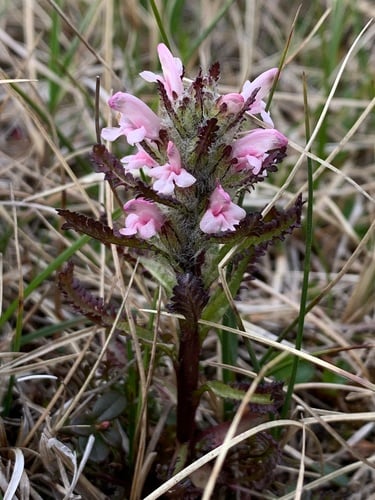
iNaturalist· cc-by-nc
(c) Emily L. Stanley, some rights reserved (CC BY-NC), uploaded by Emily L. Stanley
iNaturalist· cc-by-sa
(c) Douglas Goldman, some rights reserved (CC BY-SA), uploaded by Douglas Goldman
Summary
Source: WikipediaPedicularis canadensis, commonly called Canadian lousewort or wood betony, is a flowering plant in the family Orobanchaceae. It is native to North America, where it is found in southeastern Canada, the eastern United States, and eastern Mexico. It has a wide-ranging natural habitat, being found in mesic to dry, forests, woodlands, and prairies.
Description
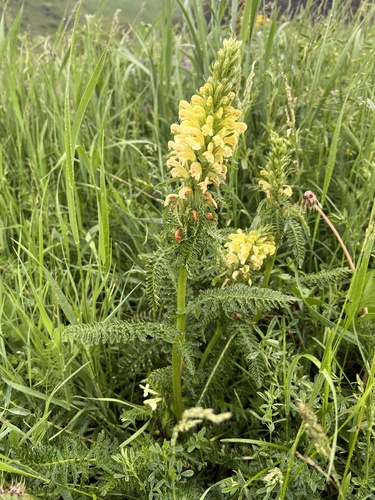
A herb that keeps growing from year to year. It grows 50 cm tall. There are leaves at the base and alternate up the stem. They are oblong and finely divided. The flowers are yellow and at the top of the plant.
Edible Uses
Leaves are edible when cooked.
Traditional Uses
The leaves are cooked and eaten.
This uses section is brief — help expand it
Medicinal Uses
The roots are blood tonic, cardiac, and stomachic. A tea made from the roots is used to treat stomach aches, ulcers, diarrhoea, anaemia, and heart troubles. A poultice of the root is applied to swellings, sore muscles, and tumours. Finely grated roots have been secretly added to food as an alleged aphrodisiac. An infusion of the leaves has been used to procure an abortion and to treat a sore throat, whether made from fresh or dried leaves.
Known Hazards
The plant is said to be poisonous to sheep.
Distribution
It is a temperate plant. It grows in woodland and open areas.
Where It Grows
Canada, Central America, Mexico, North America, USA,
Cultivation
A semi-parasitic plant, growing on grass roots. Rather difficult to establish in cultivation, it is best grown in conditions that approximate to its native habitat. It requires a moist peaty soil and the presence of host grasses. The plant is said to parasitize at least 80 different species in 35 different genera. Requires a partially shaded to sunny site in a well-drained gritty but moist soil.
Propagation
Sow seed in pots of turf collected from near wild colonies, or sow directly onto the site where plants are to remain. Division of established plants may be possible in spring; establish divisions close to the parent plants.
Other Uses
None known.
Notes
Also put in the family Scrophulariaceae.
References (6)
- Beckstrom-Sternberg, Stephen M., and James A. Duke. "The Foodplant Database." http://probe.nalusda.gov:8300/cgi-bin/browse/foodplantdb.(ACEDB version 4.0 - data version July 1994)
- MacKinnon, A., et al, 2009, Edible & Medicinal Plants of Canada. Lone Pine. p 247
- Mant. pl. 1:86. 1767
- Moerman, D. F., 2010, Native American Ethnobotany. Timber Press. p 380
- Plants for a Future database, The Field, Penpol, Lostwithiel, Cornwall, PL22 0NG, UK. http://www.scs.leeds.ac.uk/pfaf/
Show all 6 references Hide references
- Toupal, R. S. & Hollenback, K., 2009, An Ethnobotany of Indiana Dunes National Lakeshore: Plant Uses of the Ojibwa People. Bureau of Applied Research in Anthropology. University of Arizona