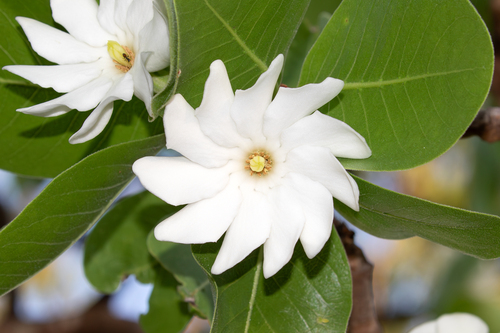
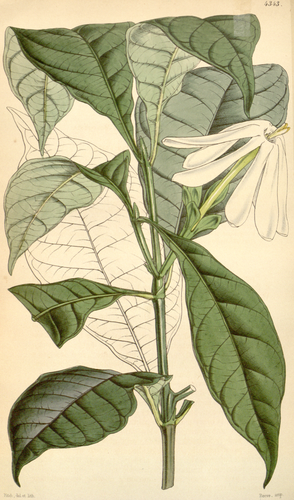
Pauridiantha dewevrei
(De Wild.) Bremek.
Yoco
gbif· cc-by-sa
Murielle Simo-Droissart
gbif· cc-by-sa
Murielle Simo-Droissart
gbif· cc-by-sa
Murielle Simo-Droissart
Description
A shrub or small tree. It grows 6 m tall. The stems have dense velvety hairs. The leaves are narrowly oblong and 8-20 cm long by 2-7 cm wide. They taper to the tip and are wedge shaped at the base. The flowering shoots are short and in the axils of leaves. They are yellow to greenish brown. The fruit are yellow or red berries. They are 6 mm across.
Edible Uses
The berries are eaten.
Distribution
A tropical plant. It grows in gaps exposed to light in the forest. It grows between 1,800-2,400 m above sea level.
Where It Grows
Africa, Cameroon, Central Africa, Central African Republic, CAR, Congo DR, Congo R, Gabon, Guinea, Guinée, Rwanda, West Africa,
Notes
There are 20-25 Pauridiantha species. They are in tropical Africa.
Synonyms
Also Known As
Makaku, Papaya mfinda, Safi di nkanka, Zamba di nkanka
References (2)
- Jardin, C., 1970, List of Foods Used In Africa, FAO Nutrition Information Document Series No 2.p 154
- Latham, P & Mbuta, A., 2017, Useful Plants of Central Province, Democratic Republic of Congo. Volume 2. Salvation Army p 92